
Rosethorn rockfish
Dorsal fin with 13 spines and 12–14 soft rays, anal fin with 3 spines and 6–7 soft rays, and 28–33 vertebrae. Head spines are very strong, the coronal spine is absent and the second anal spine is long. Colour is orange or yellow with greenish mottling above and 4 to 5 squarish white spots bordered with pink or yellow on the back.
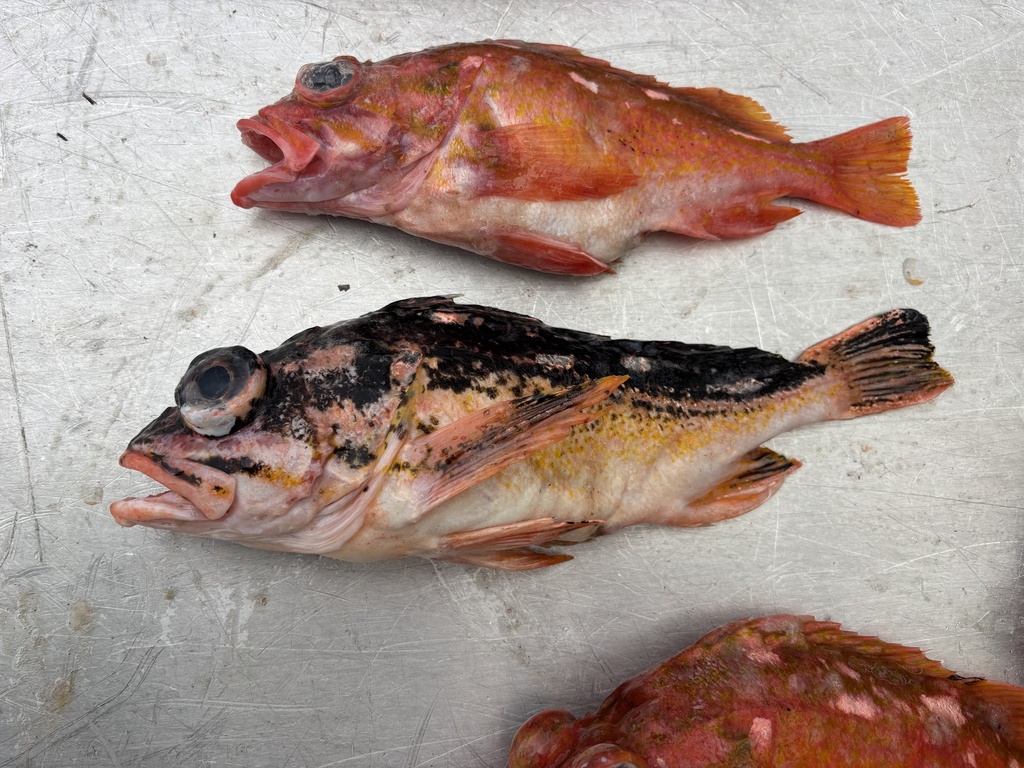
Dorsal fin with 13 spines and 12–14 soft rays, anal fin with 3 spines and 6–7 soft rays, and 28–33 vertebrae. Head spines are very strong, the coronal spine is absent and the second anal spine is long. Colour is orange or yellow with greenish mottling above and 4 to 5 squarish white spots bordered with pink or yellow on the back. Maximum length is 41 cm TL, maturity is near 23 cm and the oldest recorded fish reached 87 years. Orange-yellow body colour with greenish mottling is visible before the fish reaches the deck. The white back spots are the fastest field mark, and the strong head spines confirm it in the hand.
Habitat and behaviour
It ranges from Kodiak Island, Alaska, to Guadalupe Island, Baja California, and is rare south of San Francisco. The species is demersal from 25 to 549 m, mostly over rock and rubble on the slope. GBIF holds 19903 records, 18362 from Canada and 1492 from the United States. Small size makes it a regular by-catch in mixed slope fishing. Small size and a broad depth range put it in the same mixed schools as larger slope species. Records cluster in British Columbia, where the species is common on offshore banks.
Seasonal window
Spawning is documented from May to June off north-central California. Alaska places rosethorn rockfish in the benthic shelf group: residents may take 1 per day with 2 in possession, while non-residents are limited to July 1 to August 25, 1 per day, 1 in possession and 1 per year with a harvest record. British Columbia allows 3 rockfish per day and closes yelloweye. Spring and early summer are the practical window, while winter release survival is poor. Alaska treats it as a shelf species rather than a slope species, and that changes the limit and the season.
Gear and approach
A medium-light boat rod, braided main line and a lighter carbon leader with small circle hooks are enough. Set lead for the current with just enough contact; too much hangs up on the slope and too little drifts off the reef. Small fish need gentle handling, and everything released from depth goes down on a descending device. Light gear also makes it easier to return small fish without damage. A short dropper above the lead keeps small baits off the bottom and reduces snagging.
Edibility and regulations
Flesh is fine and limited in quantity, best used in soup or fried whole; chill the fish immediately after cleaning. Alaska: benthic shelf rockfish, residents 1 per day and 2 in possession, non-residents only from July 1 to August 25 at 1 per day, 1 in possession, 1 per year with a harvest record. British Columbia: 3 per day, yelloweye closed, Area 29 closed. Washington: coastal rockfish 7 in total, yelloweye closed. California: 10 fish in the RCG aggregate, descending device required. IUCN Not Evaluated; no CITES or CMS listing. Limits differ by jurisdiction and by group, so a fish kept in one area may be illegal in another. Non-resident anglers in Alaska face a short season, so the trip has to be planned around those dates.
Where to look
Work rocky slope and rubble between 25 and 549 m, where mixed rockfish schools form. GBIF records are mostly Canadian, and iNaturalist has a reasonable number of photos, so check the white back spots and strong head spines before confirming the fish. Alaska treats it as a shelf species, so identify it before deciding whether it can be kept. Because the species is small and often released, careful handling has a large effect on survival. Keep a few small jigs rigged and ready, because the school can appear and disappear quickly.
How to catch it
Boat bottom fishing
Fished with the listed approach, matched to the recorded depth and size.
Slow pitch jigging
Fished with the listed approach, matched to the recorded depth and size.
Where these facts come from
Check these pages before you rely on a size, range or protection status.
- FishBase — Sebastes helvomaculatus — FishBase · T2
- GBIF — Sebastes helvomaculatus occurrence records — GBIF · T2
- IUCN Red List — Sebastes helvomaculatus — IUCN · T1
- Photo record — iNaturalist — iNaturalist · T3
Fish in the same water
These fish live in the same place.

Guides for this water
Technique, gear and safety guides that fit Rosethorn rockfish.