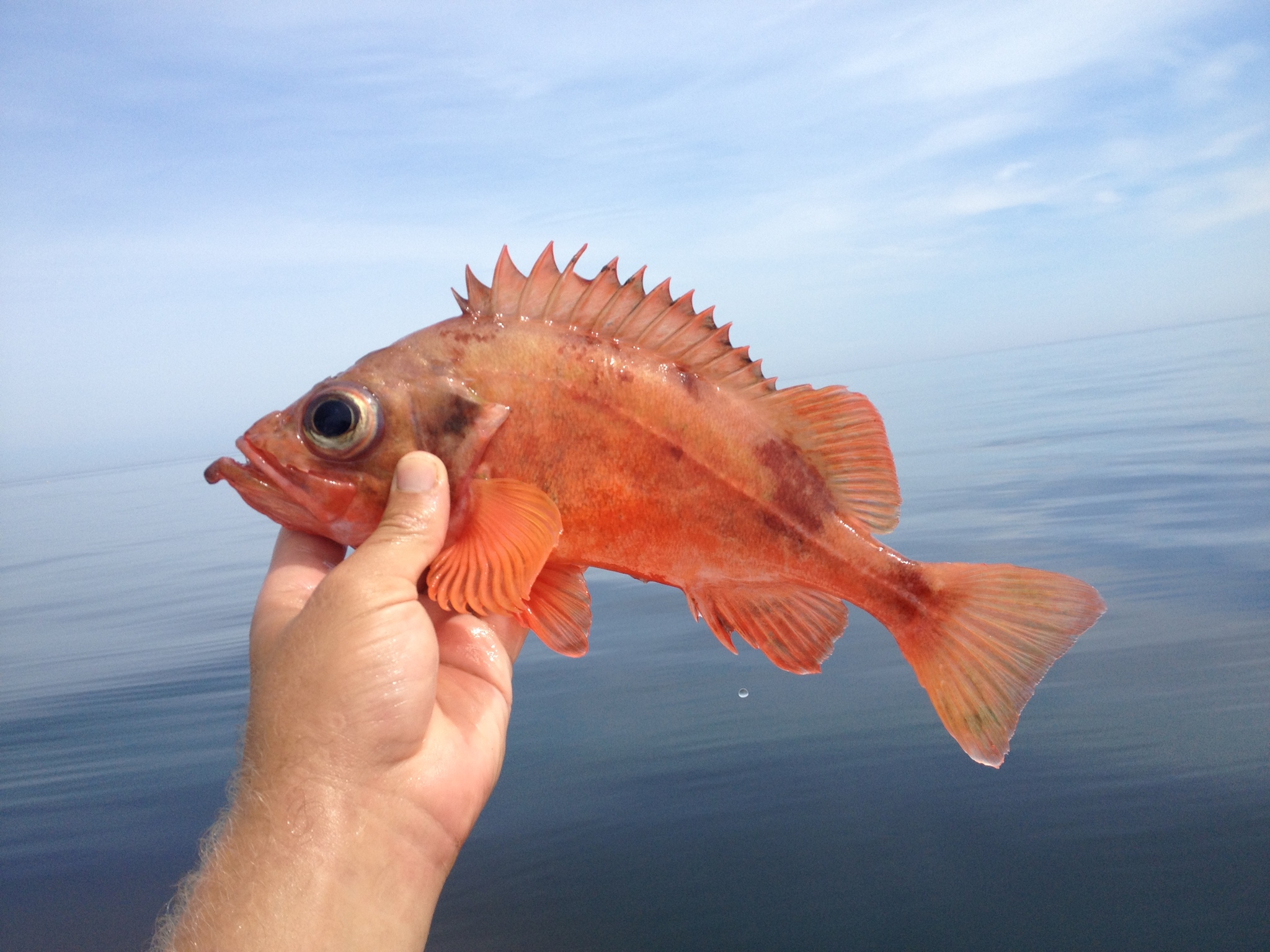
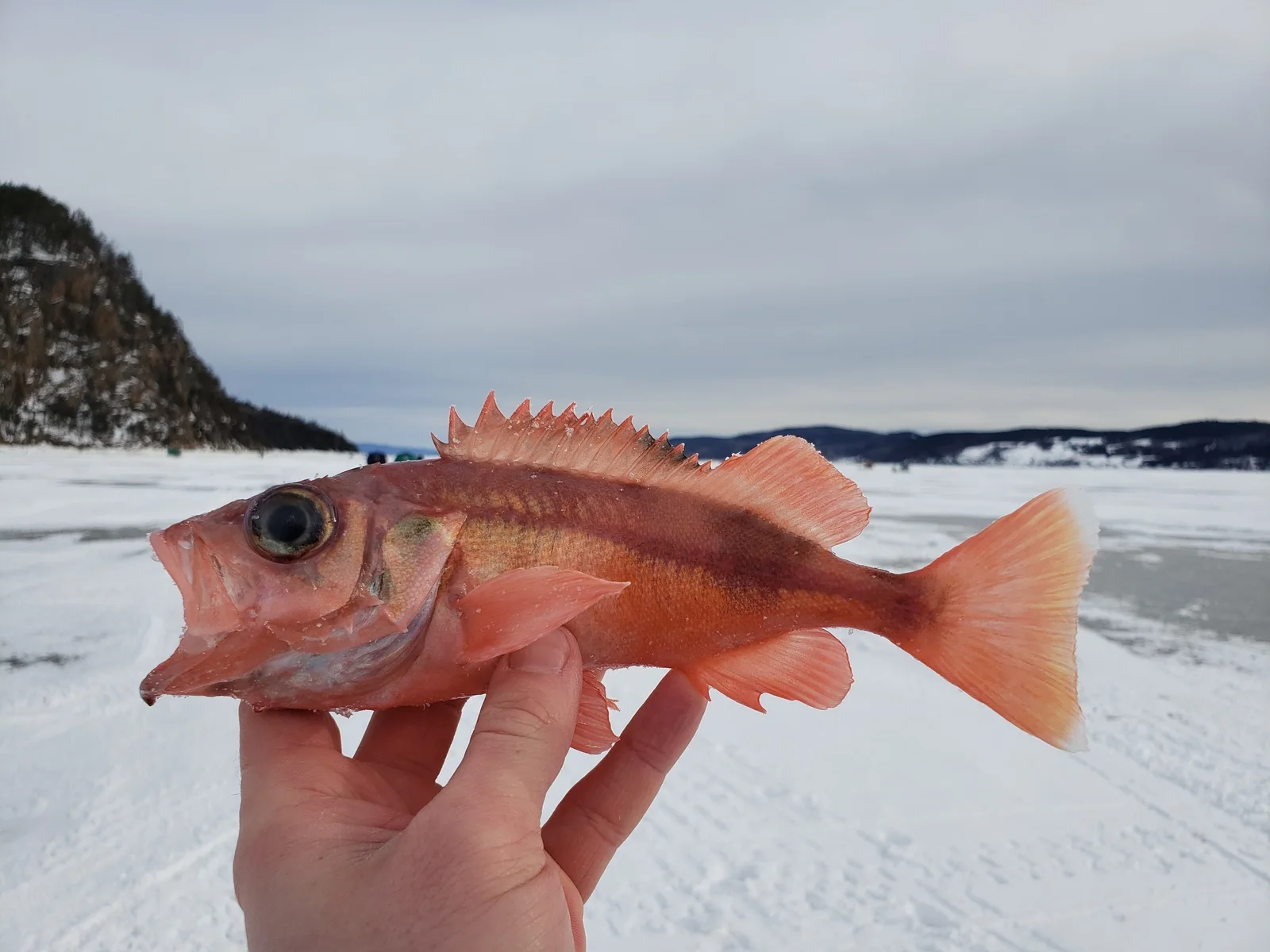
Quillback rockfish (Sebastes maliger) is a fish of the family Sebastidae. FishBase gives its range as: Eastern Pacific: From Shumagin Islands, Prince William Sound and Gulf of Alaska to San Miguel Island, southern California, USA. It is recorded from 0 to 274 m, in temperate water at 8–16 °C. The recorded maxima are 61 cm TL, 3.3 kg, 90 years. IUCN status: Not Evaluated (NE). Chinese name: .
Zero to ninety-two metres is the working band
FishBase lists 0–274 m and puts the usual range at 0–92 m. The two figures answer different questions. The 274 m is the deepest record in the literature; the 92 m is where the species is normally found. For a boat, the second number is the one that decides where to start.
The zero matters as much as the ninety-two. A quillback can be caught at the surface, over shallow rock, in water you can see the bottom through. That is unusual for a rockfish and it explains why the same species turns up in kelp and in deeper reef holes on the same day. It is not a deep-water fish that occasionally comes shallow; it is a shallow fish with a deep tail in its record.
The Canadian assessment adds the shape of the bottom. Submersible observations run from 16 to 182 m over hard, complex substrate with vertical relief: broken rock, reef ridges and crevices. That is the "where" behind the depth numbers. A flat sand plain inside the same depth band is not the same habitat, and the fish are not on it.
The 95 per cent line is 14 to 143
Canada's COSEWIC assessment gives a tighter picture from the commercial logbooks: 95% of commercial catch records fall between 14 and 143 m. That is a different slice from FishBase's usual band, and the difference is informative. The logbook slice is deeper at the top because commercial gear fishes deeper than a shore angler; the bottom is higher because trawls and longlines do not work the kelp fringe.
Put the two together and the band you should actually fish is roughly 14–92 m, with the shallow edge accessible from a boat and the deep edge needing a reef mark. The 143 m ceiling in the logbooks is not a rule, it is where the commercial fleet stops catching them.
Eight to sixteen degrees
FishBase gives a temperature range of 8–16 °C, which is a cool-temperate envelope, not a cold one. That range explains the distribution: from the Shumagin Islands and Prince William Sound in Alaska down to San Miguel Island in southern California. The northern end is cold but not polar; the southern end is warm but not subtropical.
For a diver or an angler reading a sounder, the temperature band is a clue to where the rock is. A shallow reef that bakes in summer can push above 16 °C, and the fish move down the face or into shade. A reef with cold upwelling can hold them shallower than the depth chart suggests. The number is a filter, not a guarantee.
April to July off north-central California
FishBase records spawning in April–July, from a single record off north-central California. No spawning months are given for Alaska, British Columbia or southern California. The window is therefore a California statement, and a single record at that.
The COSEWIC report records that the species is matrotrophically viviparous, supplying nutrients to the developing embryos, and that mating takes place in December. It does not give a release month for Canadian waters. What it does give is age at 50% maturity: 11 years. A fish that takes a decade to reach spawning is not a fish you can harvest back quickly.
Thirty-one centimetres to first spawn, ninety-five years to the record
A quillback has to reach 31 cm before it first spawns. The largest recorded fish is 61 cm TL, and FishBase's oldest is 90 years. The COSEWIC report gives a maximum recorded age of 95 years and a generation time over 30 years. The two age figures are five years apart, which is what you expect when one is a literature compilation and the other is a targeted ageing study.
The practical line is 31 cm. Under that size it has not bred; over it, it may have. But a 31 cm quillback may be a decade old, so the size limit protects a fish that has already waited a long time to breed. That is the opposite of a fast-growing species where a small fish is a young fish.
A rockfish named for a quill
The common name comes from the dorsal fin: the spines are stiff and sharp, and a hand laid over the back finds them before it finds the body. FishBase lists the species as harmless to humans, which is a statement about poison, not about spines. A quillback can still open a finger.
Handling follows from that. Support the body, keep the palm behind the dorsal, and never lift by the jaw. On a rocky shore a fish that is dropped is a fish that lands on rock, and the survival of a released rockfish depends on how it was handled before it went back.
1,673 observations, nine GBIF rows, two flags
iNaturalist holds 1,673 observations, by far the largest photographic record in this batch. That number reflects a species that lives shallow, sits still, and is seen by divers and shore anglers, not a species that is unusually abundant.
GBIF's distributions endpoint returns nine rows: two for Canada and seven with no country at all, all from marine-region or global sources. Neither file gives a density. What they do agree on is the coastline: both the photographs and the distribution rows point to the northeast Pacific shelf from Alaska to California.
Not Evaluated globally, Threatened in Canada
FishBase's IUCN field says Not Evaluated. COSEWIC assessed the species as Threatened in 2009, citing fishing as the primary threat and noting that all survey indices had declined. The two labels do not contradict each other; they answer different questions. One says no global assessment exists; the other says the Canadian population is at risk.
For an angler in British Columbia, the Canadian label is the one that matters, and the assessment describes the management that sits behind it: closed areas, lower commercial quotas, and recreational bag limits that the report says do not actually restrict catches. For an angler in California, the same species is not covered by that assessment, and the state rules apply instead. The global "Not Evaluated" is not a green light anywhere.
Regulations before you keep it
These are the published regulations for this fish. Read the number first. The notice below it is the actual regulation.
Protected species2
No retention at any time · zero fish per person
United States — California · US-CA
California prohibits taking or possessing quillback rockfish at any time, at any depth.
These Rockfishes May Not Be Taken or Possessed in California - No Retention at Any Time: Bronzespotted Rockfish (JPG), Cowcod, Quillback Rockfish, and Yelloweye Rockfish (CCR T14, §28.55). Fishing is closed year-round, at all depths, no retention at any time (zero fish per person).
No retention allowed
United States — Oregon · US-OR
Oregon prohibits retaining quillback rockfish in its sport groundfish fishery.
NO RETENTION ALLOWED ... Quillback Rockfish
Every record above names its source and the date it was retrieved. See the regulation register for the full list, or how to read these regulations.
Where these facts come from
Check these pages before you rely on a size, range or protection status.
-
FishBase — Sebastes maliger
— FishBase · T2
-
GBIF — Sebastes maliger occurrence records
— GBIF · T2
-
IUCN Red List — Sebastes maliger
— IUCN · T1
-
Photo record — iNaturalist
— iNaturalist · T3