
Matsubara's rockfish
A large red deep-water rockfish called akou-dai in Japan. It lives on rocky ground from 200 to 1000 m, is viviparous, mates from December to April, and pregnant females rise to 200 to 300 m to release larvae. The bulging eyes caused by pressure change give it the Kanto name menuke.
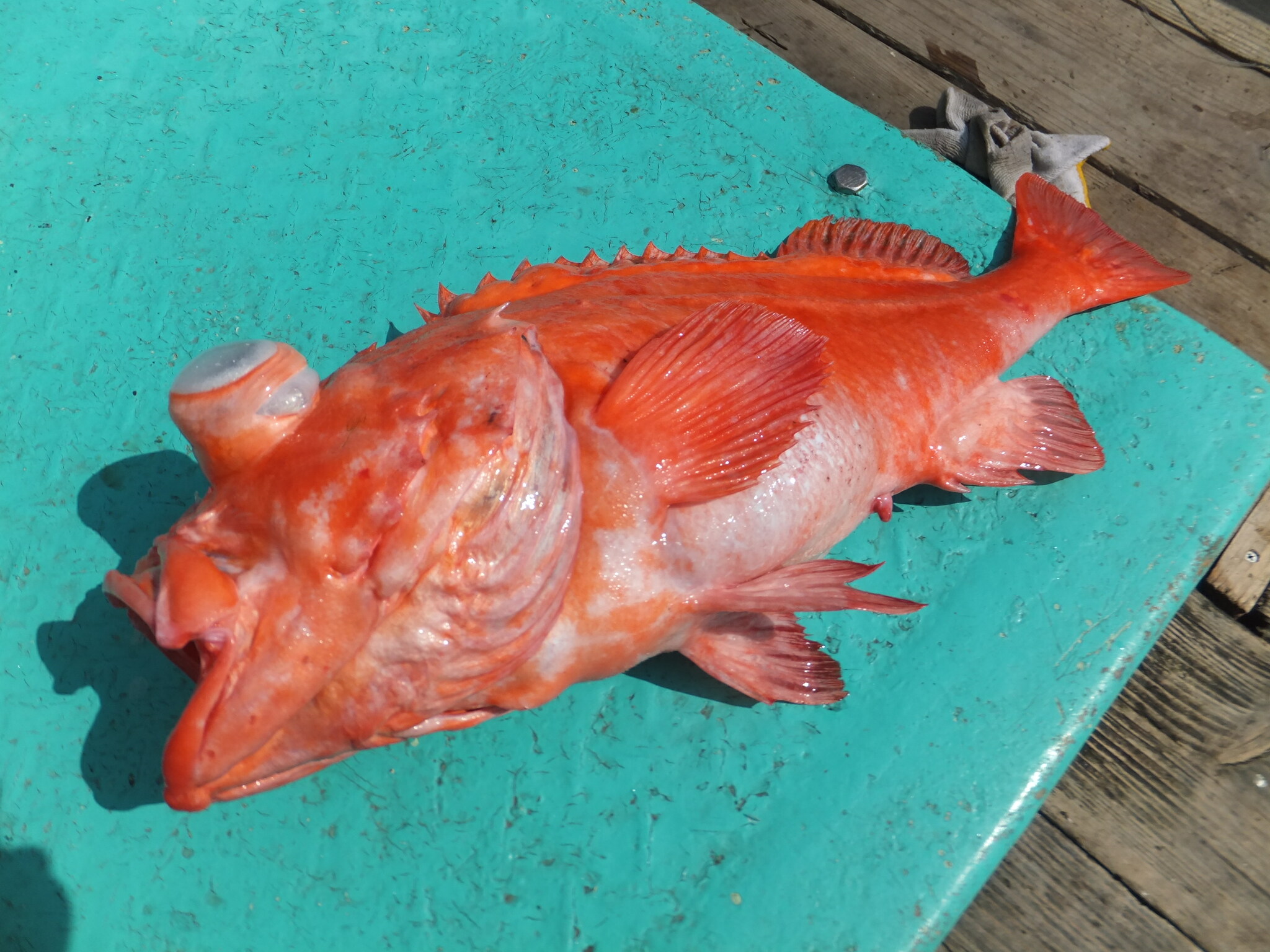
A large red deep-water rockfish called akou-dai in Japan. It lives on rocky ground from 200 to 1000 m, is viviparous, mates from December to April, and pregnant females rise to 200 to 300 m to release larvae. The bulging eyes caused by pressure change give it the Kanto name menuke.
Red rockfish, and a name that describes a symptom
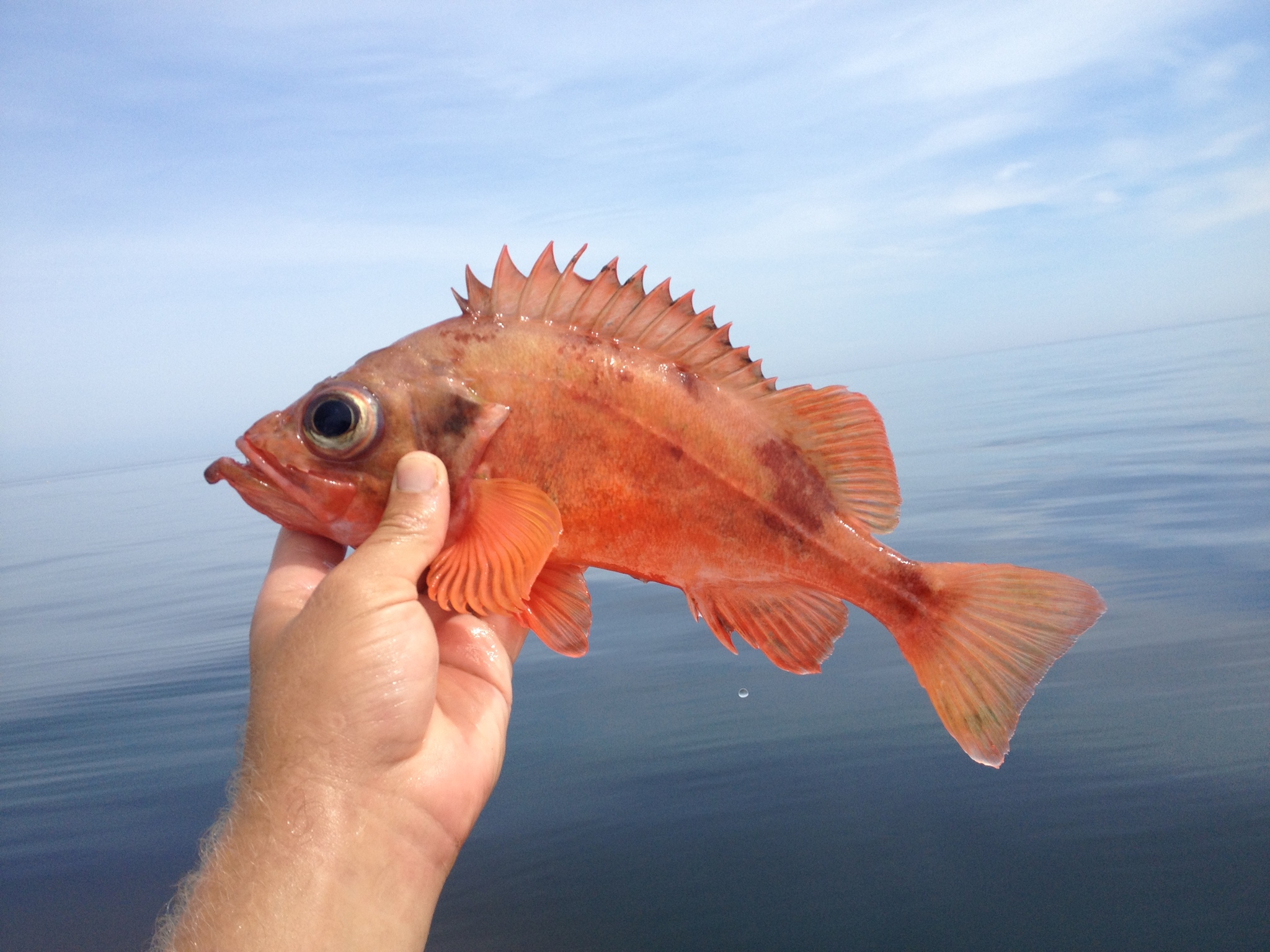
The body is elongate-oval and compressed, the head large, the lower jaw projecting with a knob-like process beneath its tip. There are 13 dorsal spines, head spines are well developed, the eye is large, and a small sharp spine sits before and after the lower orbital rim. Colour is bright vermilion with indistinct dark blotches; juveniles carry five dark vertical bands. The peritoneum and the inside of the opercle are black.
Menuke is not a taxonomic name. It describes the bulging eyes of a fish brought up from depth, and Kanto applies it to several deep red species, which is how osaga and baramenuke get mixed in. The lower-jaw knob, the dorsal spine count and the black peritoneum are what identify this fish.
FishBase gives a maximum of 60 cm standard length; the Japanese guide gives 80 cm and 8 kg, with ordinary catches of 2 to 4 kg.
Northern Japan, and two depth ranges
FishBase records the northwest Pacific, northern Japan. The Japanese record is southern Hokkaido, the Pacific coast from Aomori to Tosa Bay, off Kagoshima, Niigata, Toyama Bay, and Shimane Oki and Hamada, with the Sea of Japan scarce, plus the Mamiya Strait and the Pacific side of the Kuril Islands.
Depth is disputed. FishBase gives 310 to 383 m; the Japanese guide gives 200 to 1000 m while noting that the real figure may be near 800 m. The difference comes from different sampling and different grounds. Both are printed here with no midpoint invented.
The fish is viviparous, and pregnant females rise to 200 to 300 m to release larvae. That is why spring fishing on shallower ground can produce females carrying young.
Mating in winter, release in spring
The reproductive period runs from December to April. After mating, eggs are fertilised and hatch inside the mother, and the female releases larvae that can already swim.
The Japanese guide puts the season in autumn and winter and says quality falls in spring, yet spring is exactly when landings peak. That is a clean example of a season and a landing peak pointing in different directions, and the article keeps both rather than choosing the more flattering one.
Winter fat is the best. After spring release the flesh thins. Deep water stays cold and stable all year, so the seasonal signal is a change in depth and fat content rather than the clear bite shutdown seen in shallow-water fish.
Traditional deep-water marks
This is the representative deep-water target. Kanto marks include Outer Boso, South Boso, Sagami Bay, South Izu, Izu Oshima, Niijima, Miyakejima, Kozushima and Hachijojima, with additional grounds off the Oi River mouth, off Omaezaki, off Lake Hamana, off Toba, South Kii and off Muroto.
A standard rig carries a size 300 or 500 sinker on a bottom rig or tenbin, with squid strips, mackerel chunks or sardines as bait. Light deep-water rigs built around PE 6 to 8, a shorter rod and a smaller reel have become common and cut fatigue.
The mouth is large and the fish takes deep, so the strike should be firm rather than delicate.
Weight matters more than diameter
The standard deep rig is a rod rated 150 to 200 with a 300 sinker, or 250 with a 500 sinker, a manual or electric reel, PE main line of 6 to 8, leader 8 to 12, and Maruseigo hooks in 18 to 22 or dedicated deep-sea hooks.
The key property of a deep rig is weight, not fineness. Whether the sinker reaches the bottom and holds the fishing depth in a fast current decides more than line diameter. An electric reel reduces the effort of the ascent, but the final stage of bringing a fish up is still controlled by hand.
A season that does not match the landings
The flesh is white and watery, with fat mixed into the muscle fibres, and it turns cloudy if kept too long. The skin is thick and forms a gelatin layer under heat. It suits sashimi with the skin seared, kombu-jime, teriyaki, salt-grilling, drying and hotpot, and it also works in bouillabaisse and gratin. On Izu Oshima, akou-jiru uses fish chunks and ashitaba in a miso soup, a local dish rather than a restaurant invention.
The Japanese source suggests chilling the fish for two to three days after capture before cutting, for firmer flesh.
Japan has no nationwide recreational size or closed season; prefectural fishery adjustment regulations and cooperative rules apply. No species-level restriction was found, but the rules of Chiba, Kanagawa and Shizuoka were not checked line by line. That item is deferred.
Sixty centimetres and eighty, both kept
Classification, accepted name, distribution and the 310 to 383 m depth come from FishBase. The 200 to 1000 m figure, spawning period, viviparity, market position and eating assessment come from the market guide. Morphology, marks and rigs come from the angling encyclopedia.
The maximum length is given as 60 cm by FishBase and 80 cm by the Japanese guide. The two are printed side by side and not merged. A single number would hide which source a reader is relying on, and the difference is large enough to matter when judging a fish at the rail.
How to catch it
Boat bottom fishing
Fished with the listed approach, matched to the recorded depth and size.
Jigging
Fished with the listed approach, matched to the recorded depth and size.
Where these facts come from
Check these pages before you rely on a size, range or protection status.
- FishBase — Sebastes matsubarai — FishBase · T2
- GBIF — Sebastes matsubarai occurrence records — GBIF · T2
- IUCN Red List — Sebastes matsubarai — IUCN · T1
- Photo record — iNaturalist — iNaturalist · T3
Fish in the same water
These fish live in the same place.

Guides for this water
Technique, gear and safety guides that fit Matsubara's rockfish.