
Grass rockfish
Grass rockfish has 13 dorsal spines, 12–14 dorsal soft rays, 3 anal spines and 6 anal soft rays, with 26 vertebrae and 7 branchiostegal rays. The body is fusiform with a fairly large mouth and moderate head spines. Colour is olive brown with fine mottling and a pale belly, without the broad dark bars of the treefish. Maximum total length is 56 cm, maturity is near 27.5 cm, and the recorded age is 28 years.
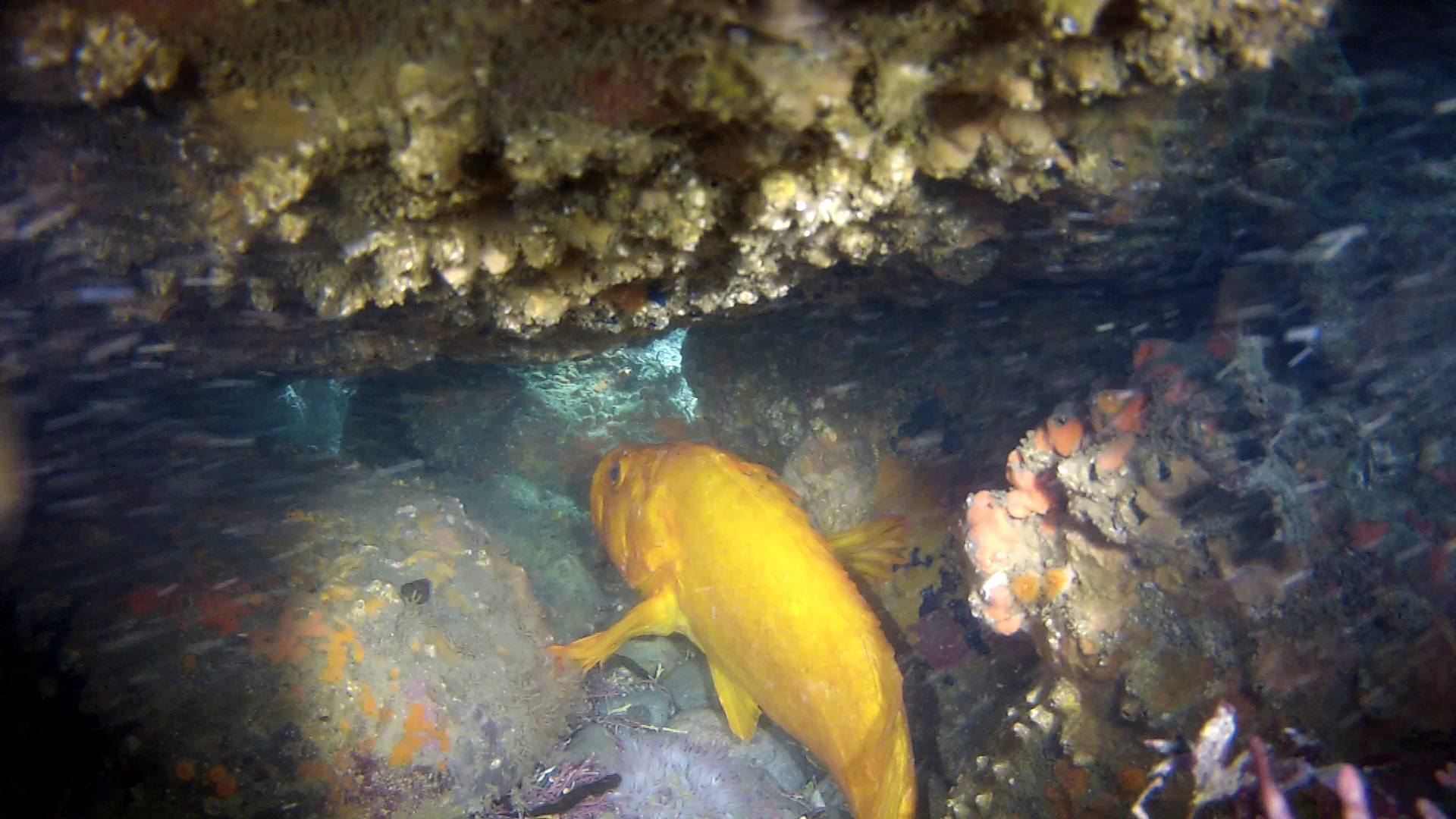
Grass rockfish has 13 dorsal spines, 12–14 dorsal soft rays, 3 anal spines and 6 anal soft rays, with 26 vertebrae and 7 branchiostegal rays. The body is fusiform with a fairly large mouth and moderate head spines. Colour is olive brown with fine mottling and a pale belly, without the broad dark bars of the treefish. Maximum total length is 56 cm, maturity is near 27.5 cm, and the recorded age is 28 years. The combination of a large mouth, olive mottling and a pale belly is usually enough at the boat.
Habitat and behaviour
Yaquina Bay in Oregon to Baja California, Mexico. Demersal from the surface to 46 m, over shallow rock, kelp and sand edges. GBIF holds 73011 records, 72962 from the United States and 31 from Mexico. iNaturalist lists 626 observations. The diet includes fishes, crabs, shrimps and snails, taken around rock and along sand edges. It leaves the reef more readily than the smaller rockfish beside it, so sand edges are worth fishing. Sand edges beside kelp are as productive as the reef itself, and fish often sit just off the weed line.
Seasonal window
Spawning is recorded in December, January and February, with California Current records in January and December. FishBase gives no temperature range, so the window follows the spawning block and the open season. The California RCG complex is open all year; shallow reef still fishes in winter, and fish spread out in spring. After heavy swell, move from shallow rock to a deeper edge. Because the spawn falls in winter, the shallow window and the spawning window overlap and fish stay close in.
Gear and approach
A medium-heavy rod, braided main line and a fluorocarbon leader. Wide-gap hooks, weight set by current: light over sand, heavy over rock. A medium leader balances drift and snag risk. Check the leader after every snag, because a nick in the rock costs the next fish. Keep the rod tip up on the retrieve to steer the fish away from the reef. Hold the rod steady after the hookset so the fish cannot cut across the reef, and pump it up rather than dragging it through the rocks.
Edibility and regulations
The flesh is white with a coarser grain, good sliced and pan-fried or in soup; bleed, gill and ice the fish promptly. The fillets are firm enough to cube for chowder and hold together on the grill. Alaska: outside the range, no specific rule, so check the current announcement. British Columbia: outside the range, no specific rule, so check the current announcement. Washington: outside the usual range, no specific rule, so check the current announcement. California: RCG complex 10 per day in aggregate, no minimum size for rockfish, bronzespotted, cowcod, quillback and yelloweye prohibited, and a descending device must be on board. IUCN Not Evaluated; CITES and CMS Not Evaluated; harmless to humans.
Where to look
Fish shallow rock, kelp and the sand-rock edge from the surface to 46 m. The dense GBIF cluster in the United States follows the California and Oregon coast. Work the edge where reef meets sand, and cast along it rather than into the middle of the kelp. In winter, a deeper edge holds fish after swell has muddied the shallows. On a flooding tide, fish the sand side; on the ebb, work the rock side where bait is pulled off the reef. Keep the boat off the weed line and cast back into the edge so the jig lands in the gap. A second drift over the same edge is usually better than a new mark.
How to catch it
Boat bottom fishing
Fished with the listed approach, matched to the recorded depth and size.
Shore fishing
Fished with the listed approach, matched to the recorded depth and size.
Jigging
Fished with the listed approach, matched to the recorded depth and size.
Where these facts come from
Check these pages before you rely on a size, range or protection status.
- FishBase — Sebastes rastrelliger — FishBase · T2
- GBIF — Sebastes rastrelliger occurrence records — GBIF · T2
- IUCN Red List — Sebastes rastrelliger — IUCN · T1
- Photo record — iNaturalist — iNaturalist · T3
Fish in the same water
These fish live in the same place.

Guides for this water
Technique, gear and safety guides that fit Grass rockfish.