
Korean rockfish
Korean rockfish is a demersal, rocky-reef fish of the northwest Pacific, from Japan and Korea to China and the Russian Far East. It lives from 3 to 100 m in temperate water, reaches 65 cm TL and 3.1 kg, and can live 20 years. Sources disagree on diet, with FishBase listing algae and other accounts calling it predatory. Boat bottom fishing or rock fishing is the usual approach, with the season running May to June.
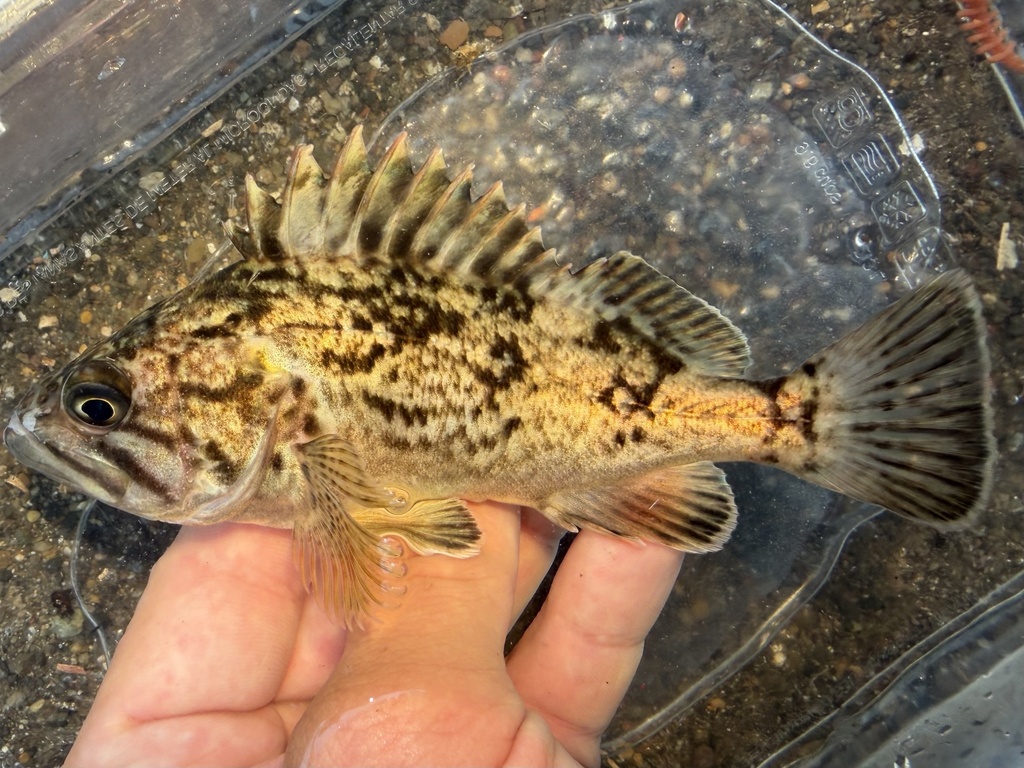
The Korean rockfish arrives with two incompatible labels. FishBase's habitat line says demersal and rocky, and its diet keyword is a single word: algae. iNaturalist, drawing on the same species, calls it a predatory fish, and Wikipedia lists it among the predatory members of its subfamily. An algae-eating rockfish and a predatory rockfish are not the same animal. This page keeps both labels visible and works out what each one is actually evidence of.
Algae or fish: which label is the record
The diet field in the fact sheet is a keyword, not a stomach-content study. "Algae" may come from a single reference, from a gut-content sample, or from an early life stage. The Wikipedia summary says predatory, and a 65 cm scorpionfish-shaped fish with a large mouth is not built like a grazer. The two statements are not reconciled anywhere in the sources, and this page will not pick a winner.
What the conflict does change is the bait question. If the algae label reflects what small individuals eat, then a rockfish taken on weed or a bare jig is not evidence against the predatory label. If it reflects the adult diet, the predatory description is wrong. Either way, the working assumption is to fish animal bait or a fish-like lure, and to treat a fish caught on something green as a data point rather than a contradiction.
What demersal and rocky pin down
The environment line is marine, demersal, temperate. The habitat keyword is rocky, and the approved shore method is rock fishing from rocky marks. A tight, consistent set: sand flats and open blue water are out, and nothing in the record hints otherwise. The label conflict is in the diet, not in the bottom type.
Demersal plus rocky also settles the presentation. A bait needs to sit on or just above rock, and a lure needs to reach the rock without snagging on the way down. The 100 m ceiling is what makes the difference between a shore mark and a boat mark; the bottom type is the same in both.
Three metres to a hundred
The recorded depth range is 3 to 100 m. Three metres is a rock pool at high water or the edge of a breakwater; 100 m is a boat mark with a sounder. The record gives no usual depth, no temperature range and no substrate beyond the single word "rocky". A fish recorded across 97 metres of coast is not equally catchable across all of it.
The practical reading is that the shallow end is reachable and the deep end is a different fishery. A float bait along a rock wall covers the first few metres. A boat bottom rig covers the deeper part, but the record does not say at what depth the fish becomes common. Treat 3 to 100 m as the envelope, and find the band on the sounder rather than from the page.
Twenty-seven centimetres, twenty years
Top size: 65 cm TL, 3.1 kg, 20 years; maturity sits at Lm 27 cm within a 26–28 cm band. No common length is offered. The gap between a 27 cm mature fish and a 65 cm record is wide, and the 20-year lifespan explains part of it: this is a slow-growing fish that keeps adding length for a long time.
For a release decision, 27 cm is the record's release line, and the 26 to 28 cm range is narrow enough to treat as one number. A 20-year fish at 65 cm implies that the largest individuals are old, not that they are a separate stock. It also implies that removing the big fish removes the oldest part of the population, which is the part least able to be replaced quickly.
May and June, Primorye only
The spawning table gives May and June, with one record from Primorye in the Russian Far East. Primorye sits at the range's northern limit, not its middle. Japan, Korea and China are in the distribution text, but no spawning record from those waters appears in the table. A single Primorye record does not describe a season for the whole Northwest Pacific.
The timing is plausible for a temperate rockfish: late spring, after the winter cold. But plausibility is not data. If the spawn is later in the north than in the south, the table cannot show it, because it holds one region. Treat May and June as a northern hint; confirm locally before planning around them.
Schlegel's black rockfish, woo-reok
The English names are Korean rockfish and Schlegel's black rockfish; the Korean name is woo-reok. The Chinese name on the approved list is , after Schlegel, and the fact sheet also carries as an alternative. "Rockfish" in English covers a large group of scorpionfishes, so the name alone does not identify this species outside its range.
The Latin binomial holds steady. Sebastes schlegelii is accepted by GBIF at 99 percent confidence, and the specific epithet commemorates the same naturalist as the common names in Chinese and English. A Korean angler and a Chinese angler using local names are talking about the same fish only if the Latin name matches.
Not Evaluated, farmed, and a gamefish
No Red List assessment has been made; the category reads NE and carries no date. The use record names commercial capture, commercial farming, gamefishing and possible aquarium display. A Not Evaluated species is not a species known to be safe; it is a species nobody has assessed, and this page will not read the blank as reassurance.
The aquaculture entry is the part with a direct consequence. Farmed rockfish reach the market under the same name as wild ones, and a stock that is both fished and farmed can absorb fishing pressure in ways a wild-only stock cannot. That does not make the wild fish abundant, and the record gives no landing figures to support either conclusion.
Where the dots actually are
GBIF holds 1,178 records: Japan 473, South Korea 427, China 103, Russia 13. Those four are consistent with the stated Northwest Pacific range. Then there are Turkey 4, Bulgaria 2, Ukraine 2 and Argentina 1. None of those countries is in the distribution text, and the source offers no explanation for them. They may be mislabelled specimens, aquarium records or data-entry errors; this page will not decide which.
iNaturalist has 193 observations, concentrated where the GBIF counts are concentrated. Two approved approaches, bottom fishing from a boat and shore fishing over rock, both suit a demersal fish on hard ground. The two useful numbers are 27 cm for maturity and 65 cm for the record; the 3 to 100 m band is where to look, not where the fish is guaranteed.
How to catch it
Boat bottom fishing
Anchored or drifting boat, bait or lure worked near the recorded bottom.
Rock fishing
Float or bait fishing from rocky shore marks.
Where these facts come from
Check these pages before you rely on a size, range or protection status.
- FishBase — Sebastes schlegelii — FishBase · T2
- GBIF — Sebastes schlegelii occurrence records — GBIF · T2
- IUCN Red List — Sebastes schlegelii — IUCN · T1
- Photo record — iNaturalist — iNaturalist · T3
Fish in the same water
These fish live in the same place.

Guides for this water
Technique, gear and safety guides that fit Korean rockfish.