
Treefish
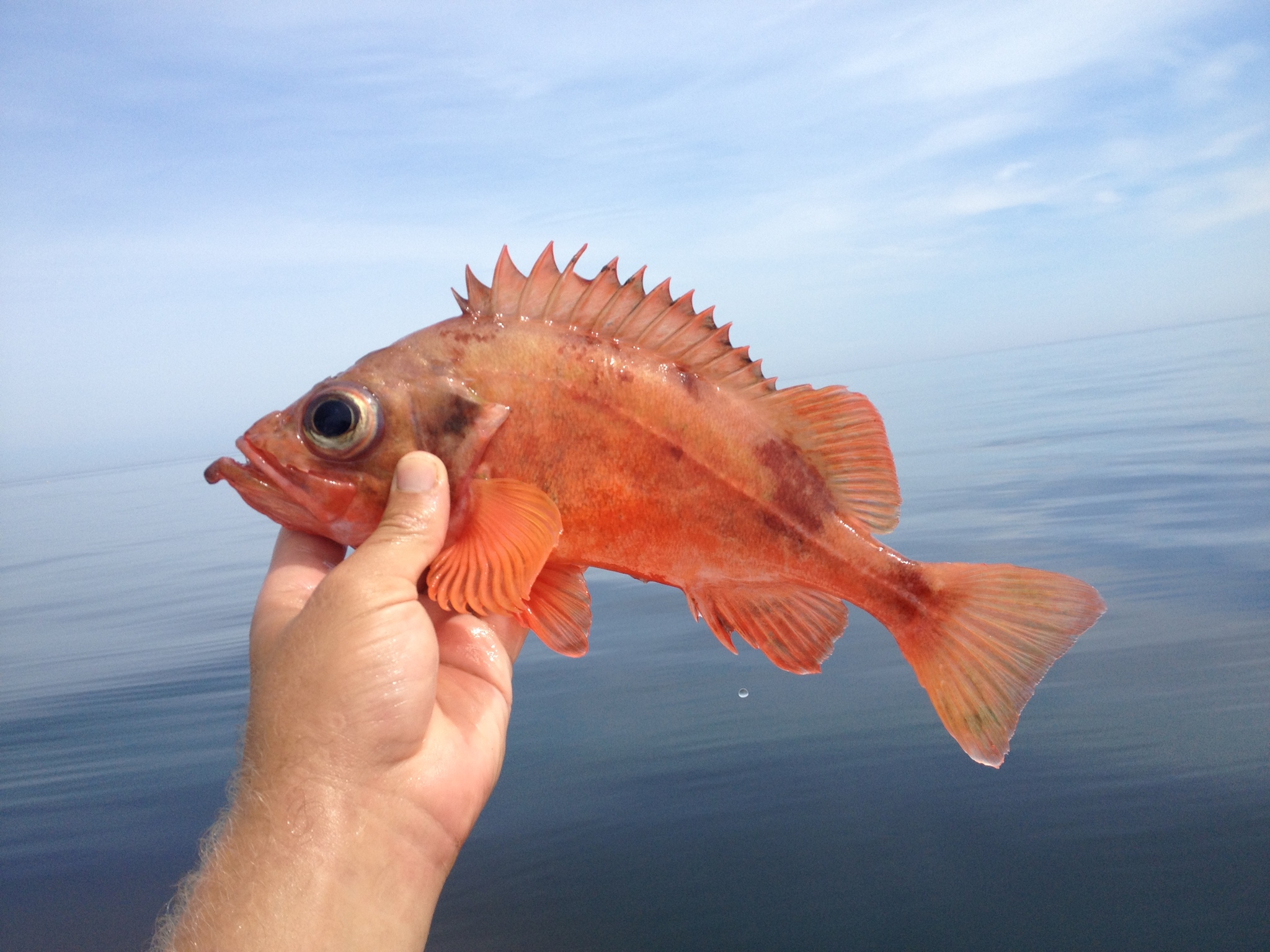
Treefish is a thick-set nearshore rockfish with a large head, heavy lips and strong head spines; maximum total length is 41 cm. The FishBase summary gives no fin-ray or vertebral counts, so identification rests on head shape, the heavy lips and the dark bars on the flank. The body is olive brown with darker bars, which separates it from the finely mottled grass rockfish at the same sites.

Treefish is a thick-set nearshore rockfish with a large head, heavy lips and strong head spines; maximum total length is 41 cm. The FishBase summary gives no fin-ray or vertebral counts, so identification rests on head shape, the heavy lips and the dark bars on the flank. The body is olive brown with darker bars, which separates it from the finely mottled grass rockfish at the same sites. The mouth is large and the dorsal spines are stout, so handle the fish with care. The head is broad and the eyes sit high, which gives the fish a blunt profile in photographs.
Habitat and behaviour
San Francisco in California to central Baja California, Mexico. Demersal from 5 to 90 m, over rocky reef and crevices. GBIF holds 74183 records, 74109 from the United States and 44 from Mexico. iNaturalist lists 348 observations. It stays around crevices and caves and feeds on fishes and benthic crustaceans. The body is deep and the fins are stiff, so it turns slowly in a hole and relies on cover rather than speed. Caves and undercuts are the main marks, and the fish is usually within a body length of the entrance.
Seasonal window
FishBase records no spawning months for this species, so the season here is set only from the open season and nearshore conditions; no temperature is given. The California RCG complex is open all year, with stable reef fishing in summer and autumn and slower fishing after winter swell. No spawning window is inferred, and the trip is planned around sea state and visibility. Winter storms move the fish deeper, and the shallow holes empty until the water clears.
Gear and approach
A medium-heavy boat rod with braided main line and a fluorocarbon leader. Wide-gap hooks and weight matched to the depth of the hole and the current. Use a single hook and a short leader where crevices are dense, and accept a few lost rigs rather than fish light. Use just enough weight to hold bottom beside the hole and let the bait work in the eddy. Lift the fish off the rock before winding, or it will turn sideways into the hole.
Edibility and regulations
The flesh is white and firm, good steamed, pan-fried or in soup; bleed, gill and ice promptly. It holds up well in soup and does not fall apart in the pan. Alaska: outside the range, no specific rule, so check the current announcement. British Columbia: outside the range, no specific rule, so check the current announcement. Washington: outside the usual range, no specific rule, so check the current announcement. California: RCG complex 10 per day in aggregate, no minimum size for rockfish, bronzespotted, cowcod, quillback and yelloweye prohibited, and a descending device must be on board. IUCN Not Evaluated; CITES and CMS Not Evaluated; the dorsal spines are venomous.
Where to look
Work crevices, cave mouths and boulder piles from 5 to 90 m. The dense GBIF cluster in the United States matches the California range. Fish the dark side of a rock and the mouth of a hole rather than open reef. Repetition on a known hole pays, as the fish stays close to cover and does not roam far between marks. If a hole has produced before, give it a second pass on the next tide rather than hunting new ground. The drift matters more than the cast on this ground. Keep the bait still for a few seconds after it reaches bottom; the strike often comes while the rig is sitting.
How to catch it
Boat bottom fishing
Fished with the listed approach, matched to the recorded depth and size.
Drift fishing
Fished with the listed approach, matched to the recorded depth and size.
Jigging
Fished with the listed approach, matched to the recorded depth and size.
Where these facts come from
Check these pages before you rely on a size, range or protection status.
- FishBase — Sebastes serriceps — FishBase · T2
- GBIF — Sebastes serriceps occurrence records — GBIF · T2
- IUCN Red List — Sebastes serriceps — IUCN · T1
- Photo record — iNaturalist — iNaturalist · T3
Fish in the same water
These fish live in the same place.

Guides for this water
Technique, gear and safety guides that fit Treefish.