
Thomson's rockfish
Thomson's rockfish, or usu-mebaru, is Japan's large mebaru: a cold-water rockfish approaching half a metre that gives birth to live young at 70–150 m. It schools tightly around deep reefs, which is why one productive patch of rock can fill a boat. Fish it vertically with bait or slow jigs.

Thomson's rockfish is the big one among Japan's *mebaru*: a cold-water rockfish that grows to nearly half a metre, gives birth to live young at 70–150 m, and schools so reliably around deep reefs that a boat can fill up on one patch of rock. English readers know it as goldeye rockfish; Japanese fishers know it as usu-mebaru, and in spring, confusingly, as "bamboo-shoot mebaru".
The largest of the mebaru
Sebastes thompsoni was described by Jordan and Hubbs in 1925 from one specimen taken off Iwate and two off Osaka, and it sits in the Sebastidae among the northwest Pacific rockfishes. WoRMS carries the name as accepted.
Japan has 33 species of Sebastes, thirteen of which carry "mebaru" in their standard Japanese name, and several look alike closely enough that the names are routinely mixed in the market. This species is the largest of them: average total length around 35 cm, with individuals approaching 50 cm. FishBase's figure is lower — 30 cm standard length — which is a fork-length-versus-standard-length difference plus a difference in what has been measured and published.
The Japanese trade treats it as a mebaru without always separating it from the others, and because it is landed in spring it is also sold as takenokomebaru, bamboo-shoot mebaru — a name that properly belongs to a different, smaller species. That is the kind of naming problem that only matters if you are trying to buy or record a specific fish.
Five blotches, not six
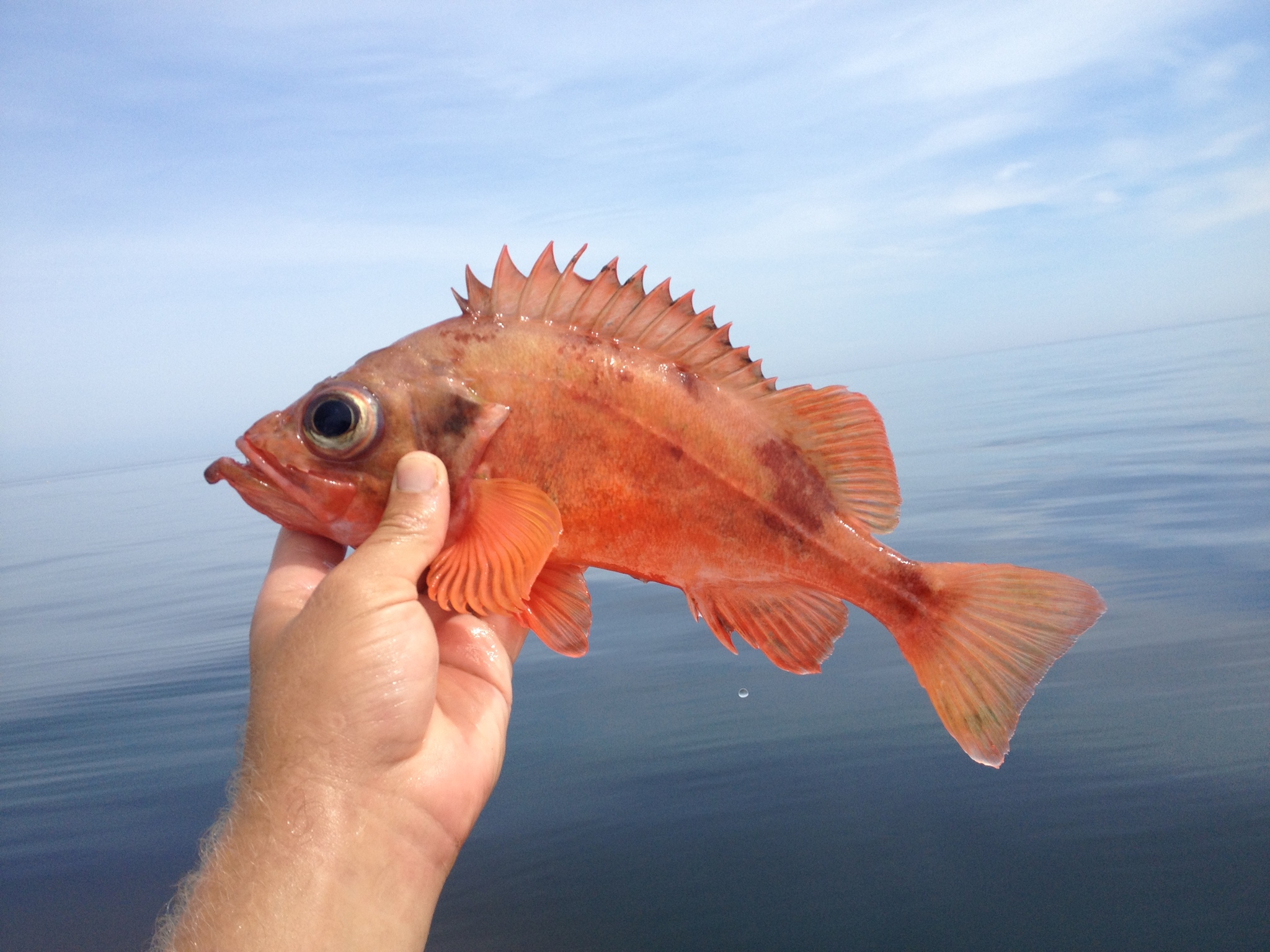
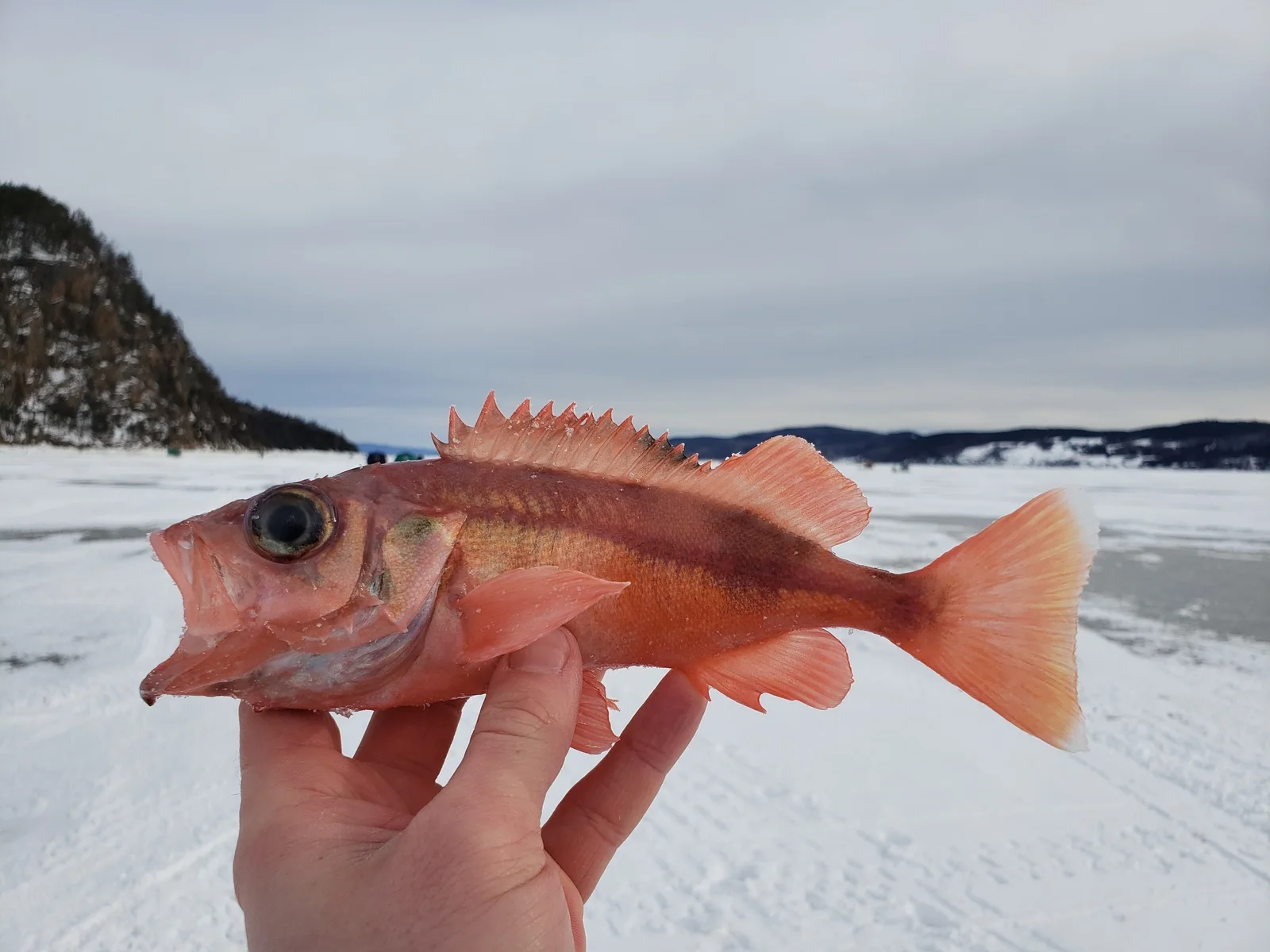
The most useful field character is the pattern of dark blotches along the flank. S. thompsoni carries five: the first four under the dorsal fin and the fifth on the caudal peduncle. The closely similar S. togottomebaru carries six, with more rounded outlines, and the blotches on this species are paler.
Two more characters separate it in the hand: scales on the lower jaw, and two sharp spines on the lower edge of the lachrymal bone in front of the eye. Eyes are large and protruding, and the body colour is a pale red-orange that fades fast after death.
FishBase's morphology fields for the species are empty — no fin-ray counts, no vertebral count, no body-shape description — so the Japanese identification literature is doing all the work here.
Southern Hokkaido to the Tsushima Strait
On the Pacific side the species runs from southern Hokkaido to around Suruga Bay; on the Japan Sea side from Aomori to the vicinity of Tsushima. FishBase compresses this to "northwest Pacific: northern Japan" and adds Korea, both North and South.
GBIF's 469 records are weighted the other way round from what the Japanese literature suggests: 283 from South Korea, 135 from Japan, four from China and two from North Korea. iNaturalist, which needs a photograph, has only 12 observations. A 2022 paper documenting the species from Yakushima extended the known southern limit well beyond Suruga Bay, which is a reminder of how patchy the record is at the edges.
The depth range is 40–150 m in FishBase, and Japanese accounts put adults at 50–200 m depending on size.
Live birth at 70–150 m
Rockfishes do not scatter eggs. Mating takes place in December and January; the female carries the fertilised eggs internally until they hatch, and releases larvae between March and early June over rocky ground at roughly 70–150 m. This is viviparity in the literal sense — larvae, not eggs.
The larvae then do something unusual: they school in groups of tens to thousands and live among drifting algae for about 50 days, which is why they turn up in coastal set nets fishing around weed lines. At around 5 cm they leave the weed and settle on shallow bottom, and from there they move deeper as they grow: schools of 10–20 cm fish sit at 50–100 m, and fish of 16–24 cm and above sit at 100–200 m.
There is no inshore spawning migration. Mating and larval release happen in the same deep water the adults live in.
Size follows depth
That size-depth relationship is the single most practical thing on the page for a boat angler. If you are catching 15 cm fish, you are above the main body of adults; if you want the 30 cm-plus fish, you need to be deeper, and the Japanese literature is explicit that the bigger schools sit at 100–200 m.
The behaviour is equally consistent: adults stay in schools of a dozen or so around rocky outcrops, hanging head-up at an angle, and they are not wary. Hook one and the rest of the school stays.
That reliability has been engineered. In Niigata Prefecture, artificial reefs of metal and concrete have been placed on the bottom specifically to concentrate the species for efficient catching, and separate structures have been built as nursery habitat for juveniles.
The boat rig: a heavy sinker and a long trace
Japanese boat fishing for this species is bottom fishing with a multi-hook rig rather than lure casting. A 2.4–3 m rod rated for 50–80 go sinkers, usually with a small electric reel because of the depth; a rig with several hooks on short snoods, either with or without flashers, chosen according to whether mackerel are thick on the ground that day.
The technique is a free-spool drop to the bottom, an immediate lift to take out the slack, then holding the sinker just ticking the bottom as the boat rises and falls. On a bite, two turns of the handle or a little line released lets the next fish take before you wind up. Larger fish tend to take the upper hooks.
Chumming with krill is used in some fisheries, but the standard approach is the plain bottom rig.
Tsugaru Strait mebaru
Since 1994 the Komadome and Shimomae districts of Aomori Prefecture have shipped this fish under the brand name "Tsugaru Strait mebaru". The pitch is specific: the fast current of the strait keeps the fish working and the food supply rich, and the flesh is white, semi-translucent with faint vermilion streaks, which makes it good enough for raw preparation — unusual for a fish that is more often simmered or salt-grilled. Most of it goes to the Tokyo and Osaka wholesale markets.
Aomori's Japan Sea fishery itself is seasonal and gear-specific: gillnets from June to August, hook-and-line all year, with the peak running May to August, mostly at 80–150 m.
Food, rules and what the record does not say
Culinary, this is a textbook low-fat white fish: low energy, soft flesh, mild flavour, and among the mebaru the least assertive. It is at its best simmered, and the fish from fast-current ground is the one worth eating raw.
Legally there is almost nothing to report. The species has no IUCN assessment, is not listed by CITES or CMS, and is harmless to handle. Japan manages it inside general coastal licence and gear rules rather than a species-specific quota; Korean management of the stock that produces most GBIF records is not documented in the sources used here.
The factual gaps are the interesting part. There is no growth curve, no maturity length, no age record, no diet composition by weight, and no Korean-language material in the retrieval at all. The size discrepancy between FishBase's 30 cm SL and the Japanese 50 cm TL is a good illustration: the same fish, described by two traditions that measure differently and rarely reconcile.
How to catch it
Boat bottom fishing
Anchored or drifting boat, bait or lure worked near the recorded bottom.
Where these facts come from
Check these pages before you rely on a size, range or protection status.
- FishBase — Sebastes thompsoni — FishBase · T2
- GBIF — Sebastes thompsoni occurrence records — GBIF · T2
- IUCN Red List — Sebastes thompsoni — IUCN · T1
- Photo record — iNaturalist — iNaturalist · T3
Fish in the same water
These fish live in the same place.

Guides for this water
Technique, gear and safety guides that fit Thomson's rockfish.