
Dusky rockfish
Dusky rockfish has XIII–XIV dorsal spines and 13–16 soft rays, III anal spines and 7–9 soft rays, and 28–29 vertebrae. It carries 43–54 lateral-line pores, 47–63 scales and 16–19 pectoral rays. The body runs from light yellow through greenish brown to gray, usually greenish brown, with orange flecks on the sides, distinctly light areas above the anal-fin base and on the ventral pectoral rays, a peritoneum from light gray to jet.
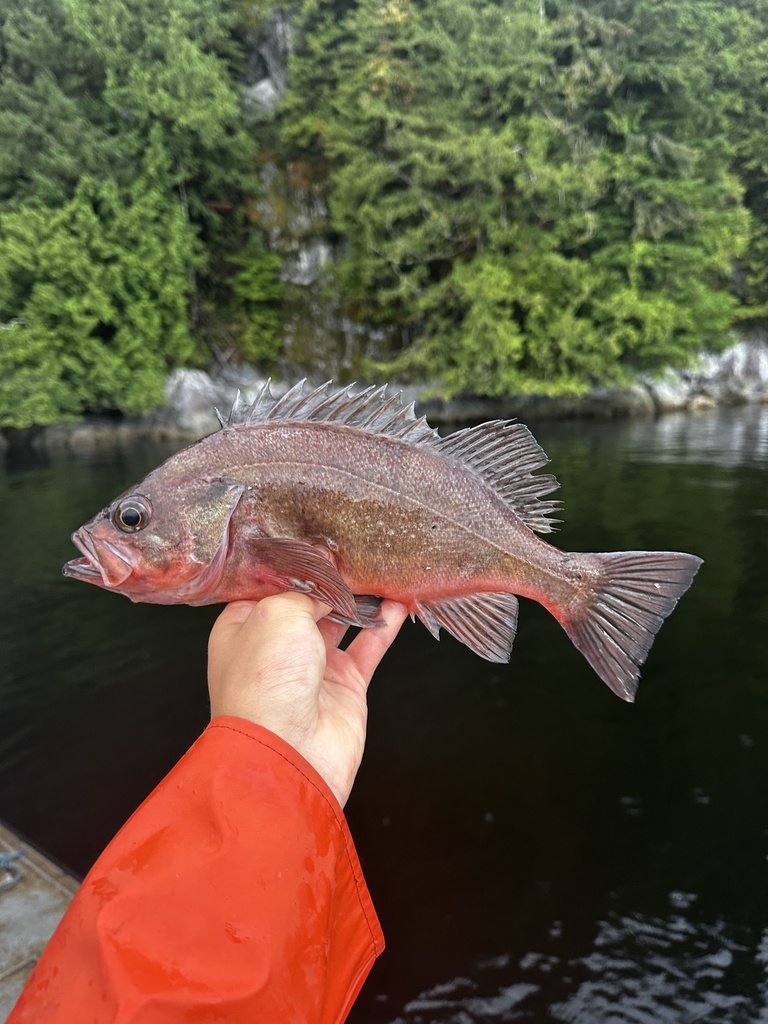
Dusky rockfish has XIII–XIV dorsal spines and 13–16 soft rays, III anal spines and 7–9 soft rays, and 28–29 vertebrae. It carries 43–54 lateral-line pores, 47–63 scales and 16–19 pectoral rays. The body runs from light yellow through greenish brown to gray, usually greenish brown, with orange flecks on the sides, distinctly light areas above the anal-fin base and on the ventral pectoral rays, a peritoneum from light gray to jet black, and a strong symphyseal knob. Maximum length is 43.1 cm SL, maximum age 50 years, and maturity 36.5 cm. Colour varies widely, so identification should rest on the pores and the knob rather than on shade alone. The species is harmless to humans and carries a moderate to high vulnerability score.
Habitat and behaviour
The range runs from Japan and the east coast of Kamchatka through the western Bering Sea and the Aleutians to 60°N in the eastern Bering Sea, then through the Gulf of Alaska to Johnstone Strait, British Columbia, and central Oregon. The country table lists Alaska, Canada, Japan and the contiguous United States. It is demersal from 6 to 675 m, usually 100–300 m. GBIF holds 4254 records, 3993 from the United States, 246 from Canada, 3 from Japan and 2 from Russia; iNaturalist has 70 observations. Mud, gravel and deep slopes are the main bottom types. The record lists it as a commercial species rather than a gamefish.
Seasonal window
Spawning is recorded from April to May, with matching records from the central Gulf of Alaska. Southeast Alaska does not list the species separately, so it falls under nearshore rockfish and the current announcement. British Columbia allows 3 rockfish a day except yelloweye. Washington's coastal bottomfish season runs from the second Saturday in March to the third Saturday in October, with 9 bottomfish and 7 rockfish a day. Spawning is in spring and deep water is weather-limited, so late spring to early autumn is the steadier window. No temperature range is recorded, so none is given. The spawning window sits inside the spring transition, when weather is still unsettled.
Gear and approach
At 43.1 cm maximum, a medium-light boat rod with a sensitive tip and some power lower down is enough. Braid needs enough capacity for a drop past 300 m, with an abrasion leader on the end. Use circle hooks or strong single hooks, and choose lead by depth and current rather than a fixed size. Carry a descending device for release, as Alaska requires for rockfish. Wind steadily rather than fighting the fish against the drag. A line counter makes a repeated drop to the same slope easier.
Edibility and regulations
The flesh is white and fine, good steamed, pan-fried or in soup; bleed, gill and ice the fish on the boat. Southeast Alaska does not list the species, so it is managed with other nearshore rockfish and the Alaska entry here is an inference. British Columbia: 3 rockfish a day except yelloweye. Washington coast: 9 bottomfish and 7 rockfish a day, and the Puget Sound keep list does not include this species, so check the current announcement. The range does not reach California, so California rules do not apply. IUCN Not Evaluated; CITES and CMS Not Evaluated.
Where to look
FishBase supplies taxonomy, morphology, distribution, spawning and use; GBIF supplies occurrences; iNaturalist supplies observations and images. Regulations come from three agencies' public summaries, and the Alaska and Puget Sound entries are inferences. FishBase carries no Chinese name, so the approved name is used, chosen for the species' variable body colour. The seasonality curve is an editorial judgement, not catch data.
How to catch it
Boat bottom fishing
Fished with the listed approach, matched to the recorded depth and size.
Jigging
Fished with the listed approach, matched to the recorded depth and size.
Where these facts come from
Check these pages before you rely on a size, range or protection status.
- FishBase — Sebastes variabilis — FishBase · T2
- GBIF — Sebastes variabilis occurrence records — GBIF · T2
- IUCN Red List — Sebastes variabilis — IUCN · T1
- Photo record — iNaturalist — iNaturalist · T3
Fish in the same water
These fish live in the same place.

Guides for this water
Technique, gear and safety guides that fit Dusky rockfish.