
Broadbanded thornyhead
A deep-water bottom scorpaenid called kichiji in standard Japanese and kinki in the market. It lives on muddy slope from 100 to 1500 m, feeds mainly on brittle stars, and spawns around Hokkaido from February to May. Its fat is mixed into white flesh, and it is among the most expensive of the red fish.
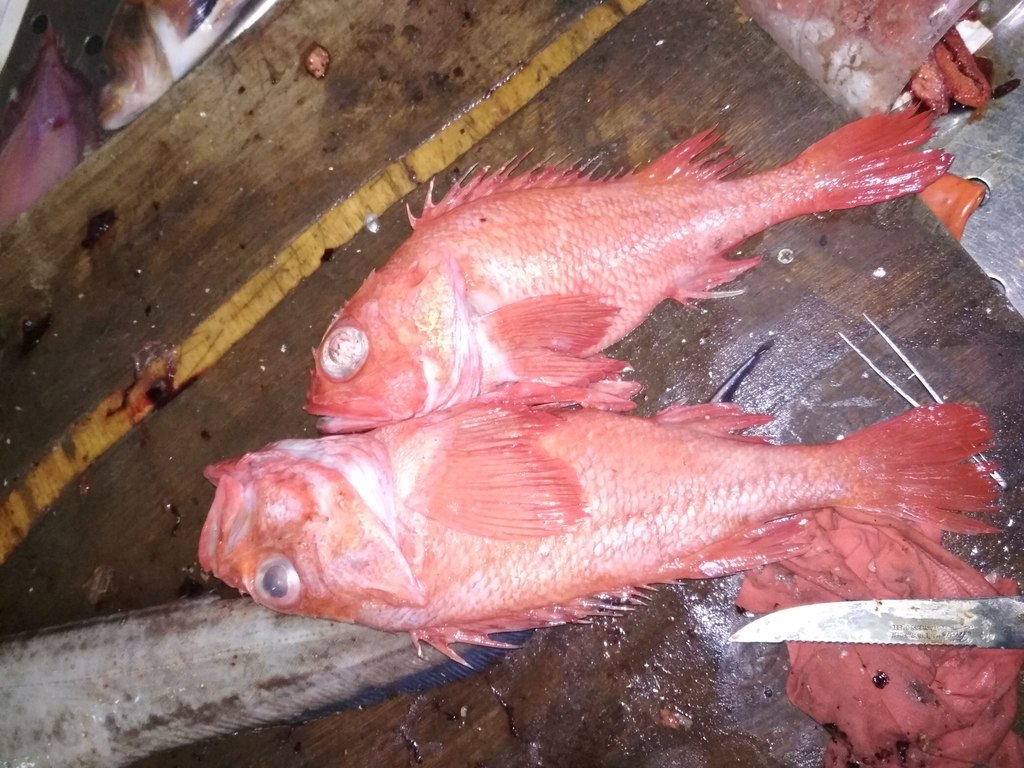
A deep-water bottom scorpaenid called kichiji in standard Japanese and kinki in the market. It lives on muddy slope from 100 to 1500 m, feeds mainly on brittle stars, and spawns around Hokkaido from February to May. Its fat is mixed into white flesh, and it is among the most expensive of the red fish.
A thornyhead whose spines deserve respect
The body is elongate with a relatively large head, red to orange-red in colour. The dorsal spines are well developed, slender and sharp, and the Japanese source warns that a jab hurts for a long time.
Against Sebastes matsubarai it is smaller and more pointed at the snout, with a different arrangement of pectoral and head spines; against other species of the genus it is separated by dorsal spine count and body markings.
The FishBase page checked carries no length field. The Japanese stock assessment and the market guide both treat it as a small to medium deep-water fish, with ordinary catches of a few hundred grams. No calculated length is used here.
Pacific slope, almost absent from the Sea of Japan
FishBase records the North Pacific from Sagami Bay in Japan to the southern Kuril Islands and off Sakhalin. The Japanese record is the Okhotsk coast of Hokkaido, the Pacific coast from Hokkaido to Cape Daiozaki in Mie, scarce south of Chiba, and scarce in the Sea of Japan at Niigata and Shimane Oki, plus Wonsan in Korea, scarce Peter the Great Bay, the Sea of Okhotsk, southeastern Sakhalin, the Kurils, southeastern Kamchatka to the Bering Sea, and the Aleutians in small numbers.
Depth is given as 257 to 1537 m by FishBase and 100 to 1504 m by the Japanese guide. The diet is benthic, with brittle stars dominant in stomach contents and amphipods and other small crustaceans behind them. Fish mud slope, not rock.
February to May, and a season that barely moves
Around Hokkaido the spawning period is February to May. The Japanese guide puts the season in autumn and winter but also says the fish eats well all year, which signals that fat content varies less than in shallow-water species. Winter into early spring remains a stable window.
The fish is almost absent from the Sea of Japan, and the guide says so explicitly. That is consistent with a distribution weighted to the Pacific side, the Okhotsk and the Kuril-Kamchatka line. A trip plan should favour the Pacific side and eastern Hokkaido rather than the Japan Sea coast.
Brittle stars on the bottom
This is deep bottom fishing, and the rig has to sit on the bottom. Baits are squid strips, mackerel chunks and sardines on a bottom rig or tenbin. The fish is not fussy about the state of the bait, but the mouth is large and it takes deep, so the hook size has to be adequate.
Because the main prey are brittle stars and benthic crustaceans, smell matters more than swimming action. Letting the bait rest on the bottom in a slow current works better than lifting and dropping it. The ascent from deep water is slow, and a landed fish should be given time to decompress.
Handling is the risk
A boat rod rated 150 to 250, a manual or electric reel, PE main line of 5 to 8, leader 8 to 12, and Maruseigo hooks in 16 to 20. Sinkers run from 200 to 500 according to depth and current.
Handling demands thick gloves or pliers on the dorsal and opercular spines. A spine wound is not merely painful; it can swell and ache for a long time. Cutting the line and leaving the hook in the fish is safer than reaching into the mouth with bare hands.
High price, shrinking catch
The flesh is white with almost no visible dark muscle, and fat runs as white streaks under the skin and between the fibres, congealing at low temperature. The liver is large and fatty, and whether it is included changes the rating of a simmered dish. It suits sashimi, simmering, salt-grilling and hotpot, and Hokkaido groups it with menuke and Alaska menuke among the akamono, the red fish.
The Japanese guide notes that landings have fallen sharply in recent years and prices have risen, with Kanto sometimes above ten thousand yen per kilogram. That is a market observation, not a stock assessment conclusion.
Japan has no nationwide recreational size or closed season. No species-level restriction was found, but Hokkaido, Miyagi and Ibaraki rules were not checked line by line. That item is deferred.
On the Russian side, table 4 of the Far East basin rules, as checked, does not list a size for this species. The current text and permit conditions govern, and that item is deferred.
A missing length and an unlisted rule
Classification, distribution and the 257 to 1537 m depth come from FishBase. The 100 to 1504 m figure, spawning period, diet, market position and eating assessment come from the market guide. Spine risk and fishing background come from the angling encyclopedia. The standard Japanese name and distribution are confirmed by the stock assessment digest.
FishBase provides no length, so the text carries no derived figure. The Russian rule is stated only in the conservative form that no size is listed for this species, which is what the checked table supports and no more.
How to catch it
Boat bottom fishing
Fished with the listed approach, matched to the recorded depth and size.
Where these facts come from
Check these pages before you rely on a size, range or protection status.
- FishBase — Sebastolobus macrochir — FishBase · T2
- GBIF — Sebastolobus macrochir occurrence records — GBIF · T2
- IUCN Red List — Sebastolobus macrochir — IUCN · T1
- Photo record — iNaturalist — iNaturalist · T3
Fish in the same water
These fish live in the same place.

Guides for this water
Technique, gear and safety guides that fit Broadbanded thornyhead.