
Painted comber
The painted comber is the small grouper stand-in that shore anglers meet on almost any rocky coast, but its markings look drawn on rather than grown. It is a simultaneous hermaphrodite, spawns from early spring into early summer, grows slowly and lives up to sixteen years. Treating it as a keepable grouper is the one mistake this species punishes.
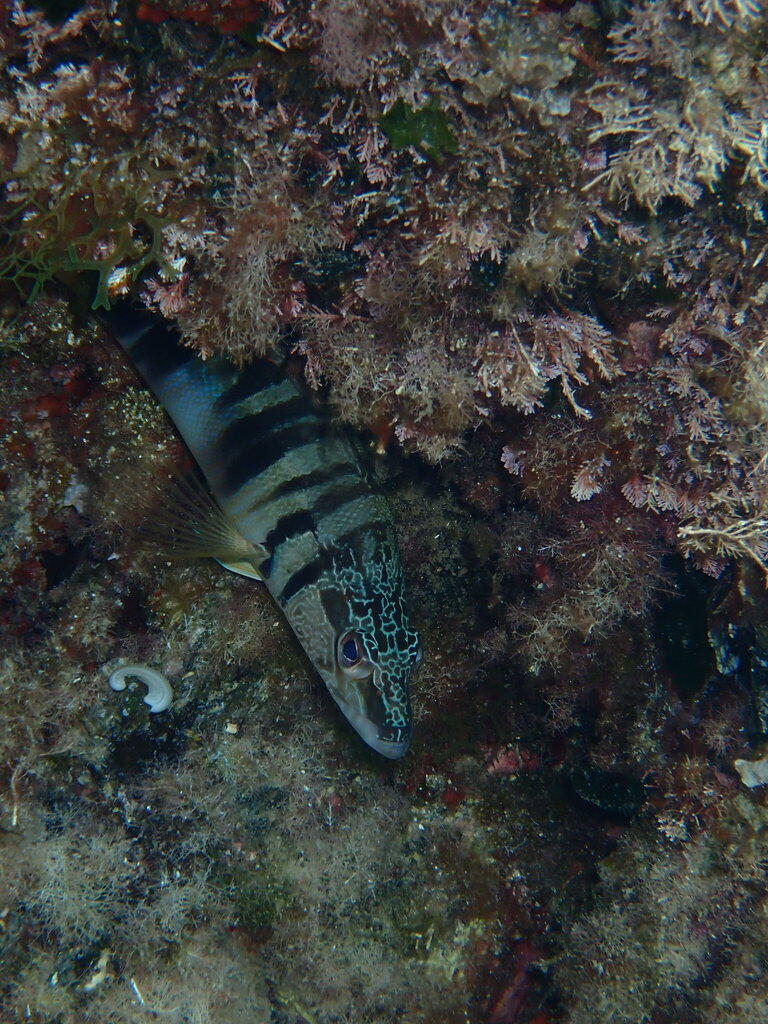
The painted comber is the small grouper stand-in that shore anglers meet on almost any rocky coast, but its markings look drawn on rather than grown. It is a simultaneous hermaphrodite, spawns from early spring into early summer, grows slowly and lives up to sixteen years. Treating it as a keepable grouper is the one mistake this species punishes.
Five to seven bars and a head covered in blue script
Look for five to seven dark vertical bars along the flank, dense blue worm-like lines across the head, a large protractile mouth with fine sharp teeth, and a caudal fin with a nearly straight rear edge. The base colour can be grey, purple or red-brown, and the bars darken when the fish is stressed or out of water. The split from S. cabrilla is in the head and the body: the painted comber is deeper-bodied with denser, finer blue head markings, while the comber carries sparser head lines, larger irregular flank blotches and a more slender frame. They share the same reef, and colour converges under poor light, so compare head pattern density and body depth first, tail shape second, and photograph the flank if doubt remains.
A Mediterranean resident that follows food, not just rock
FishBase places the species in the Mediterranean and Black Sea, so it is a local fish rather than an immigrant. The recorded depth is 5 to 150 m, usually inside 30 m, which covers the rock, rubble and Posidonia that shore and inshore boat anglers can reach. It patrols rocky ground but also enters muddy and algae-covered soft bottom, which says it follows prey rather than depending strictly on hard structure. Shore fishing works the reef edge and the seam between seagrass and rock; boat fishing finds fish on the upper slope, with the larger individuals usually deeper and closer to complex structure.
Spawning starts in early spring and ends in early summer
FishBase records spawning from early spring to early summer and describes the species as a simultaneous hermaphrodite, meaning one fish carries both ovarian and testicular tissue at the same time. No monthly peak or spawning temperature is given, so work with that broad window rather than a date. Mediterranean catches improve as water warms in spring, hold through summer and remain possible in autumn, while winter fish drop to deeper structure and bite less. A recorded lifespan of sixteen years is long for a fish this size, which means removing the large individuals takes a while to replace.
Fast bait near the shadow line, not a long cast
This is an ambush predator that eats fish and crustaceans, so the bait should move and look like a damaged baitfish. From shore, a float rig with a live shrimp or small fish swims slowly along the reef edge, and the strike usually comes out of the shadow. Inshore from a boat, a small soft plastic or a 20 to 40 g micro jig crawled along the rock, with a pause, takes fish on the stop. The third option is bottom fishing at the sand-rock seam with shrimp or squid strip for patrolling fish. None of these needs distance: the fish stays tight to structure, so accuracy beats range, and a bait parked at the edge of the shadow outperforms one in open water.
Light tackle that still turns a fish out of the rocks
From shore, a 2.4 to 2.7 m medium spinning rod with a 2500 to 3000 reel, 15 to 20 lb braid, a 20 lb fluorocarbon leader and a size 2 to 1/0 wide-gap hook covers it. The mouth is large, so the hook need not be tiny, but a fine, tough wire makes release quick. Boat anglers can add weight, using 30 to 60 g to hold the bait on the slope. A hooked fish dives for the crevice immediately, so keep the drag off lock-up and leave an arm's length of leader to resist abrasion. Unhook without lifting the fish clear of the water; because every individual is a potential spawner, the large ones are the ones most worth putting back.
No EU size, no national size, and a slow-growing spawner
Flesh: no dedicated eating-quality assessment was found for this species. It is a serranid with white flesh and a modest size; gut and ice it, and fish over 30 cm carry more meat, though those are also the breeding fish most worth releasing. Rules by jurisdiction. EU: Serranus scriba is not listed in Annex IX Part A of Regulation (EU) 2019/1241, so there is no EU minimum conservation reference size. Article 2(2) applies only Articles 7, 10, 11 and 12 to recreational fishing, so Annex IX sizes do not bind anglers unless a member state extends them. Article 17 of Regulation (EC) 1967/2006 bans sale of recreational catch. Spain (ES): shore and boat fishing both require an autonomous-community licence under RD 347/2011; the Mediterranean table in RD 560/1995 Annex II does not list the species, and communities may be stricter. France (FR): no sea-fishing permit, but RecFishing registration is required from age 16; the Mediterranean section of the 26 October 2012 arrêté does not list it, and sale of catch is banned. Italy (IT): no paid licence, but an annual MASAF declaration is required, with electronic catch registration from 2026. Greece (GR): licence abolished by Law 4256/2014, 5 kg per person per day, 10 kg with longlines, and spearfishing banned nationwide in May. Croatia (HR): a licence is required from shore and boat, 5 kg per person per day plus one fish over 5 kg, and the national table does not list the species. Turkey (TR): foreign visitors may shore-fish without a document; boat fishing needs a tourism permit or avlanma fişi, and the 2024/21 size table was not retrieved, so no Turkish size is stated. A missing species size is not permission: gear limits, protected areas and the sale ban still apply. Check the current year's official notices before you go.
Evidence limits and one unresolved identification risk
Length, depth, distribution, diet, lifespan, spawning window and IUCN status (LC, assessed 2013) come from FishBase. Regulation text comes from the EU regulation and national official sources retrieved in November 2026. The field separation from S. cabrilla rests on body depth and head pattern, which are observational rather than measured, so photo review is listed as pending. Monthly catch strength has no published dataset; the seasonal ranking follows regional angling reports.
How to catch it
Shore casting
Fished with the listed approach, matched to the recorded depth and size.
Jigging
Fished with the listed approach, matched to the recorded depth and size.
Where these facts come from
Check these pages before you rely on a size, range or protection status.
- FishBase — Serranus scriba — FishBase · T2
- GBIF — Serranus scriba occurrence records — GBIF · T2
- IUCN Red List — Serranus scriba — IUCN · T1
- Photo record — iNaturalist — iNaturalist · T3
Fish in the same water
These fish live in the same place.

Guides for this water
Technique, gear and safety guides that fit Painted comber.