
White-spotted spinefoot
Most inshore species are described by a bottom type or a depth. This one is described by a gradient. Siganus canaliculatus is recorded as oceanodromous, moving between brackish and fully marine water, and its habitat list runs from estuaries and large lagoons to inshore algae reefs.
Most inshore species are described by a bottom type or a depth. This one is described by a gradient. Siganus canaliculatus is recorded as oceanodromous, moving between brackish and fully marine water, and its habitat list runs from estuaries and large lagoons to inshore algae reefs. That is why two anglers fishing the same bay on the same day can disagree about whether the fish is present: one is standing at the river mouth end of the gradient, the other at the reef end. The practical question is never whether the species is here, but which segment of the salinity line is holding fish this week. A mark that produced in March can be empty in November without anything having changed except the flow. The gradient also explains why local knowledge here is so uneven: a guide who works one river mouth knows that estuary intimately and may know nothing about the reef three kilometres away, and the two of you can be describing the same species in good faith.
Twenty spines and a warning label
The fin formula is thirteen dorsal spines and ten soft rays, seven anal spines and nine soft rays, with twenty-three vertebrae. The anal spine count is the one that surprises people: seven stout spines on the lower edge, all of them grooved and venomous. FishBase files the species under Venomous, and that label refers to the spines, not to the flesh. A landed fish raises them the moment it is handled, and the palm of a hand fits neatly over the dorsal row. Pliers, not fingers, and never a towel wrapped around the body. The spines are grooved glands, so a puncture delivers venom rather than a clean cut, and the pain arrives out of proportion to the size of the wound. Hot-water immersion (about 45 °C) and a medical review should follow any deep puncture.
A hundred to two hundred spots, and six bars that appear when it is frightened
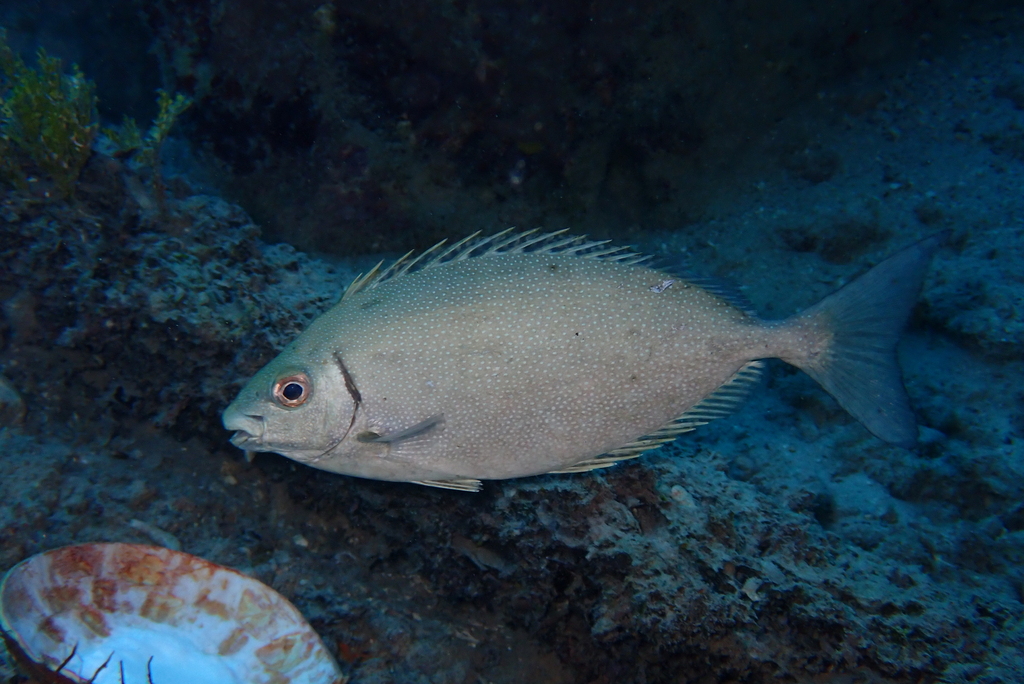
Colour is variable enough that photographs of the same species look like different fish. The base ranges from greenish grey to yellow brown, covered with a hundred to two hundred pearly blue or whitish spots, match-head sized on the lower flank. When the fish is frightened or injured, the flank breaks into six or seven regularly spaced dark diagonal zones with paler bands between them. There is usually a dark eye-sized spot just behind the upper end of the gill opening. The stress pattern is useful: a fish that has been in a bucket for ten minutes may show it and nothing else. Count spots on the lower flank rather than the back, and check the dark spot behind the gill opening before deciding what you have.
Reading the gradient: river mouth, seagrass, reef
Start with water colour. Greenish, turbid water with a metre or two of visibility usually means the estuarine segment; clear water over coral means the reef segment. In the wet season, freshwater pushes out and the fish move seaward with the salt wedge; in the dry season the seawater pushes in and they follow it back up. Fish the edges rather than the middle: the seam where the grass bed meets sand, the outer edge of an algae-covered rock, the mouth of a lagoon where the tide drains. Baits are algae clumps, dough, or shrimp meat, on a small hook, because the mouth is small and the teeth are fine and built for scraping. Fish the tide rather than the clock: the salt wedge moves on the tide, and the seam you want is wherever fresh and salt water are meeting that hour.
Two metres of rod, one pair of pliers
A common length of 20 cm and a maximum of 40 cm does not call for heavy tackle. A 2.4 to 3 m light rod, a small reel, 1.5 to 2 lb main line and a finer leader will do, with a narrow-gauge hook. The fish fights sideways and tries to reach cover, so keep the rod low and turn it away from the grass. Landing is the dangerous part. Hold the leader, not the fish, and put the pliers on the hook shank. If a spine goes in, soak the wound in water as hot as you can tolerate for twenty to thirty minutes, then get medical attention; numbness, swelling or a red streak is a reason to go now rather than later. Do not pack it in ice, and do not try to suck the wound.
Farmed, fished, lightly watched
The species supports commercial fishing and commercial aquaculture, and it matures at 11.6 cm, which is unusually early. Resilience is medium with a generation time measured in a couple of years, and fishing vulnerability is 31 out of 100. The Red List category is Least Concern, assessed on 10 March 2015. None of that makes the local rules irrelevant. Seven countries in this page's brief manage the same fish under different frameworks, from national park closures in Thailand to marine park core zones in Malaysia and zoning in Indonesian protected areas. The gradient crosses all of them. Because the animal moves with the salt, the closure you are standing in is a better guide than the label on the fish.
How to catch it
Shore casting
Fished with the listed approach, matched to the recorded depth and size.
Float fishing
Fished with the listed approach, matched to the recorded depth and size.
Where these facts come from
Check these pages before you rely on a size, range or protection status.
- FishBase — Siganus canaliculatus — FishBase · T2
- GBIF — Siganus canaliculatus occurrence records — GBIF · T2
- IUCN Red List — Siganus canaliculatus — IUCN · T1
- Photo record — iNaturalist — iNaturalist · T3
Fish in the same water
These fish live in the same place.

Guides for this water
Technique, gear and safety guides that fit White-spotted spinefoot.