
Dusky spinefoot
The dusky spinefoot is one of the Suez Canal's most firmly established arrivals: it grazes Mediterranean algal film down to bare rock and has become one of the easiest shore-caught fish in the eastern basin. Handling it is not, because every dorsal spine is venomous and no jurisdiction sets a minimum size for it.
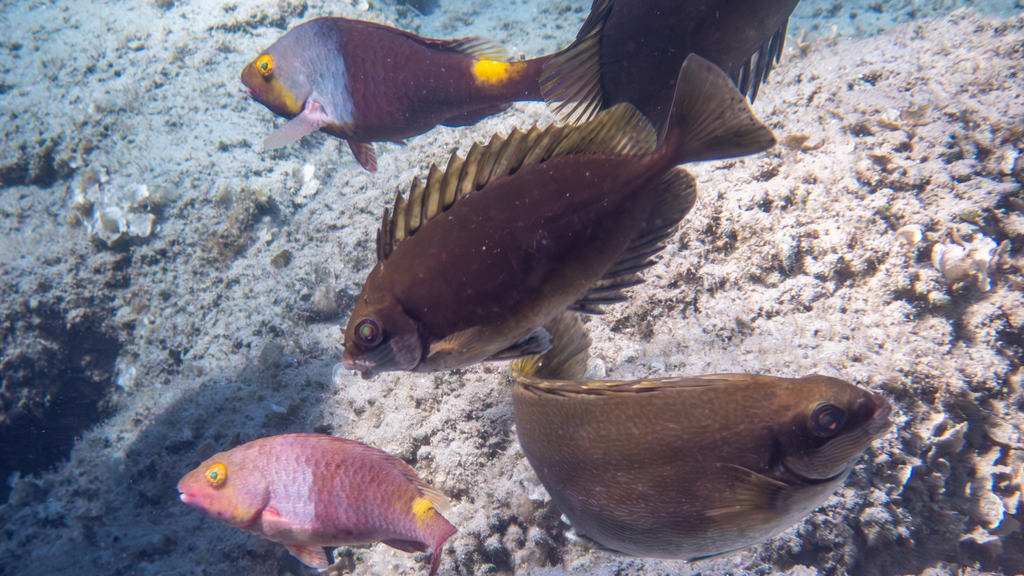
The dusky spinefoot is one of the Suez Canal's most firmly established arrivals: it grazes Mediterranean algal film down to bare rock and has become one of the easiest shore-caught fish in the eastern basin. Catching it is simple. Handling it is not, because every dorsal spine is venomous and no jurisdiction sets a minimum size for it.
A square tail and a back full of venom
Look at the tail first, not the colour. The dusky spinefoot has a caudal fin that ends almost square, as if cut with a knife, and the lobes barely extend. There is no golden band along the flank; the body runs dark olive to grey-brown with a paler belly, and a frightened fish goes mottled. The marbled spinefoot on the same rock is paler, carries a golden sheen and a netted pattern that reaches into the fins, and its tail is slightly concave. Both fish carry 13 dorsal spines and 7 anal spines in a similar arrangement, and every one of them is venomous, including the forward-pointing spine on the nape. The usual accident is a flat hand across the back.
From the Red Sea to the Aegean, island by island
FishBase puts the native range in the western Indian Ocean, from the Persian Gulf and the Red Sea to East Africa and the islands beyond, and labels the Mediterranean population as an immigrant through the Suez Canal. After the canal opened, the fish established itself off the Levant, then worked west along southern Turkey, Cyprus and the Greek islands; records from the central and western basin keep accumulating. That is the Lessepsian pattern in its clearest form: first the eastern Mediterranean, then a slow spread west, island by island. It stays shallow, from 2 to 40 m, over hard ground of compacted sand with rock or coral debris. Juveniles school close to the bottom and adults are often alone or in groups of three or four. The working edges for an angler are the rubble inside a breakwater, the algal film on a rock platform and the concrete of a harbour wall, not open sand.
Warm water moves the fish, not the calendar
FishBase calls the species thermophilic and gives no month-by-month spawning table, so the Mediterranean spawning window stays open. What can be used is temperature. As the water warms in spring, fish move from slightly deeper ground onto the algal film at one to a few metres and feed in groups, which is when shore fishing produces best. In autumn they pull back to the outer structure and deeper rock, and bites thin out without stopping. In winter the shallow ground goes quiet and the fish left behind are scattered. No long-distance migration is recorded for the species, so catch strength follows local water temperature and algal growth more than any fixed month.
Fishing the algal film, not the water column
The fish eats attached algae, so the bait has to travel along the algal surface instead of hanging in midwater. From shore, a small float or a running lead puts the hookbait on the edge of a rock platform or a rubble strip, touching down and moving with the swell, and a fish grazing the film takes what it sweeps up. From a boat, work the hard bottom with a light lead and a single hook, dragging slowly and pausing at every rise in the rock, because the take usually comes after the pause. Lures are not the main tool, but when fish are packed tight a small soft plastic or a light jig hopped along the weed can trigger a feeding response. All three approaches share one rule: stay in the layer where the fish has its head down.
Light tackle, long pliers, thick gloves
A 2.7 to 3.3 m medium-action spinning rod with a 2500 or 3000 reel, 0.8 to 1.0 braid, an 8 to 12 lb fluorocarbon leader and a size 6 to 8 fine-wire single covers the fishing. The mouth is small, so a wider gap hooks more fish and the wire does not need to be heavy. The kit that matters is the unhooking kit: long-nosed pliers, a thick glove and a wet towel, approaching the fish from the head and staying off the dorsal line. A hand laid flat across the back is how people get spiked. Keep the leader past an arm's length over rock so the braid never touches the edge. If the fish is going back, cutting the hook off is often safer than wrestling it at the gunwale.
No size rule anywhere, a sale ban everywhere
The flesh is white and firm, good steamed or pan-fried, though it is bony; bleed and ice it early and remove the gills and viscera. FishBase lists it as a food fish that is occasionally poisonous, without data on Mediterranean populations, so large fish and organs are best left alone. EU: Annex IX Part A of Regulation (EU) 2019/1241 sets no minimum size for Siganus, and Article 2(2) extends only Articles 7, 10, 11 and 12 to recreational fishing, so those sizes do not bind anglers automatically; Article 17 of Regulation (EC) 1967/2006 bans the sale of recreational catch. Spain requires an autonomous-community licence from shore and from a boat (RD 347/2011) and lists no size in the Mediterranean annex of RD 560/1995. France needs no licence but requires RecFishing registration from age 16, and the 2012 Mediterranean order has no entry. Italy requires the annual MASAF declaration, with electronic catch registration from 2026. Greece has no licence, a 5 kg daily limit and a May spearfishing ban. Croatia requires a licence and a 5 kg bag. Check the current year's notices before you go.
What FishBase covers and what it leaves open
Distribution, the 2 to 40 m band, the 30 cm maximum, the 13 to 14 dorsal spines, the algal diet and the IUCN Least Concern assessment of 2017 come from FishBase. The spread west is written from the standard Lessepsian narrative rather than one cited survey. The regulations section states only what was retrieved; no Turkish or Cypriot size table was available, so none is quoted. Spawning months and local abundance trends are missing.
How to catch it
Shore casting
Fished with the listed approach, matched to the recorded depth and size.
Bottom fishing
Fished with the listed approach, matched to the recorded depth and size.
Lure fishing
Fished with the listed approach, matched to the recorded depth and size.
Where these facts come from
Check these pages before you rely on a size, range or protection status.
- FishBase — Siganus luridus — FishBase · T2
- GBIF — Siganus luridus occurrence records — GBIF · T2
- IUCN Red List — Siganus luridus — IUCN · T1
- Photo record — iNaturalist — iNaturalist · T3
Fish in the same water
These fish live in the same place.

Guides for this water
Technique, gear and safety guides that fit Dusky spinefoot.