
Barhead spinefoot
A reef flat at low tide is a confusing place: dozens of small fish, most of them moving in and out of coral branches. The barhead spinefoot gives you a shortcut. Larger juveniles and adults occur in pairs, not in loose aggregations, on coastal reef flats, slopes and estuaries. Two fish of the same size, side by side, stopping together to graze and then moving on together, is a pattern you can pick out at twenty metres.
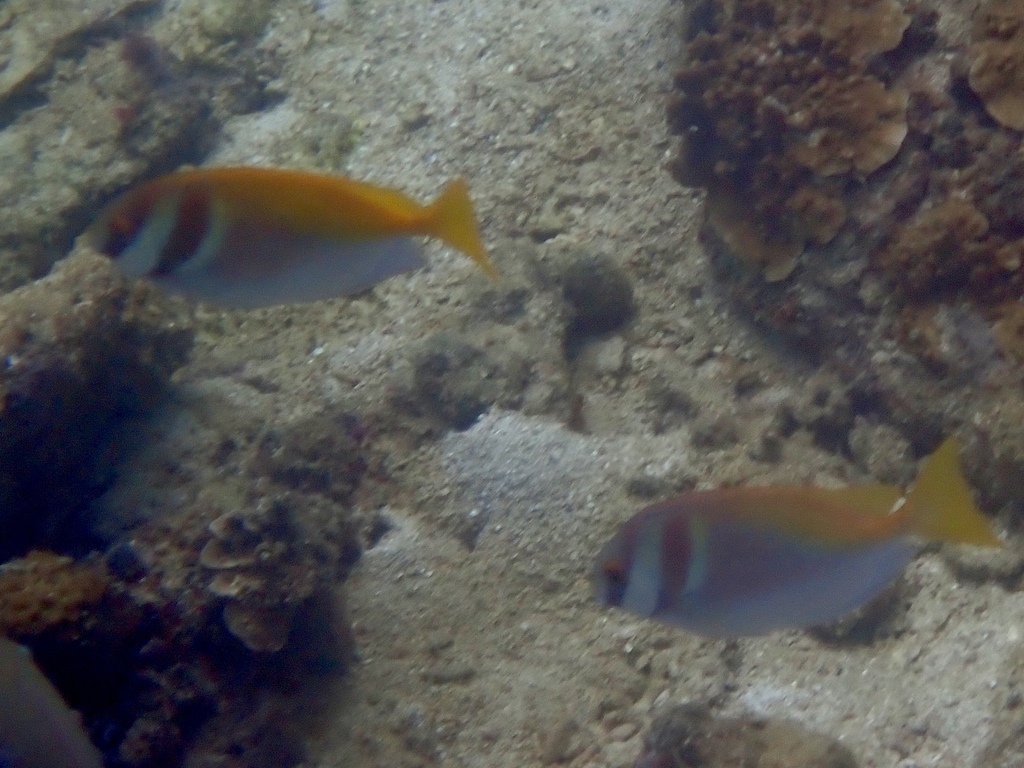
A reef flat at low tide is a confusing place: dozens of small fish, most of them moving in and out of coral branches. The barhead spinefoot gives you a shortcut. Larger juveniles and adults occur in pairs, not in loose aggregations, on coastal reef flats, slopes and estuaries. Two fish of the same size, side by side, stopping together to graze and then moving on together, is a pattern you can pick out at twenty metres. It also tells you what happens after a capture: the pair is a social unit, and taking one leaves the other circling the same patch. That is worth thinking about before you keep a fish that weighs less than a bag of rice. That is a small thing to notice and a large thing to use, because most of the flat looks alike until you start sorting it by behaviour rather than by species. Two fish moving as one are easier to read than twenty moving independently.
Two bands, blue spots, one short tube
The head carries two brown diagonal bands, one from the nape to the chin, the other from the base of the fourth or fifth dorsal spine to the base of the pectoral fin. Both bands are speckled with blue, and there is a zone of silvery yellow immediately behind the shoulder band. The preopercular angle runs from 100 to 111 degrees, cheek scalation varies from a few scales to almost fully scaled, and the anterior nostril is ringed by a prominent rim or short tube with a small peak at the back. Thirteen dorsal spines and ten soft rays, seven anal spines and nine soft rays, and stout, pungent, venomous spines on both fins. The band behind the eye is the one that varies most with mood, so check the lower band first, the one running from nape to chin.
Dirty water is not a closed day
Most shallow reef fishing advice assumes clear water. This species tolerates murky conditions, and the adults work reef flats and slopes where sand, rock and soft coral are mixed. After rain, when the flat turns the colour of weak tea, the fish are still there and are often easier to approach because the visibility that would normally spook them has gone. The same turbidity makes the angler's job harder in one respect only: you cannot sight-fish. Switch to a float or a slow sink and work the edges by feel. The fish are still paired, still grazing, but now you find them by the tap on the rod rather than by the eye.
Casting to a fish you can already see
When the water is clear, do not cast at the fish. Cast beyond it and bring the bait back into its path, because a splash on the flat clears the area for several minutes. The bait should land in a gap between coral heads, not on the branches. Algae clumps, shrimp meat or a small strip of sandworm all work; the fish grazes in short, nodding movements, and the rod tip shows two or three quick taps before the line tightens. Strike on the second or third tap rather than the first, which is often the fish testing the bait against the rock. If you miss, leave the bait where it is for a count of ten; the pair usually comes back to the same square metre.
Light line and a firm grip
Twenty centimetres is the common length and thirty the maximum, so the tackle can be genuinely light. A 2.4 to 2.7 m rod, 1.5 lb main line, a finer leader and a small, thin-wire hook are enough. Fine line has a second purpose on a shallow flat: heavy line throws a shadow the fish can see in bright sun. Landing is where the risk sits. The fish raises thirteen dorsal spines and seven anal spines as soon as it is handled, and both sets are venomous. A fish this small still has enough venom in it to ruin an afternoon, which is the part that surprises people who judge danger by size. Pliers on the hook, a hand on the leader, and hot-water immersion followed by medical care if a spine goes in. On a shallow flat there is no safe way to kneel on the fish, so do the unhooking standing up. Hot-water immersion (about 45 °C) and a medical review should follow any deep puncture.
Fast growth, small landings
The species is a minor commercial catch and also enters the aquarium trade. It grows fast, with a minimum population doubling time under fifteen months and a fishing vulnerability of 22 out of 100, the lowest figure in this group. The Red List category is Least Concern, assessed on 18 July 2017. Small juveniles live in mangroves and can enter freshwater before moving back to coral, which means the habitat that produces next year's reef flat fish is not the reef flat. In Malaysia, Indonesia and the Philippines that nursery habitat is managed under separate rules from the reef itself. The species is not the problem; the coastal construction that fills a mangrove is.
How to catch it
Shore casting
Fished with the listed approach, matched to the recorded depth and size.
Float fishing
Fished with the listed approach, matched to the recorded depth and size.
Where these facts come from
Check these pages before you rely on a size, range or protection status.
- FishBase — Siganus virgatus — FishBase · T2
- GBIF — Siganus virgatus occurrence records — GBIF · T2
- IUCN Red List — Siganus virgatus — IUCN · T1
- Photo record — iNaturalist — iNaturalist · T3
Fish in the same water
These fish live in the same place.

Guides for this water
Technique, gear and safety guides that fit Barhead spinefoot.