
Orange-spotted spinefoot
Orange-spotted spinefoot is an eastern Indian Ocean and western Pacific rabbitfish, from the Andaman Islands, Thailand, Malaysia, Singapore, Indonesia (including Irian Jaya), Vietnam, the Ryukyus, southern and eastern China, Taiwan region, the South China Sea and the Philippines to Palau.
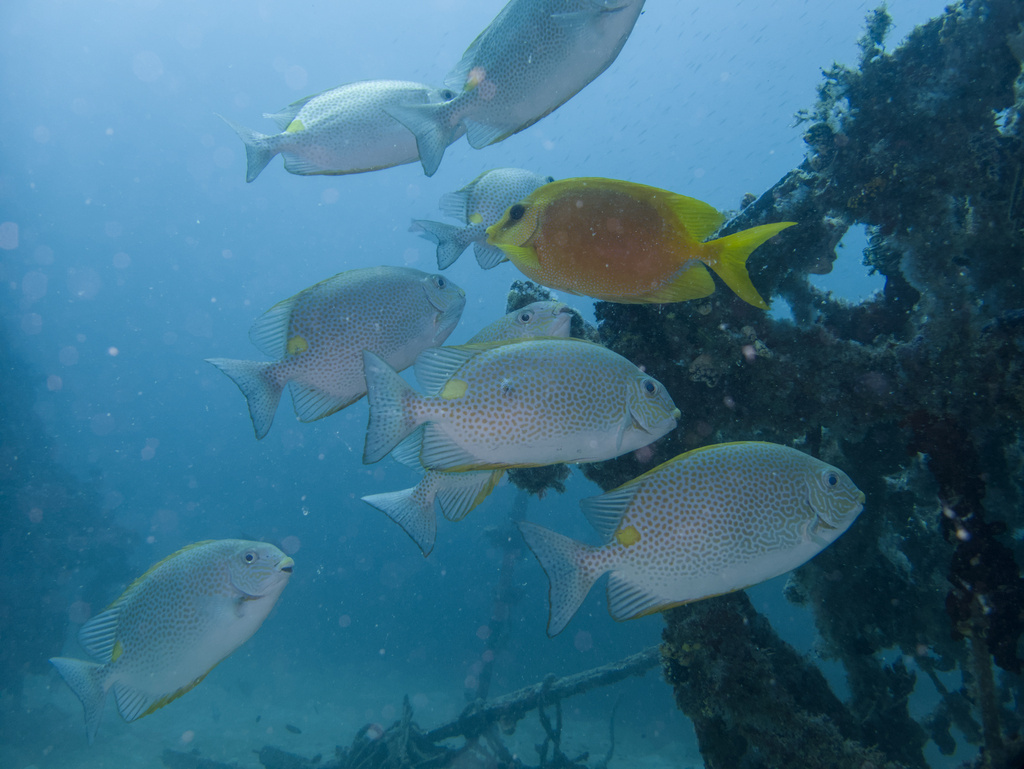
Orange-spotted spinefoot is an eastern Indian Ocean and western Pacific rabbitfish, from the Andaman Islands, Thailand, Malaysia, Singapore, Indonesia (including Irian Jaya), Vietnam, the Ryukyus, southern and eastern China, Taiwan region, the South China Sea and the Philippines to Palau. It lives at 0–25 m in 24–28°C turbid inshore reefs, often among mangroves, tolerates low salinity; fry settle in seagrass around river mouths, adults enter and leave rivers with the tide, and the species also occurs on inshore fringing reef drop-offs to 6 m. FishBase gives a maximum of 42 cm total length, a common length of 25 cm and maturity at about 18.1 cm. IUCN lists it as Least Concern, assessed in 2015.
Reading the spines
The dorsal fin has 13 spines and 10 soft rays; the anal fin has 7 spines and 9 soft rays; there are 13 vertebrae. The back is dusky blue and the belly silvery; a bright yellow spot sits beside the last few dorsal soft rays; the head has lines and spots. The preopercular angle is 91°–102°; strong scales fully cover the cheeks; the thorax midline is scaled but the pelvic ridges are not; the anterior nostril has an extremely low rim and is slightly expanded posteriorly; the spines are stout, pungent and venomous. The yellow spot behind the dorsal fin, 13 dorsal spines and fully scaled cheeks are the reliable checks. All rabbitfish spines are venomous, so handle with care.
A mangrove and river-mouth rabbitfish
FishBase's range is the eastern Indian Ocean and western Pacific: the Andaman Islands, Thailand, Malaysia, Singapore, Indonesia, Vietnam, the Ryukyus, southern and eastern China, Taiwan region, the South China Sea, the Philippines and Palau; it is replaced by Siganus lineatus to the west, south and east. The country table includes the Andaman and Nicobar Islands, Australia, Cambodia, China, Hong Kong SAR, India, Indonesia, Japan, Malaysia, Micronesia, Palau, the Philippines, the Ryukyu Islands, Singapore, Taiwan region, Thailand, Timor-Leste and Vietnam. GBIF's 1,910 records are led by the Philippines (379), Japan (351), Thailand (273), Indonesia (207), Malaysia (160), Vietnam (93), Taiwan region (87), mainland China (74) and Singapore (71). It inhabits turbid inshore reefs among mangroves and tolerates low salinity; fry settle in seagrass around river mouths, adults enter and leave rivers with the tide and also occur on fringing reef drop-offs to 6 m; it schools throughout life, with adult schools of about 10–15; it feeds on benthic algae and, unlike other siganids, is reported to be active at night. Because it tolerates and even prefers low salinity, heavy rain does not push it offshore the way it pushes stricter reef fish, so river-mouth marks can stay fishable when the reef goes quiet.
The blanks are information
FishBase publishes no spawning months. It lives at 24–28°C and is catchable all year; in Taiwan region, Hong Kong SAR and Southeast Asia, late spring to autumn is the main window, with winter fish deeper or inside estuaries. No finer local season table is published, so follow local reef and estuary temperature. It is nocturnal, so night fishing beats daytime; tide and slack water concentrate food along mangrove edges and the inner estuary. Find the school rather than guarding one spot.
Where to start looking
The GBIF pattern is the Philippines, Japan, Thailand and Indonesia first. Fish the mangrove edge, the river-mouth seagrass and the shallow reef, not the open sand. The source gives no coordinates; local knowledge of creeks and reef structure is the real map.
Tackle and baits
Light rock fishing and shore casting are the standards: small hooks, fine leaders, and seaweed, prawn, sandworm or bread. Because the fish eats benthic algae, algae-based bait often beats pure prawn around mangroves and reef. Small soft plastics, algae imitations and micro-minnows can be slow-rolled. Night fishing with scented bait is effective. The spines are venomous: unhook with long-nose pliers, never grab the fish, and keep it on a hard surface away from bare feet.
Eating, handling and the rules
Orange-spotted spinefoot supports commercial fisheries, commercial aquaculture and the aquarium trade and is sold fresh. The flesh is fine, good steamed, braised or in soup. Bleed, gut and ice it promptly; cut the dorsal, anal and pelvic spines or wear thick gloves. Ciguatera is mainly a reef-predator issue, and this alga-feeding rabbitfish is lower risk, but organs should not be eaten in quantity. Rules vary: Taiwan region manages inshore fishing and reef species through closed areas, seasons and protected zones, and recreational fishing must follow Fisheries Agency and local government notices; Hong Kong SAR's Fisheries Protection Ordinance regulates methods, with no angling or collecting in marine parks and reserves; Southeast Asian states differ widely, with Malaysia, Indonesia, the Philippines and Thailand issuing size and closed-season rules and usually prohibiting take in marine protected areas and mangrove reserves. Check the current local notice.
What the record leaves open
The page is built from FishBase taxonomy, morphology, distribution, environment, biology, use, IUCN and venom entries, with the country table for range and GBIF/iNaturalist for occurrence. Spawning months, water temperature and local size limits are not standardised, so the text stays conservative. and are local aliases; the formal name remains .
How to catch it
Bottom fishing
Fished with the listed approach, matched to the recorded depth and size.
Lure fishing
Fished with the listed approach, matched to the recorded depth and size.
Where these facts come from
Check these pages before you rely on a size, range or protection status.
- FishBase — Siganus guttatus — FishBase · T2
- GBIF — Siganus guttatus occurrence records — GBIF · T2
- IUCN Red List — Siganus guttatus — IUCN · T1
- Photo record — iNaturalist — iNaturalist · T3
Fish in the same water
These fish live in the same place.

Guides for this water
Technique, gear and safety guides that fit Orange-spotted spinefoot.