
Streaked spinefoot
Most reef fish are described by what they sit on. This one is described by where it floats. When it is not feeding, Siganus javus rests in midwater at two to six metres, in small schools of up to about ten individuals. The reef is still the reason it is there, and the algae on the reef is what it came to eat, but between meals the fish is not on the bottom at all.
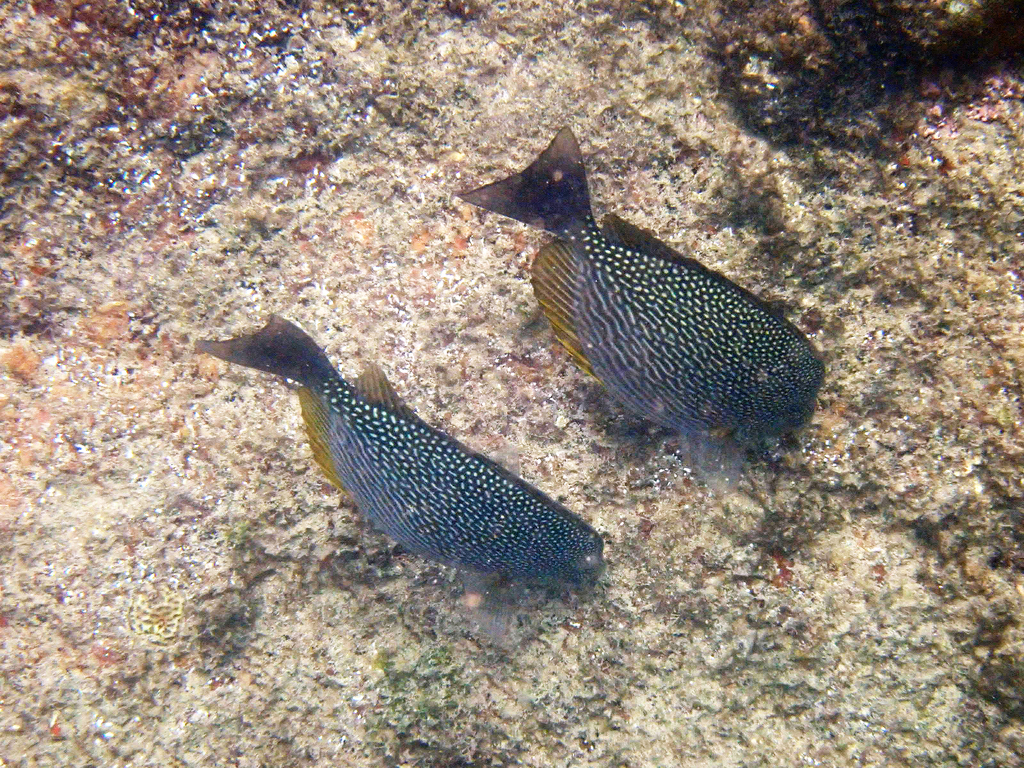
Most reef fish are described by what they sit on. This one is described by where it floats. When it is not feeding, Siganus javus rests in midwater at two to six metres, in small schools of up to about ten individuals. The reef is still the reason it is there, and the algae on the reef is what it came to eat, but between meals the fish is not on the bottom at all. That single behaviour reorganises the whole approach: a bait that reaches the reef surface has passed underneath the fish you are trying to catch. Find the school with your eyes first, then decide how to present a bait in its layer. It is also why a sounder shows a mark that a bottom rig cannot reach, and why the same mark disappears at dusk when the school drops down to feed on the reef. Read the screen for the layer, not for the bottom.
Bronze above, white below, and a flap that shrinks
The body is bronze on the back with a white belly and thorax, the iris light brown, the pectoral fins hyaline and the pelvic fins white. The fin counts are thirteen dorsal spines and ten soft rays, seven anal spines and nine soft rays. The dorsal spines are slender and pungent; the anal spines are short and stout; both sets carry venom glands, and the lower edge does more damage than the upper one in a crowded bucket. Juveniles carry a broad triangular flap on the anterior nostril that reaches halfway to the posterior nostril; with age it shrinks to a small crescent. On an adult, do not expect to see the flap. The bronze-and-white pattern is also the easiest way to tell this species from the spotted spinefoots sharing the same lagoon, so look at the flank before the fins. On the reef, that plain back reads as a dark shape against pale sand.
Two to six metres is a resting depth, not a feeding depth
The two numbers in the file describe two different things. The depth range is nought to twenty metres, usually two to twenty. The resting depth is two to six. Between them sits the feeding behaviour, which happens on the substrate and can be much shallower, on reef flats and rock at the edge of a lagoon. In practice, then, sight the school in the water column and then work out where it has been eating. Calm water over a patch of algae-covered rock, a lee shore inside a lagoon mouth, or the back of a coral block that breaks the current are the places a small school will hold. A rising tide that lifts water over a shallow flat is another, because it gives the fish fresh substrate to graze.
Bait that drifts, not bait that sinks
It eats attached algae and floating algal fragments, so the bait has two jobs: look like a drifting fragment and stay in the layer where the fish is holding. A light sinker, or none at all, plus an algae clump, dough or a small piece of shrimp, allowed to sink slowly and stop a metre above the school. Do not drop it into the middle of the group. Put it upstream and let the current carry it in, because that is how the fish expects food to arrive. A bite often looks like the bait simply stopping. Wait a beat, then lift. If the bait reaches the bottom untouched, you are either below the school or the school has moved; retrieve and re-sight rather than soaking.
A narrow thermal window on a very wide map
The map is enormous: Persian Gulf and Gulf of Oman eastward through Pakistan, India, Sri Lanka, Burma, the Andaman Islands, Thailand, Vietnam, southern China, Malaysia, Indonesia, the Philippines, Australia, New Guinea, Vanuatu and New Caledonia. The temperature is not: twenty-five to twenty-eight degrees, narrower than the white-spotted spinefoot shares with it. Ryukyu and Ogasawara records may be strays rather than residents. So the far edges of the map are places where a warm eddy can put the fish for a season and then take it away. The file gives no spawning month and no maturity length, so there is no seasonal argument to fall back on at all.
Spines first, market second
The species is commercially fished, sold fresh, and also enters the aquarium trade. The Red List category is Least Concern, assessed on 12 March 2015. The threat field says Venomous, meaning the spines, and no flesh-toxicity report is attached to it. Handling is therefore the practical issue: pliers on the hook, a hand on the leader rather than the body, and hot-water immersion followed by medical care if a spine goes in. In Thailand, Malaysia, Indonesia and the Philippines the same fish sits under four different management frameworks, from national park closures to marine park core zones and protected-area zoning. None of those rules is written around a fish that changes depth twice a day, so the closure boundary matters more than the species list. Hot-water immersion (about 45 °C) and a medical review should follow any deep puncture.
How to catch it
Shore casting
Fished with the listed approach, matched to the recorded depth and size.
Float fishing
Fished with the listed approach, matched to the recorded depth and size.
Where these facts come from
Check these pages before you rely on a size, range or protection status.
- FishBase — Siganus javus — FishBase · T2
- GBIF — Siganus javus occurrence records — GBIF · T2
- IUCN Red List — Siganus javus — IUCN · T1
- Photo record — iNaturalist — iNaturalist · T3
Fish in the same water
These fish live in the same place.

Guides for this water
Technique, gear and safety guides that fit Streaked spinefoot.