
Marbled spinefoot
The marbled spinefoot behaves like an occupying force in the Mediterranean: schools of fifty to several hundred strip algal film off harbour walls, and a float and a ball of bread can produce fish after fish inside a port. Identification rests on the tail and the body colour, not on the golden name, and every dorsal spine is venomous.
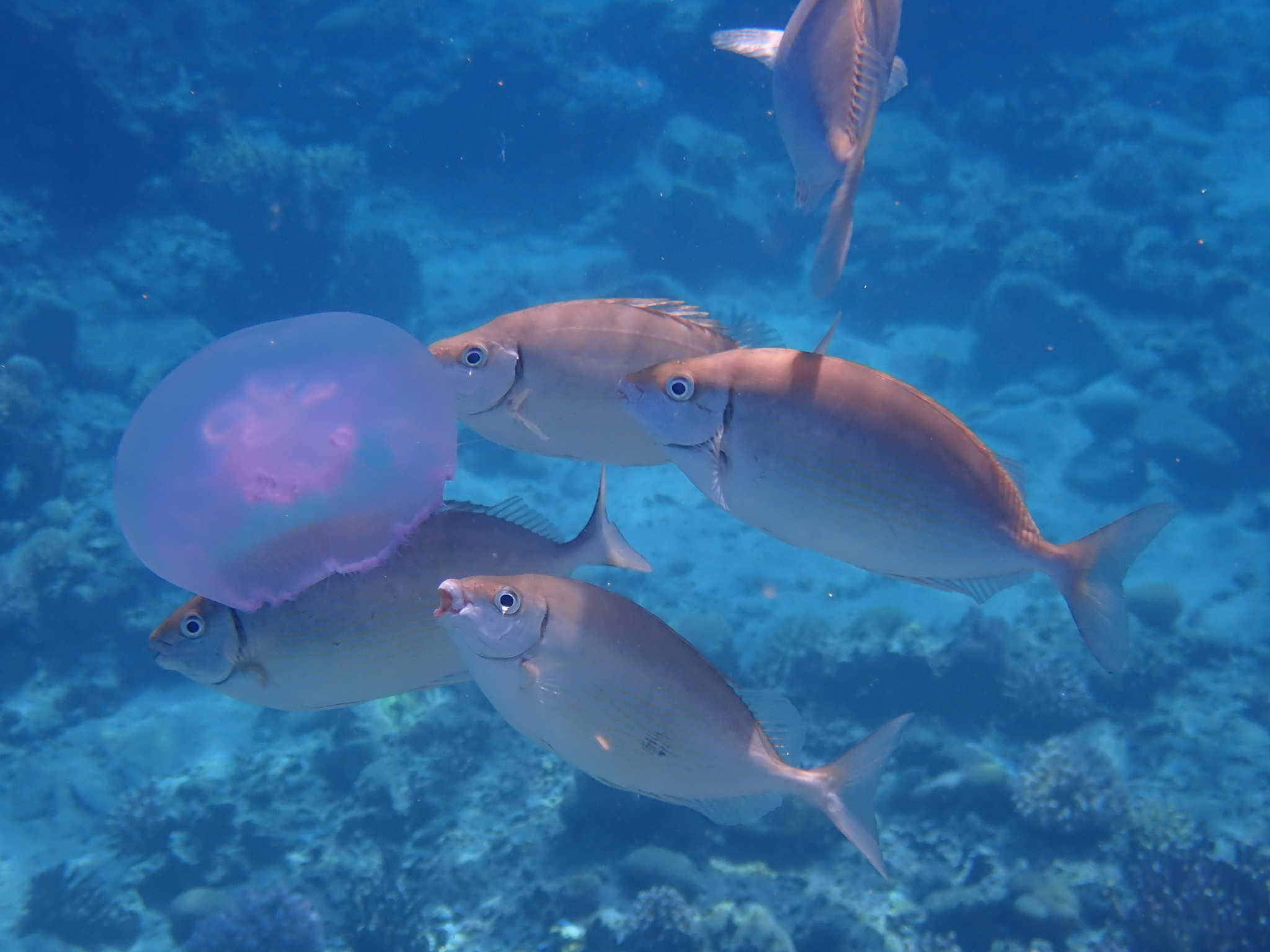
The marbled spinefoot behaves like an occupying force in the Mediterranean: schools of fifty to several hundred strip algal film off harbour walls, and a float and a ball of bread can produce fish after fish inside a port. Identification rests on the tail and the body colour, not on the golden name, and every dorsal spine is venomous.
A pale fish with a shallow fork and a golden iris
Take the tail before the colour. The marbled spinefoot has a caudal fin with a shallow notch and lobes that extend only slightly. The body is pale, grey-green to brown above and silver below, the iris carries a metallic silver or gold sheen, and the pattern runs out onto the fins. A frightened fish goes mottled or shows six diagonal zones across the flank. The dusky spinefoot beside it has an almost square tail, a darker body and no golden tone. Both carry 13 dorsal spines and 7 anal spines, all venomous. At the boat, the tail settles the identification; colour only helps, because both species darken in shadow.
Schools of hundreds in sheltered water
The native range runs through the western Indian Ocean, from several East African localities and the Red Sea into the eastern Mediterranean through the Suez Canal. With the dusky spinefoot it is the most frequently cited Lessepsian example: first abundant in the eastern basin, then spreading west along coastlines and islands. Compared with its relative, it prefers sheltered water, which means harbours, quay walls, lagoon mouths and the brackish fringe, from 1 to 30 m. FishBase describes schools of 50 to several hundred fish. That habit decides the fishing: find a school and the bites come one after another; miss it and a whole stretch of water can be empty. Check whether angling is allowed before fishing inside a port, since many harbour basins are restricted to licence holders.
The school arrives before the season does
The species is warm-water and FishBase gives no monthly spawning table, so the Mediterranean spawning window is unknown. The usable pattern is temperature. When the water warms in spring, schools move onto shallow hard ground at one to a few metres, and the thickest algal film on quay walls and rock platforms holds the most fish. They stay schooled through late summer and autumn but shift with the algae, and in winter they drop back into harbour basins, bays and slightly deeper water, where shore bites fall away. Schooling tracks temperature more closely than the calendar: in the same stretch of sea, a sun-facing harbour basin usually holds fish earlier than an exposed rock platform.
Chum and a float work on a grazer
The fish grazes algae, so chum does more than a change of bait. From a quay, throw a few handfuls of wet breadcrumb or crushed algae so the fragments sink along the wall, then float a bread bait down the same column; the school rises along the trail. From a boat, drag a light lead and single hook over the edge of a rock platform, pausing at every rise. Lures work when the school is small and tight: a small soft plastic hopped along the algal film triggers a competitive grab. All three methods keep the bait in the layer where the fish has its head down. Lift it half a metre and the bites stop.
Fine gear for a fish that never stops moving
A 2.7 to 3.0 m medium spinning rod, a 2500 reel, 0.8 braid, an 8 to 10 lb fluorocarbon leader and a size 6 to 8 fine-wire hook cover most of it; inside a harbour, a rod over 3 m is a nuisance. From a boat, a 2.1 to 2.4 m short rod fishes a bait straight down with better control. The mouth is small, so hook gap matters more than wire strength. Unhooking needs long-nosed pliers and a thick glove, working from the head and clear of the dorsal and anal spines. A hot school is where people over-keep: use barbless hooks, have the release tools ready, and stop at what you will eat.
No minimum size, but the bag limit still bites
The flesh is white and firm with many small bones, good steamed, braised or fried whole; bleed and ice it early and clean out the gills and viscera. FishBase also lists it as a food fish that is occasionally poisonous, with no Mediterranean toxicity data, so large fish and organs are better avoided. EU: Regulation (EU) 2019/1241 Annex IX Part A sets no minimum size for Siganus, Article 2(2) does not extend those sizes to recreational fishing, and Article 17 of Regulation (EC) 1967/2006 bans selling recreational catch. Spain requires an autonomous-community licence from shore and boat (RD 347/2011) and has no Mediterranean entry in RD 560/1995. France has no licence requirement but requires RecFishing registration from 16, and its 2012 Mediterranean order lists no size. Italy requires the annual MASAF declaration, with electronic registration from 2026. Greece has no licence and a 5 kg daily limit, with longlining allowed 10 kg and a May spearfishing ban. Croatia requires a licence and a 5 kg bag. No size rule does not mean no rules: the sale ban, gear restrictions and marine protected areas still apply. A school makes those limits easy to reach, so decide the number before the first cast.
The limits of the evidence
The 30.2 cm maximum, the 20 cm common length, the 1 to 30 m depth band, the Red Sea to eastern Mediterranean range, the 13 dorsal spines and the IUCN Least Concern assessment of 2009 come from FishBase, as does the six-band fright pattern. The westward spread follows the standard Lessepsian account rather than a single survey. The chumming and harbour tactics come from regional catch reports, not from a study. Spawning months and local stock size are missing.
How to catch it
Float fishing
Fished with the listed approach, matched to the recorded depth and size.
Shore casting
Fished with the listed approach, matched to the recorded depth and size.
Where these facts come from
Check these pages before you rely on a size, range or protection status.
- FishBase — Siganus rivulatus — FishBase · T2
- GBIF — Siganus rivulatus occurrence records — GBIF · T2
- IUCN Red List — Siganus rivulatus — IUCN · T1
- Photo record — iNaturalist — iNaturalist · T3
Fish in the same water
These fish live in the same place.

Guides for this water
Technique, gear and safety guides that fit Marbled spinefoot.