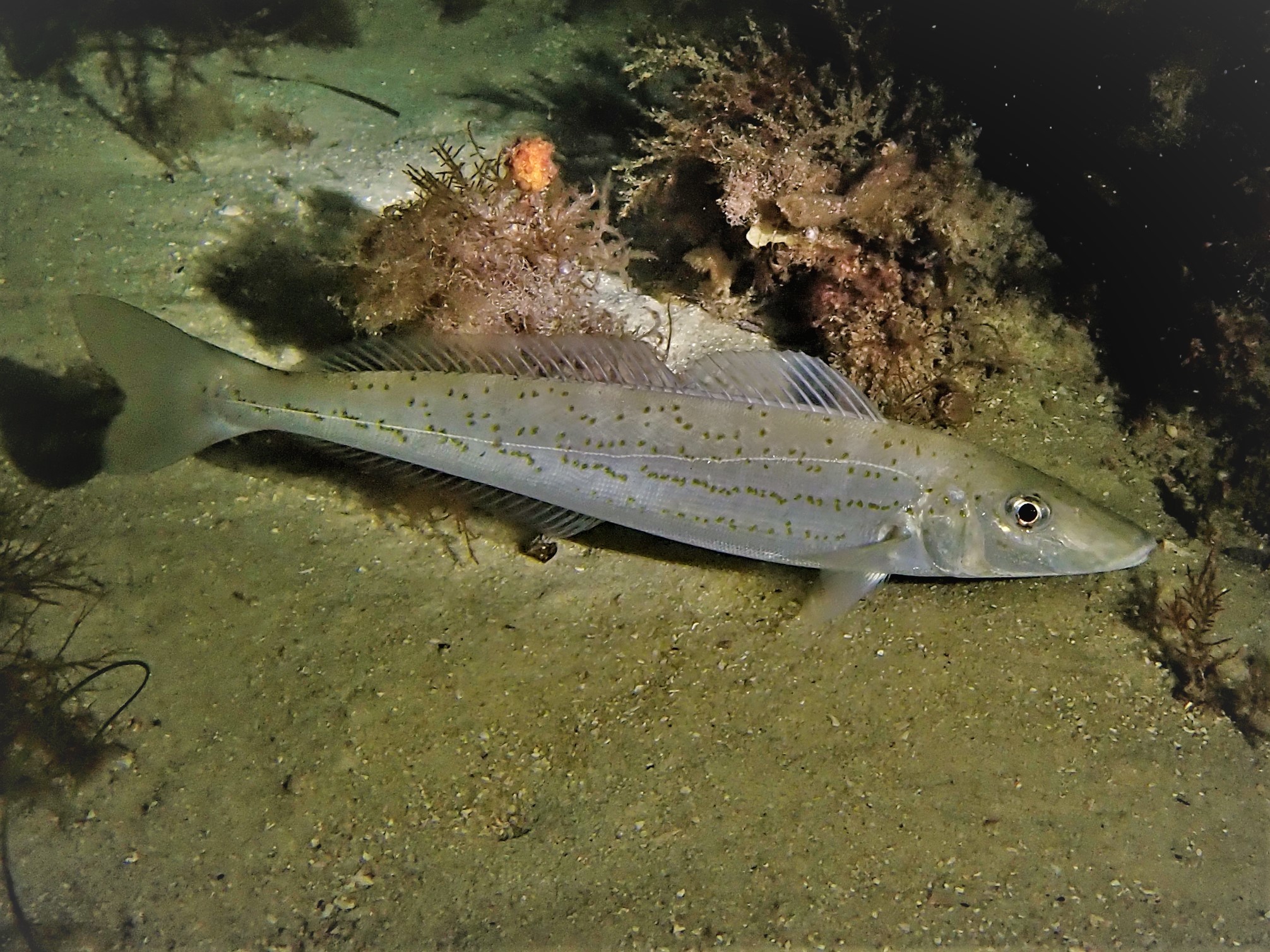
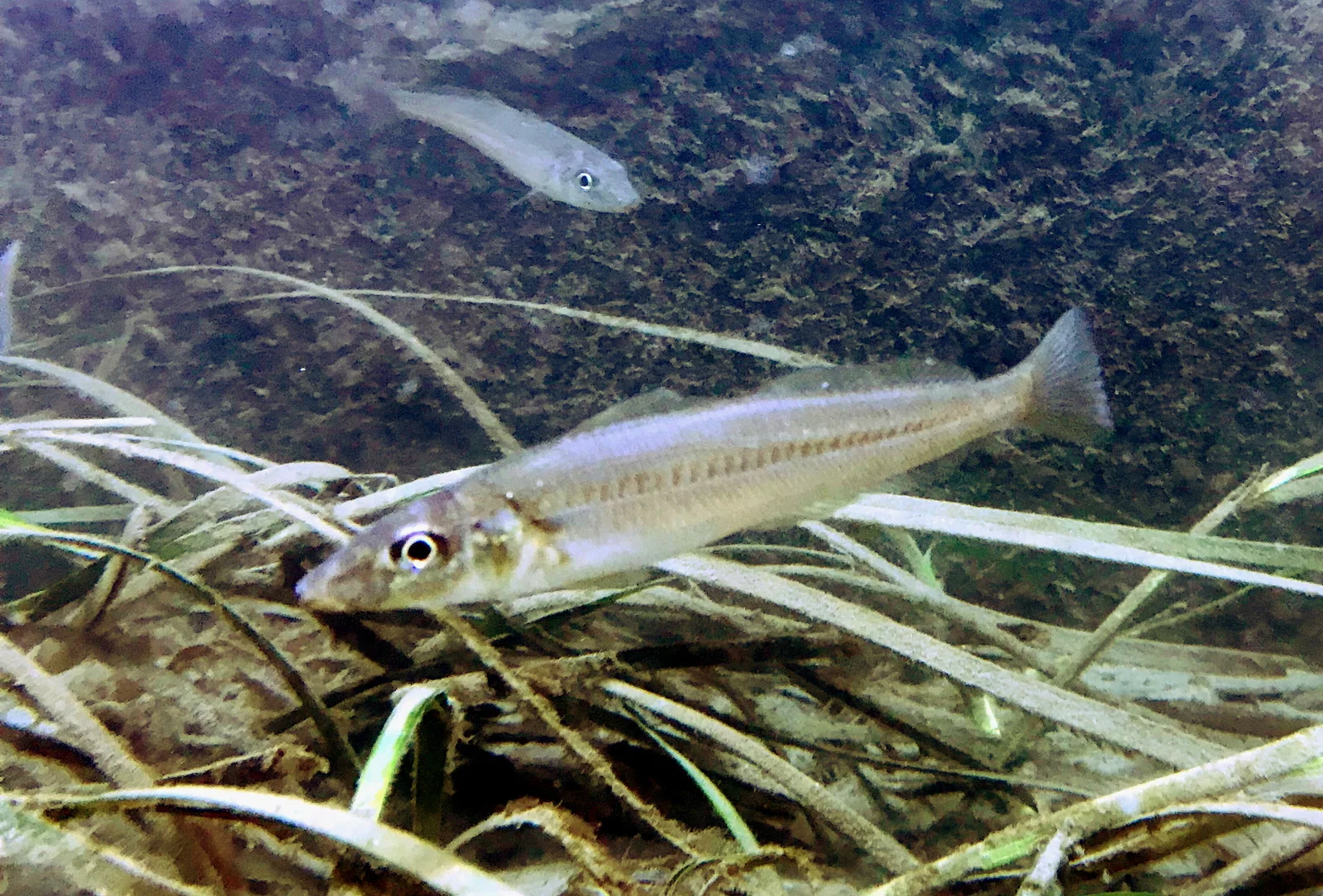
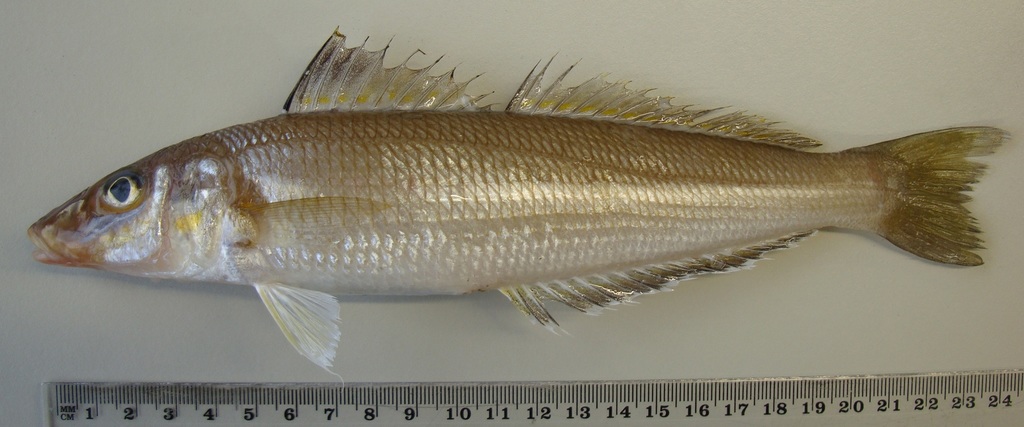
King George whiting (Sillaginodes punctatus) is a fish of the family Sillaginidae. FishBase gives its range as: Indo-West Pacific: southern Australia. It is recorded from 2 to 200 m, in temperate water. The recorded maxima are 72 cm TL, 4.8 kg, 15 years. Diet includes crustaceans, fishes and worms. IUCN status: Not Evaluated (NE). Chinese name: .
An estuary is a line, not a pin
The King George whiting is a southern Australian fish, and the source's distribution line is exactly that short: Indo-West Pacific, southern Australia. The habitat text is more useful than the map. For their first few years the fish live in seagrass beds, specifically Zostera and Posidonia creeks; small juveniles favour 2–20 m; adults move to more exposed coastal beaches and reef areas, sometimes down to 200 m. That is a salinity-and-structure gradient from estuarine grass to open coast, not a single "estuary" mark on a chart.
A fisherman who treats "the estuary" as one spot will spend the day in the wrong stretch of it. The fish's position on the line is set by age and size: the small fish is in the creek, the 35 cm common-length fish is off the beach, and the largest individuals may sit deeper than either. The gradient is the map.
The grass is the first address
Zostera and Posidonia are named in the biology text as the nursery habitat, and the creeks that hold them are the first place to look for small fish. The same text says juveniles favour 2–20 m, which is deeper than the top of a typical low-tide flat; the fish is not on the dry edge of the bed but in the water that stays over the grass.
The adult address changes twice: from grass to exposed beach, then from beach to reef and deeper ground. Each move changes the bait and the rig more than it changes the fish's name. A whiting caught over sand at 5 m and one caught over reef at 40 m are the same species at two different addresses, and the source gives both without ranking one as the "real" habitat.
The 2–18 metre band
The environment line gives 2–200 m depth, usually 2–18 m. Those two numbers do different jobs. The 200 m maximum is the outer edge of the recorded range; the 2–18 m band is the working depth, and it matches the seagrass-and-beach description better than the maximum does.
The same line records the species as demersal, non-migratory, and tolerant of brackish water. Non-migratory matters for trip planning: the fish is not a seasonal visitor that appears on a calendar, so a blank day is more likely a position error than a timing error. The depth band is the one thing a sounder can check before the first cast.
Three spawning calendars on one coast
The spawning table has three Australian records: South Australia in February–June, southwestern Western Australia in May–June, and Victoria in May–July. FishBase's reproduction note places spawning offshore, from late summer into winter.
The three records overlap without being identical. South Australia starts in February; Victoria does not start until May. The source does not merge them, and neither should a trip plan. The common thread is "offshore, late summer to winter", which is a direction rather than a date. A fisherman working one state should use that state's row and ignore the other two.
The table also settles a question the depth line raises. Spawning is offshore, while the juveniles are in the grass. The gradient is therefore used twice: adults move offshore to spawn, and the young move back into the creeks. That is why the same bay can hold both a spawning aggregation outside and a nursery inside in the same month.
What 4,243 records can and cannot say
The GBIF country facet for 2026-11-08 counts 4,243 present records, of which Australia accounts for 4,176 and the Philippines for one. The remaining 66 records carry no country facet in this query. iNaturalist holds 804 observations.
The Philippine record is outside the source's southern-Australia distribution. It is a single record, and the page does not explain it. The honest treatment is to state it and not build a range extension on it. The Australian total is large because Australian agencies and citizen-science programmes submit records, not because the fish is uniformly dense around the coast. A 4,176 figure is a measure of recording effort as much as of fish.
Bait follows the size shift
The diet text is a sequence, not a list. Juveniles eat benthic amphipods and other crustaceans; as they grow, the diet expands to polychaete worms, molluscs and peanut worms (Sipuncula). That sequence is the most practical sentence on the page, because it tells you what size bait belongs at which address.
In the grass, a small crustacean imitation matches the juvenile diet. On the exposed beach and reef, a worm or mollusc bait matches the adult diet. The page does not give hook sizes or line strengths, and it does not describe a rig; those are local choices. What it does give is the link between the fish's length and the prey group, which is enough to stop fishing a 5 cm plastic in 40 m of reef.
A premium fish with an empty rule column
The page lists the species as a commercial catch, an experimental aquaculture candidate and a gamefish. The biology text calls it a premium-quality fish that obtains a high price. No IUCN assessment exists (Not Evaluated), and the species appears on neither the CITES nor the CMS list.
An NE entry means the stock has never been assessed, so it is not a clean bill of health. For a fish that is commercially caught, farmed experimentally and sought by anglers, that absence leaves the conservation question open. FishBase offers no size or bag table: a South Australian angler needs that state's rules, a Victorian angler a different set, and neither figure appears here. WoRMS lists Sillaginodes punctata, Sillago punctata and Isosillago punctata as unaccepted names of this fish. The spelling difference matters at the rulebook: a state page or paper filed under Sillago punctata is still the King George whiting, not a second whiting with a different size limit.
Fishing the gradient
The plan the page implies is: find the grass edge for small fish, the beach and reef for adults, and the offshore ground for spawning fish. Use the 2–18 m band as the default search depth and the 200 m figure as the outer limit, not the target. Match bait to the length class: crustacean near the grass, worm or mollusc over sand and reef.
The one thing the page cannot do is tell you which state's rule applies. That depends on where the boat launches, and the three spawning rows already show that the south coast is not one jurisdiction in practice. The gradient is biological; the rulebook is political. Keeping the two separate is what makes the page usable.
Regulations before you keep it
These are the published regulations for this fish. Read the number first. The notice below it is the actual regulation.
Minimum size4
32 cm east of 136°E or in gulf waters · 30 cm west of 136°E outside gulf waters
Australia — South Australia · AU-SA
South Australia sets a 32 cm minimum for King George whiting east of 136°E or in gulf waters, and 30 cm west of 136°E outside gulf waters.
King George Whiting (east of longitude 136°E or gulf waters) | 32 | 10 | 30 ... King George Whiting (west of longitude 136°E excluding gulf waters) | 30 | 10 | 30
≥35 cm
Australia — Tasmania · AU-TAS
Tasmania sets a 35 cm minimum size for King George whiting.
Whiting, King George | 5 | 10 | - | 35 cm
≥27 cm
Australia — Victoria · AU-VIC
Victoria sets a 27 cm minimum legal length for King George whiting.
Minimum legal size: 27cm
≥280 mm
Australia — Western Australia · AU-WA
Western Australia sets a 280 mm minimum legal size for King George whiting.
"Whiting, King George Sillaginodes punctatus 280 mm 12"
Bag limit4
10 fish per person per day · 30 per boat (Spencer Gulf and other waters) · 5 per day · 15 per boat (Gulf St Vincent and Kangaroo Island)
Australia — South Australia · AU-SA
South Australia allows 10 King George whiting per person per day and 30 per boat in Spencer Gulf and other waters, or 5 per day and 15 per boat in Gulf St Vincent and Kangaroo Island.
King George Whiting (east of longitude 136°E or gulf waters) | 32 | 10 | 30
5 fish per day · 10 in possession
Australia — Tasmania · AU-TAS
Tasmania allows 5 King George whiting per day and 10 in possession.
Whiting, King George | 5 | 10 | - | 35 cm
20 fish per person per day
Australia — Victoria · AU-VIC
Victoria allows 20 King George whiting per person per day.
Bag limit | 20
12 fish per person per day
Australia — Western Australia · AU-WA
Western Australia allows 12 King George whiting per fisher per day.
"Whiting, King George Sillaginodes punctatus 280 mm 12"
Every record above names its source and the date it was retrieved. See the regulation register for the full list, or how to read these regulations.
Where these facts come from
Check these pages before you rely on a size, range or protection status.
-
FishBase — Sillaginodes punctatus
— FishBase · T2
-
GBIF — Sillaginodes punctatus occurrence records
— GBIF · T2
-
IUCN Red List — Sillaginodes punctatus
— IUCN · T1
-
Photo record — iNaturalist
— iNaturalist · T3