
Northern puffer
Northern puffer is a small tetraodontid of the western Atlantic, recorded from Newfoundland in Canada to northeastern Florida. It is a temperate fish of 10 to 183 m, reaches 36 cm TL with a common length of 20 cm. May to August is the season. Shore casting, small hook rigs and boat bottom fishing are the methods listed.
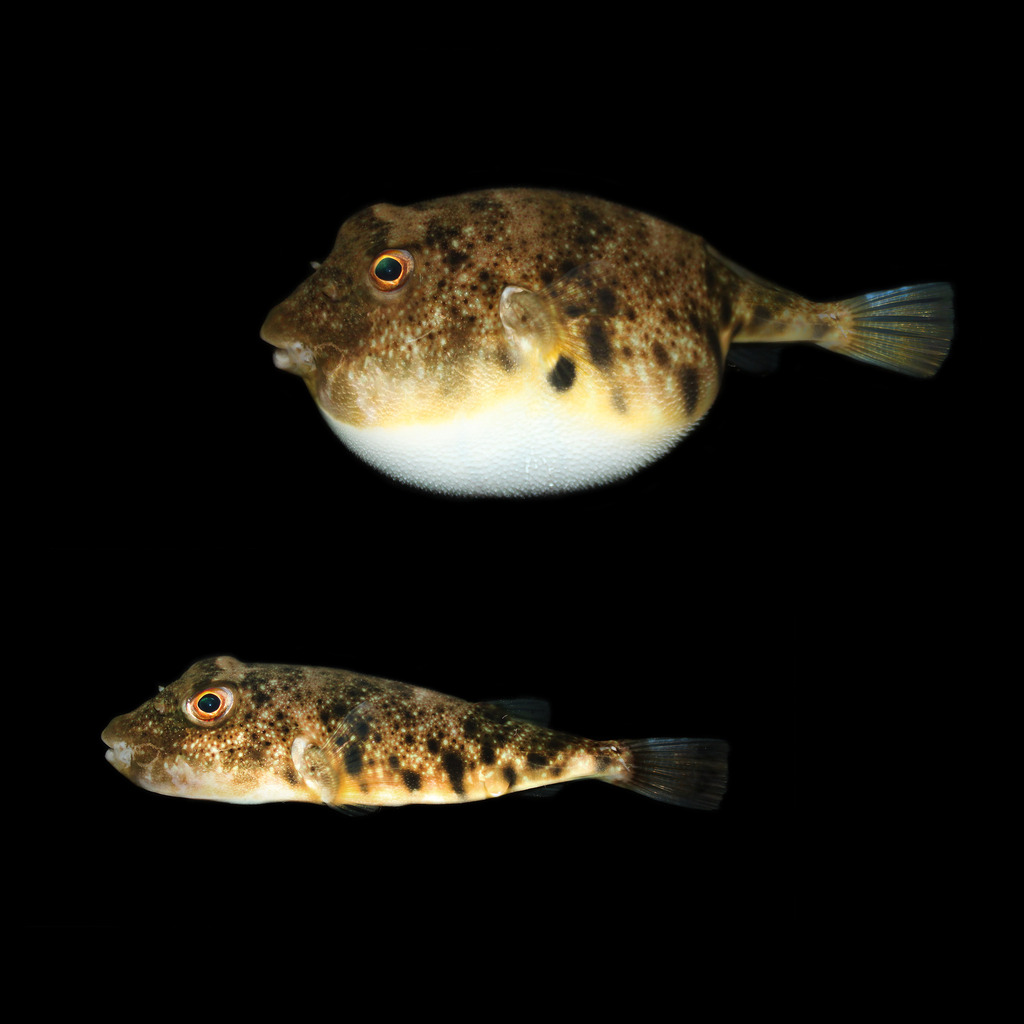
The northern puffer is a small tetraodontid of the western Atlantic, recorded from Newfoundland in Canada to northeastern Florida. FishBase gives a maximum length of 36 cm TL and a common length of 20 cm, with a depth range of 10–183 m. It is a bottom-living fish of bays, estuaries and protected coastal water, and in the northern part of its range it is sold as "sea squab"; elsewhere it is known as blowfish, sugar toad or chicken of the sea.
Identification
The body is short and deep, with a blunt head and a small mouth built from fused teeth. The species can inflate by taking in water or air. FishBase gives eight dorsal soft rays and seven anal soft rays, with no dorsal or anal spines, and describes the upper side as grey or brown with poorly defined black spots and saddles, the belly yellow to white, and tiny jet-black pepper spots about 1 mm across scattered over most of the pigmented surface, especially on the cheeks. The lower sides carry a row of black, elongated bar-like markings, and there are no lappets on the head or body.
Other puffers and burrfish turn up in the same bays; burrfish show obvious spines, and the other smooth puffers differ in pattern. FishBase gives the fin counts and a short description rather than a full diagnosis, so check photographs and a regional guide before keeping one.
Habitat and behaviour
FishBase places the species in bays, estuaries and protected coastal waters, and records it as demersal and tolerant of brackish water. The depth range runs from 10 to 183 m, though most encounters are in much shallower water. The diet is primarily shellfish, with finfish taken occasionally, and FishBase notes the species as reportedly non-toxic.
That last point needs care. "Reportedly non-toxic" is relative to other puffers, not a guarantee for every fish, tissue or location. The viscera can carry toxin, and the handling rules below matter more than the reputation.
Seasonal window
FishBase's spawning records are May in Chesapeake Bay, June and July in Chesapeake Bay, and May through August off Massachusetts; the overall table runs from May to August. That is a spawning signal, not a promise of a bite.
In practice the northern puffer is a warm-season inshore fish. Catches build as the bays warm in late spring, hold through summer and early autumn, and fall away as the water cools. The best fishing is in shallow, protected water on a moving tide, with the last of the flood or first of the ebb pushing bait through the channels. Stained water after a blow often fishes better than clear water.
Gear and approach
Light tackle is enough and is more fun: a 2.1–2.7 m rod, a 2500–3000 size reel, 10–15 lb braid and a 20 lb fluorocarbon leader. Use size 2 to 1/0 hooks, a small split shot or a 1/2–1 oz sinker depending on the tide, and keep the bait small — a sliver of shrimp, squid or clam, or a short piece of worm.
Puffers strip bait quickly, so check the hook often and keep a few spare rigs ready. Strike softly; a hard hook-set pulls the bait out of a small mouth. When a fish inflates at the surface, do not let it swell on a hot, dry deck. Support it in the water, wet your hands, and either return it promptly or dispatch it quickly. Never leave a puffed fish on the deck to dry out.
Edibility and regulations
FishBase records the species as a minor commercial catch and as an aquarium fish, and notes that it is sold as "sea squab" in the northern part of its range. The flesh is firm and mild, and fried puffer is a Chesapeake tradition. The caution is in the cleaning: puffers can carry toxin in the viscera, and some populations have shown high concentrations in the skin, so remove the skin, viscera and head, keep only clean fillets, and do not eat the liver, roe or any other organ. Do not feed the trimmings to pets. If you are unsure, check the advisory for the state where you fish.
The IUCN Red List category is LC (Least Concern), assessed on 10 June 2011. FishBase records no CITES or CMS listing, and the species is not venomous.
Federal waters carry no size, season or bag rule for northern puffer. Some states restrict the sale of puffer flesh as well as setting creel limits, so check the rule where you land fish before keeping one.
Where to look
GBIF holds 3,985 occurrence records for the matched taxon, with the largest country counts in the United States (3,733), Canada (170) and Mexico (7). FishBase's distribution runs from Newfoundland to northeastern Florida. The habitat keywords are estuary and coastal. These are distribution signals, not spot coordinates: fish the bays, estuary mouths and shallow flats with a small bait, and check local access and the tide.
How to catch it
Shore casting
Fished with the listed approach, matched to the recorded depth and size.
Small hook rig
Fished with the listed approach, matched to the recorded depth and size.
Boat bottom fishing
Fished with the listed approach, matched to the recorded depth and size.
Where these facts come from
Check these pages before you rely on a size, range or protection status.
- FishBase — Sphoeroides maculatus — FishBase · T2
- GBIF — Sphoeroides maculatus occurrence records — GBIF · T2
- IUCN Red List — Sphoeroides maculatus — IUCN · T1
- Photo record — iNaturalist — iNaturalist · T3
Fish in the same water
These fish live in the same place.
Panther puffer
- Family
- Tetraodontidae

Tiger puffer
- Family
- Tetraodontidae
- Season
- Mar, Apr

Acoupa weakfish
- Family
- Sciaenidae
- Depth
- 1–20 m
- Season
- Jan, Feb, Mar, Apr, May, Jun, Jul, Aug, Sep, Oct, Nov, Dec
Guides for this water
Technique, gear and safety guides that fit Northern puffer.