
Panther puffer
The panther puffer is one of Japan's most eaten and most dangerous pufferfish, targeted by Tokyo Bay party boats in winter. Only the muscle is edible, and the fish is sold under local names that belong to other species. For anglers the point is identification and handling, not volume: keep it off the dinner plate unless it came through a licensed dealer.
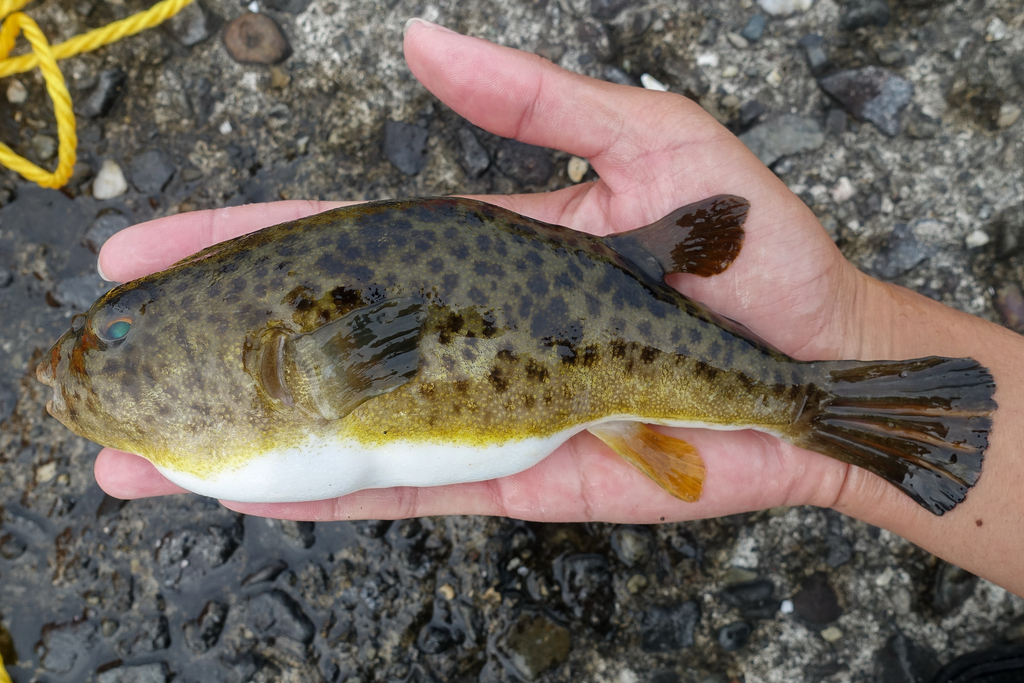
The panther puffer is one of the most eaten pufferfish in Japan and one of the most dangerous fish on the coast. It is the winter target of the Tokyo Bay party boats, it is sold under a dozen local names that belong to other species, and its edible portion is exactly one part: the muscle.
A puffer with too many names
Takifugu pardalis was described by Temminck and Schlegel in 1850 and sits in the Tetraodontidae with the other Takifugu — the genus that includes the tiger puffer, the grass puffer and the fine-patterned puffer. WoRMS carries the name as accepted.
In Japanese it is higan-fugu, "equinox puffer", a name it earned by turning up around the spring and autumn equinoxes — and, in one popular etymology, by sending careless eaters to the other shore. Anglers in Tokyo Bay call it akame, "red eye", because the white of the eye carries an orange to red tint in many individuals.
That nickname is a trap. There is a separate species whose official Japanese name is akamefugu, and the two names are swapped in different districts; boats setting out to catch higan regularly land akame and lump both together as "akame". A third name, nagoya-fugu, is shared with at least three other species. FishBase's English vernacular is panther puffer, which at least cannot be confused with anything else.
The eyes, the bumps and the missing fin
Puffers are identified by details that survive being held in a hand, and this one has three.
The eye: in most individuals the sclera is orange to red rather than white. The skin: unlike the fine-patterned puffer, this species has no small spines on the body surface but a dense covering of low, wart-like bumps, which is the single most reliable way to separate the two on deck. The fins: there is no pelvic fin, the dorsal and pectoral fins are yellowish-brown, the caudal fin brown, and none of them carries spiny rays.
FishBase's meristic record supports the soft-ray picture — 11–14 dorsal rays and 9–12 anal rays — and confirms the absence of dorsal and anal spines. Its maximum length figure is 30 cm standard length; the Japanese account gives 40 cm total length, which is the usual standard-versus-total difference rather than a dispute.
The body is stocky and rounded with a small mouth, yellow-brown to brown above with large irregular dark blotches, white to pale yellow below, and a bright yellow or orange border along the flank. Like every puffer it can inflate by taking water or air into the stomach, and it turns on the spot rather than outrunning anything.
Hakodate to the East China Sea
The range runs from Hakodate in southern Hokkaido southward through Japan, and west into the Yellow Sea and the East China Sea. FishBase lists China, Japan and both Koreas as range states.
GBIF's 764 records are heavily Japanese: 591 from Japan, 99 from South Korea, two from Russia, and one each from China, North Korea and Taiwan. iNaturalist has 47 observations.
It is a demersal fish of coastal rocky ground and algal beds, feeding on crustaceans, molluscs and bottom-dwelling animals. FishBase's habitat keyword for the species is simply "rocky", and it records no depth range at all — one of the more conspicuous blanks in the record for a fish this commonly caught.
Spawning on the spring tide
The spawning run is one of the more specific pieces of natural history attached to the species. Around the spring equinox, just after the full moon and the new moon, large schools push into very shallow water over sand beaches and rocky rubble, so shallow that the dorsal fin breaks the surface. Grass puffers spawn in the same places at the same time, and the two runs overlap.
FishBase carries no spawning record for the species — no months, no temperature, no fecundity. What it does carry is the anatomy that makes the run worth describing: a fish that can be caught by hand in ankle-deep water twice a year, and is deadly to eat if you get the parts wrong.
The poison map
This is the part of the page that matters most. In this species the muscle is the only non-toxic part. The liver and ovaries are highly toxic, the skin and intestine strongly toxic, and the testes weakly toxic. Japan's Ministry of Health, Labour and Welfare lists the edible portion for higan-fugu as muscle only — skin, liver, ovaries and testes all marked inedible. The Tokyo Metropolitan Government's guidance for puffer handling says the same.
There is a regional exception that is easy to miss: fish taken from Okkirai Bay and Kamaishi Bay in Iwate Prefecture, and from Ogatsu Bay in Miyagi Prefecture, are not permitted for food at all.
The regulation that follows from this is not a bag limit but a licence. Pufferfish may only be prepared by holders of a fugu-preparation licence, and practically every party boat that targets the species guts and portions the catch on board, returning it to anglers already disarmed. The advice printed in the Japanese angling literature is blunt: do not attempt it yourself, and do not identify a puffer by its local name.
Tokyo Bay's winter boat fishery
The fishery is an inner-bay winter fishery. Tokyo Bay's moderate tide is the classic ground; the fish prefers rocky, mixed bottom, where the fine-patterned puffer prefers sand, and the season runs from about October to early spring. The number of boats running dedicated puffer trips has grown.
The method is kattou fishing, which hooks the fish in the body rather than the mouth. The rod is short — 1.6–1.8 m, fast to medium-fast action, often a stiff filefish rod — because a fish over 1 kg is common and a soft tip loses them. A small conventional reel with PE 1 line completes it.
The rig is a kattou rig, the same as for the fine-patterned puffer, with a luminous sinker because Tokyo Bay water is usually turbid, and one or two additional bait hooks on short snoods if you prefer. Bait is frozen sweet shrimp, peeled and lashed to the bait hook, usually supplied by the boat.
The technique is a bottom presentation with constant small inputs: set the rig down, hold the rod tip at eye level with the line just taut, and lift the tip every few seconds to make the rig flash. A bite is any movement of the tip, and the hookset should be the same lift as the working stroke — a hard strike pulls the rig away rather than setting it. Some boats prohibit kattou rigs and allow bait hooks only, so the rule has to be checked before booking.
At the table
The flesh is held to be a match for the tiger puffer: excellent in hotpot, as meunière, or fried. Sashimi is served from fish that have been aged five to seven days in the refrigerator, because a just-caught fish has too little inosine monophosphate and tastes flat.
The commercial side is small and specialised. FishBase lists the species as "fisheries: of potential interest" and as a gamefish, with no aquaculture record; IUCN assessed it as Least Concern in 2011; it is not listed by CITES or CMS.
What the record does not carry
For a fish this culturally important, the database entry is remarkably thin. There is no depth range, no spawning season, no diet composition, no growth curve, no age, no maturity length and no weight in FishBase. The IUCN assessment dates from 2011 and has not been revisited.
The distribution record is also lopsided: 591 of 764 GBIF records are Japanese, with a single Chinese record and a single North Korean one, which says more about where people upload data than about where the fish lives.
What the record does carry is a warning. The species is flagged as poisonous, the ministry lists one edible part out of five, two prefectures ban it outright from certain bays, and the local names overlap with at least three other species. For a puffer, that is the most useful kind of documentation there is.
How to catch it
Boat fishing
Fished from a boat, with the approach adjusted to the recorded depth.
Shore fishing
Fished from shore, usually around structure or a depth change.
Where these facts come from
Check these pages before you rely on a size, range or protection status.
- FishBase — Takifugu pardalis — FishBase · T2
- GBIF — Takifugu pardalis occurrence records — GBIF · T2
- IUCN Red List — Takifugu pardalis — IUCN · T1
- Photo record — iNaturalist — iNaturalist · T3
Fish in the same water
These fish live in the same place.
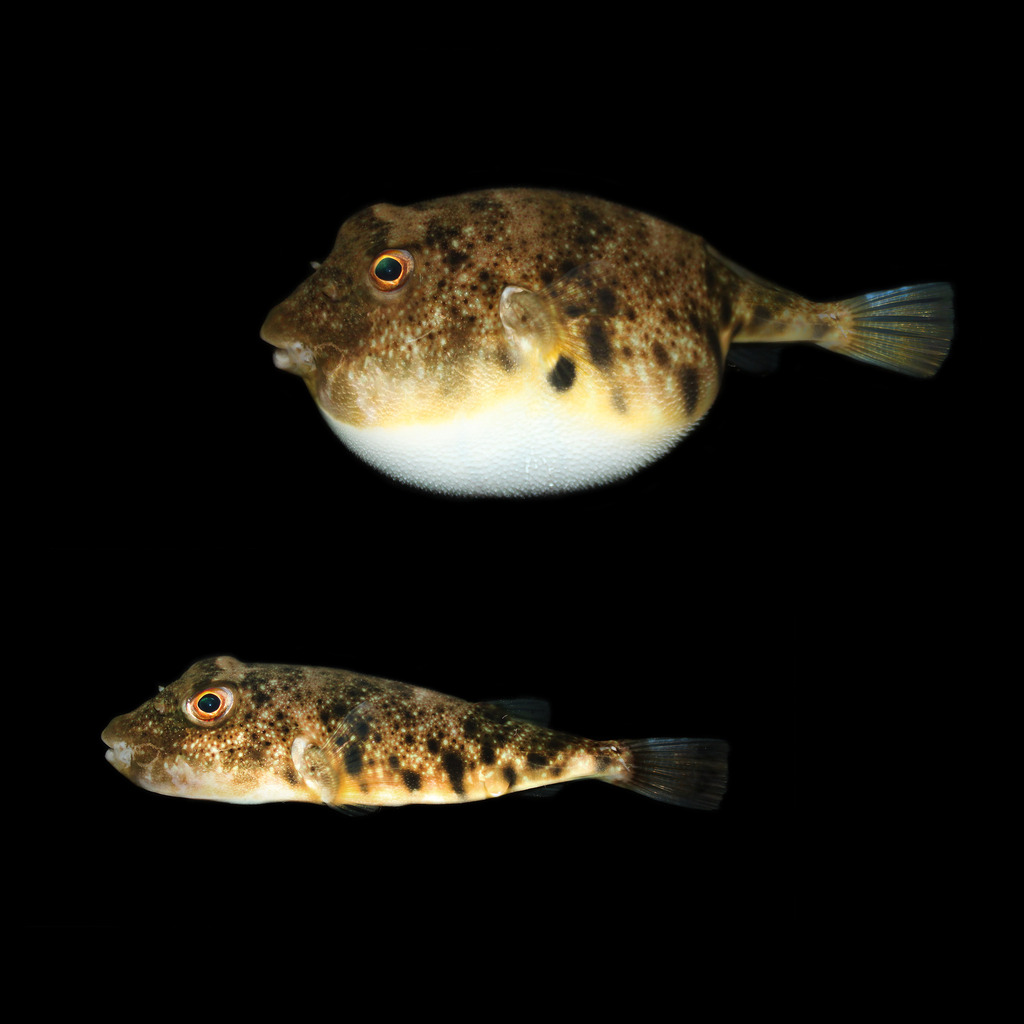
Northern puffer
- Family
- Tetraodontidae
- Depth
- 10–183 m
- Season
- May, Jun, Jul, Aug

Tiger puffer
- Family
- Tetraodontidae
- Season
- Mar, Apr

Acoupa weakfish
- Family
- Sciaenidae
- Depth
- 1–20 m
- Season
- Jan, Feb, Mar, Apr, May, Jun, Jul, Aug, Sep, Oct, Nov, Dec
Guides for this water
Technique, gear and safety guides that fit Panther puffer.