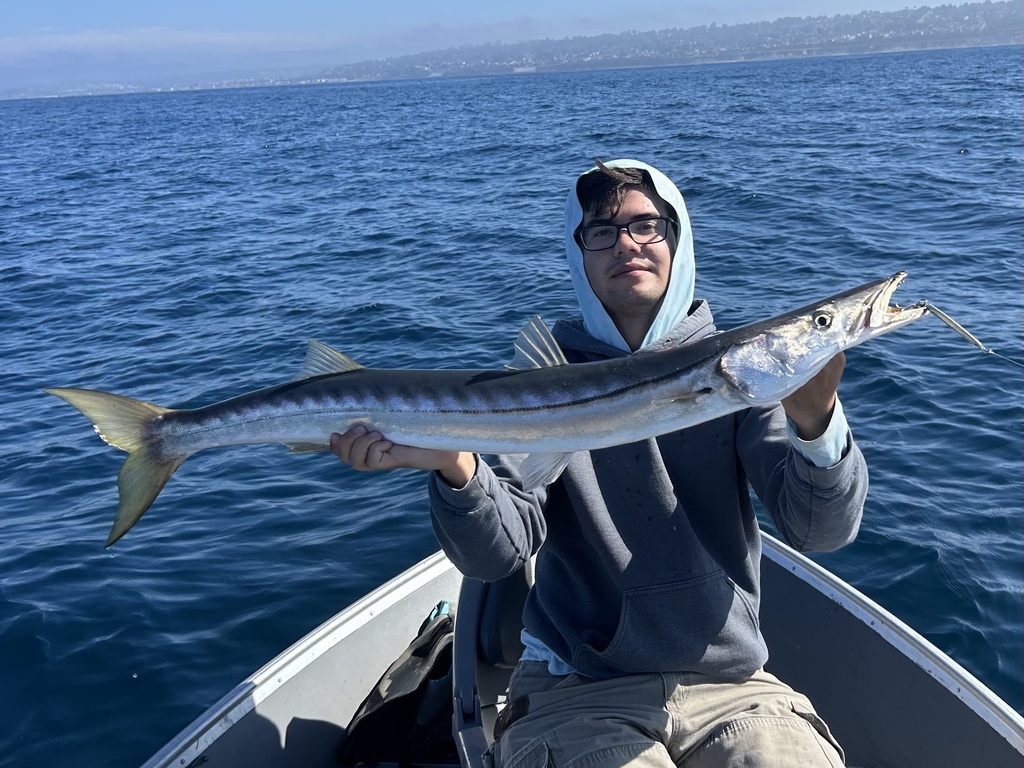
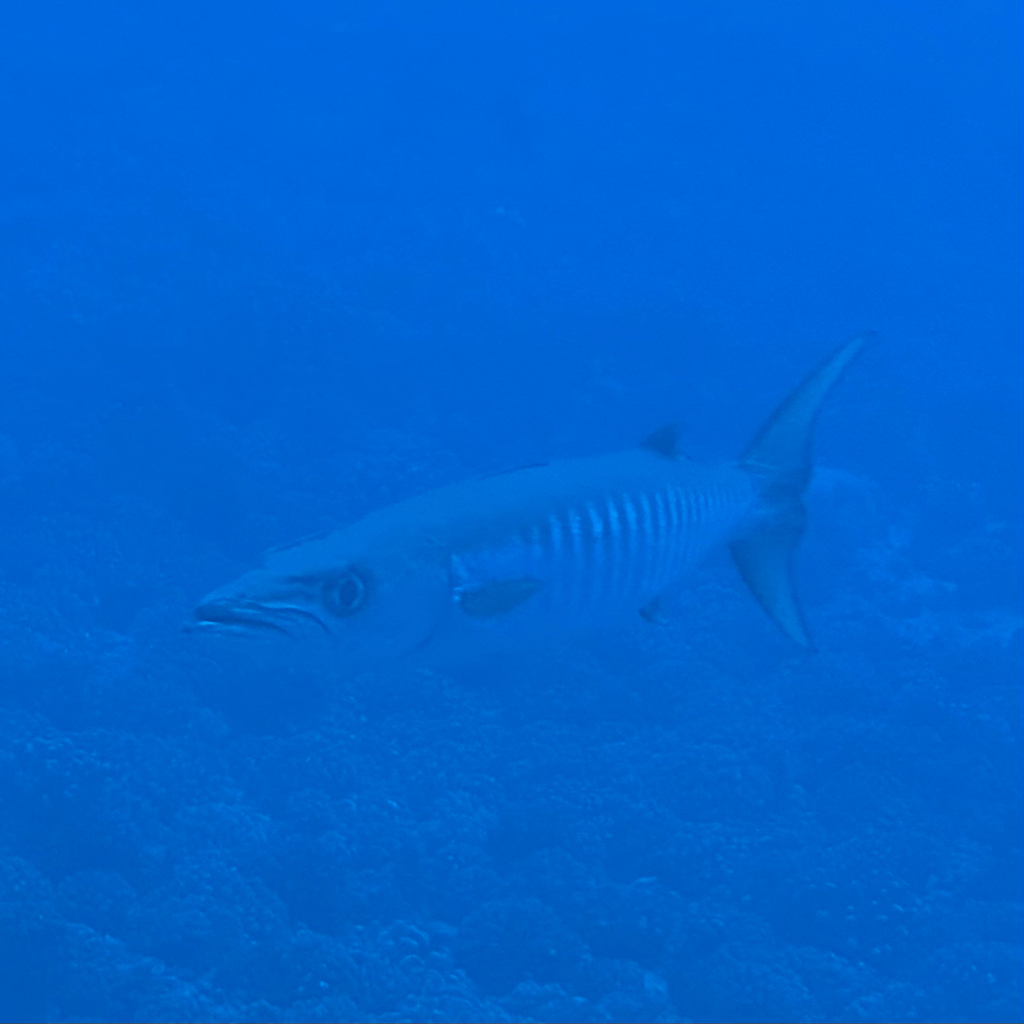
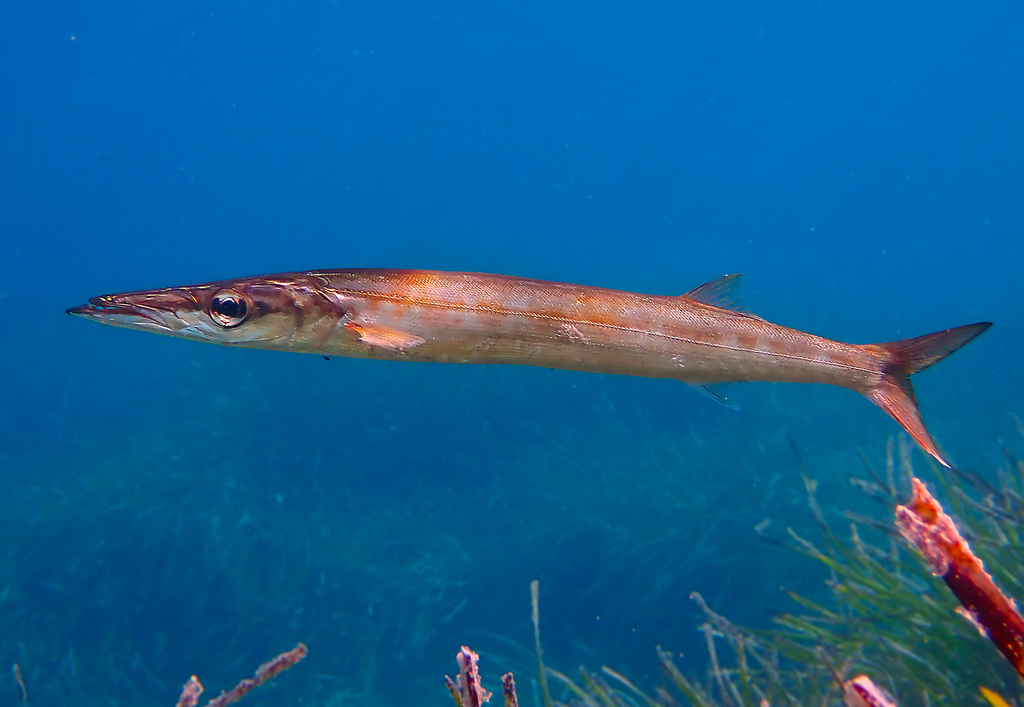
The Pacific barracuda is a summer fish with a measurement problem: 28 inches total length, or the 17-inch alternate length taken from the snout to the fork, and both get checked at the boat. It runs in small schools along colour lines and over high spots, takes a moving bait, and shows little interest in anything that sinks and sits. It is a fish you measure before you admire.
Six spines, a jaw that sits proud
Three features settle it at the rail: an elongated, almost cylindrical body, a lower jaw that projects past the upper, and a lateral line running straight from the gill cover to the tail base, catching light better than the scales around it. FishBase gives six dorsal spines and nine to ten soft rays, one anal spine and eight to nine soft rays, with a bluish or brownish back over a silver belly. Against the Atlantic great barracuda the Pacific fish is the slender one, and a continent separates them, so the comparison stays academic. Against a jack mackerel, the barracuda has a longer snout and visible teeth.
Point Conception is the northern edge
FishBase runs the range from Alaska to Magdalena Bay in Baja California and notes that the fish is not common north of Point Conception. That clause is the useful one. The species is pelagic-neritic, recorded from the surface to 18 m, usually in small schools, and young fish enter bays. In Southern California the working water is the colour line outside a point, the current edge along a kelp bed, and the mouth of a bay; pier and breakwater edges produce fish in warm years. The Alaska records mark the cold end of a range, not a destination. Note the colour line, not the GPS mark.
Autumn migration and a summer fishery
FishBase states that the species migrates south along the California coast in autumn, while fish off the Mexican coast may stay all year. Spawning is pelagic and no month-by-month table is given. The local fishery builds through summer and peaks in early autumn, when warm water pushes bait schools north; a single autumn blow can end it. No source here names a preferred temperature, so work from water colour, bait presence and current instead of a calendar. Warm blue water with birds working is a better indicator than any month. Late autumn fish are scattered rather than schooled.
Live bait on the move, irons on the boil
Live bait is the default: a whole sardine or anchovy hooked through the nose, trolled slowly enough that the bait still swims. Casting a chrome iron works when fish are up and moving; keep the retrieve continuous and leave the pause to half a beat. From a pier or breakwater, a float holds a live bait two or three metres down and lets the swell work it away from the structure. The diet is fish, and a dead bait only draws a strike when the current gives it motion. A bait that sits on the bottom is ignored. Match bait size to the sardines the school is pushing.
Fluorocarbon, not light line, for those teeth
A 7 to 8 foot medium-heavy spinning or conventional rod, a 4000 to 5000 size reel, 30 to 40 lb braid and a 40 to 60 lb fluorocarbon leader. Teeth are the wear point; a light leader fails on the first run. Use a 2/0 to 4/0 circle hook through the nose of a live bait, and swap the treble on an iron for a single to make release cleaner. Keep the drag off the lock. Barracuda shake their heads at the boat, and a hard rod tears the jaw. Land them on their side, use long pliers, and keep fingers out of the tooth line. A rod tip with give saves more fish than a drag setting.
Good flesh, one toxin warning, one tape measure
The flesh is pale, fine and full of small bones. FishBase records it sold fresh, dried or salted, and frozen, and eaten broiled or baked. Treat ciguatera conservatively: barracudas in tropical water are a known risk group, California fish carry a lower but non-zero risk, very large individuals should not be eaten regularly, and viscera and head should be discarded. California's general bag limit allows 10 fish of any one species (14 CCR § 27.60), with a 28-inch total-length minimum or a 17-inch alternate length from snout to fork (14 CCR § 28.25); hook-and-line is open year-round (FGC § 8382). State and federal water can differ, MPAs ban take, and the current CDFW notice decides. The tape gets checked at the ramp, not at the cleaning table.
What the sources cover, and what they do not
Taxonomy, range, the 0 to 18 m depth band, the 145 cm fork-length maximum, 12 kg and 12 years, the autumn migration and young fish in bays all come from FishBase. The bag limit comes from 14 CCR § 27.60 and the size from 14 CCR § 28.25, and the year-round hook-and-line rule from FGC § 8382 as republished by Cornell LII. The ciguatera passage states a risk class and cites no local testing data. Month-by-month strength is regional angling experience, not a survey. The Chinese name follows the project convention of using for Sphyraena. Everything else is regional experience and should be read that way.
How to catch it
Trolling
A whole sardine nose-hooked and trolled just fast enough to keep it swimming, worked in a zigzag outside the colour line.
Chrome iron search
A 40 to 60 g chrome jig cast and retrieved fast, switched to a jerk-and-pause when fish show at the surface.
Float fishing
A float set two or three metres down, letting the swell carry the bait away from the piling into the lane where fish pass.
Regulations before you keep it
These are the published regulations for this fish. Read the number first. The notice below it is the actual regulation.
Minimum size1
≥28 in total length or ≥17 in alternate length
United States — California · US-CA
California requires Pacific barracuda to measure at least 28 inches total length or 17 inches alternate length.
No species-specific bag limit is listed, so the default 20-finfish bag applies.
Minimum size: Twenty-eight inches total length or seventeen inches alternate length.
Every record above names its source and the date it was retrieved. See the regulation register for the full list, or how to read these regulations.
Where these facts come from
Check these pages before you rely on a size, range or protection status.
-
FishBase — Sphyraena argentea
— FishBase · T2
-
GBIF — Sphyraena argentea occurrence records
— GBIF · T2
-
IUCN Red List — Sphyraena argentea
— IUCN · T1
-
Photo record — iNaturalist
— iNaturalist · T3