
Red barracuda
A small barracuda of shallow Japanese and East Asian coasts, with a reddish cast that distinguishes it from the bluer yamato-kamasu. Juveniles stay shallow and adults school deeper, and fat content rises in cold water, which is why salt-grilling belongs to late autumn and winter.
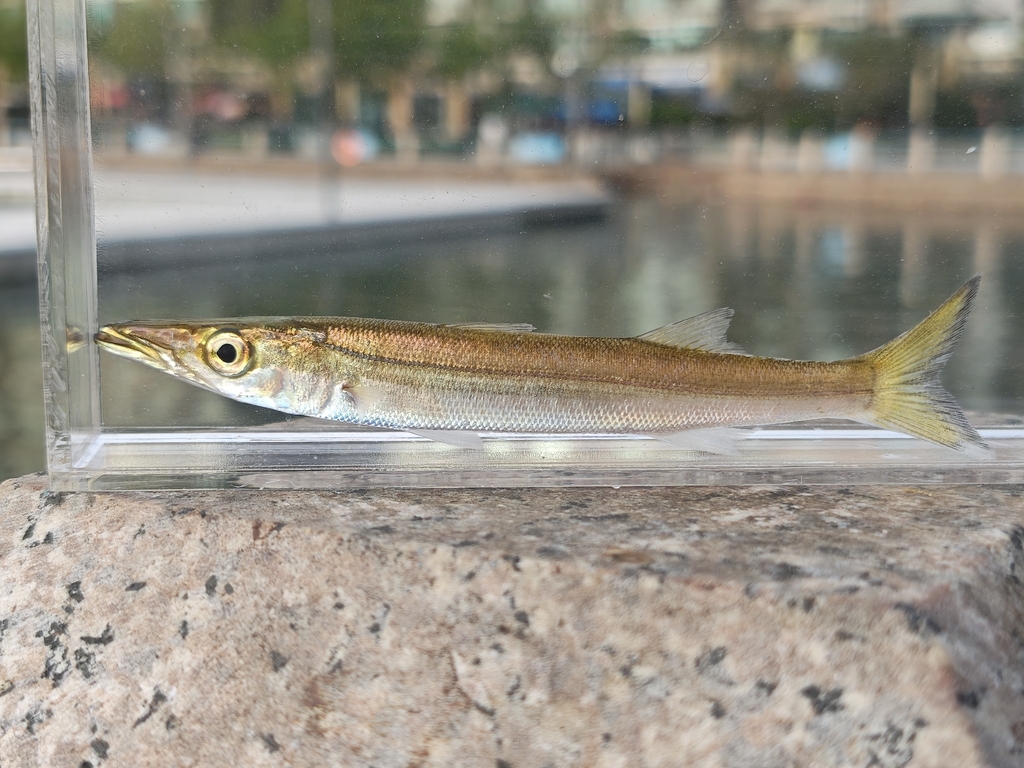
A small barracuda of shallow Japanese and East Asian coasts, with a reddish cast that distinguishes it from the bluer yamato-kamasu. Juveniles stay shallow and adults school deeper, and fat content rises in cold water, which is why salt-grilling belongs to late autumn and winter.
A barracuda that is red rather than blue
Sphyraena pinguis is elongate and cylindrical, with a long snout, a large mouth and a protruding lower jaw. The teeth are sharp, with the front ones blade-like, so the fish is a handling hazard before it is anything else. The back is blue-grey and the belly silver, and the Japanese name aka, red, refers to the reddish tinge along the flank rather than to any bright colour. The caudal fin is forked and the lateral line is prominent. The closest confusion is with Sphyraena japonica, which is bluer and finer-scaled; this species has larger, rougher scales and a warmer flank, and the market calls it hon-kamasu while japonica becomes mizu-kamasu. Against the larger barracudas it is simply smaller, reaching 50 cm.
Shallow juveniles, deep adults
FishBase gives the northwest Pacific, from southern Japan to the East China Sea and the northern South China Sea. The Japanese account is much broader: Hokkaido except the Okhotsk Sea down to southern Kyushu, on the Japan Sea, East China Sea and Pacific coasts, the Seto Inland Sea, Yakushima, Tanegashima, Amami Oshima and Okinawa, plus the west and south coasts of Korea, Jeju, the Bohai and Yellow Seas, China's East and South China Seas, the Paracel Islands, and south to New Guinea and eastern Australia, with Peter the Great Bay as a rare record. The fish lives in relatively shallow water away from coral reef, and large individuals may reach about 100 m. Juveniles stay shallow; adults school deeper. Fishing grounds therefore run from a breakwater and an inner bay to deep boat water, with the big fish mostly deep.
September to May, with the fat arriving in the cold
Spawning falls in June and July, a narrow window rather than a long season. The fish is a predator on small fish. Juveniles occupy the shallows, and as they grow they move deeper and gather in schools. The market season is given as September to May, with more fat in the cold season, the best fat from March to May, and less reliable quality after May, varying by area. Fish are landed all year, so the season is about quality rather than availability. Winter into early spring is the window when the flesh is at its best, and the same fish caught in high summer is a different proposition on the plate. The narrow spawning window and the long market season do not conflict: spawning is a short event, while the fish is present and feeding across most of the year, and what changes is condition rather than presence.
Mackerel strips in deep water, lures from shore
In Sagami Bay the cold-season method for large fish is a branch rig with mackerel slices, and below 100 m it can produce fish of around 50 cm. From shore, float fishing or lures work, with small fish or sandworm as bait and a slim minnow or a metal vibration lure as the artificial option. The fish chases quickly, so a slow retrieve is the wrong instinct. The teeth mean the leader has to be fluorocarbon or wire, and a hooked fish should not be grabbed by the mouth. Handling is the part of this fishery that produces injuries.
The leader is not optional
Boat tackle is a 1.8 to 2.1 m rod rated 30 to 60, PE 1 to 2 main line, 4 to 6 fluorocarbon leader and maruseigo 12 to 16. The shore lure rod is 2.4 to 3.0 m with PE 1 to 1.5 and a 4 to 5 leader. The leader is not optional on this fish: the teeth will cut straight through nylon. In deep boat water the lead is chosen for current, 40 to 80, and the leader is kept short to reduce tangling in the tide.
Salt-grilling, and skin that should stay on
Salt-grilling is the traditional Kanto treatment, and the best fish are the fatty large ones of late autumn. Drying, mirin-drying, boiled-and-dried and kamasu rice, in which the fish is cooked with rice, are all common. When the fish is very fresh it can be served as sashimi, seared, or cured in vinegar; the skin carries a distinct flavour, and removing it loses more than it gains. Japan has no nationwide recreational size or closed season; sea fishing follows prefectural fishery adjustment rules and cooperative angling rules. No published species-level restriction was found, but the rules of Kanagawa, Shizuoka and Ehime still need checking, which was not completed and is marked deferred. The Korean recreational rules were not obtained and are also marked deferred, with no numbers inferred.
Where each fact came from, and the rules left blank
Taxonomy, distribution, depth and length come from FishBase. The Japanese and Korean distribution, spawning, the market separation from mizu-kamasu, the season, cooking and fishing method come from the market encyclopedia. Where the Korean rules are concerned, no official text was obtained and no figure is inferred from neighbouring jurisdictions.
How to catch it
Shore casting
Fished with the listed approach, matched to the recorded depth and size.
Boat bottom fishing
Fished with the listed approach, matched to the recorded depth and size.
Lure fishing
Fished with the listed approach, matched to the recorded depth and size.
Where these facts come from
Check these pages before you rely on a size, range or protection status.
- FishBase — Sphyraena pinguis — FishBase · T2
- GBIF — Sphyraena pinguis occurrence records — GBIF · T2
- IUCN Red List — Sphyraena pinguis — IUCN · T1
- Photo record — iNaturalist — iNaturalist · T3
Fish in the same water
These fish live in the same place.
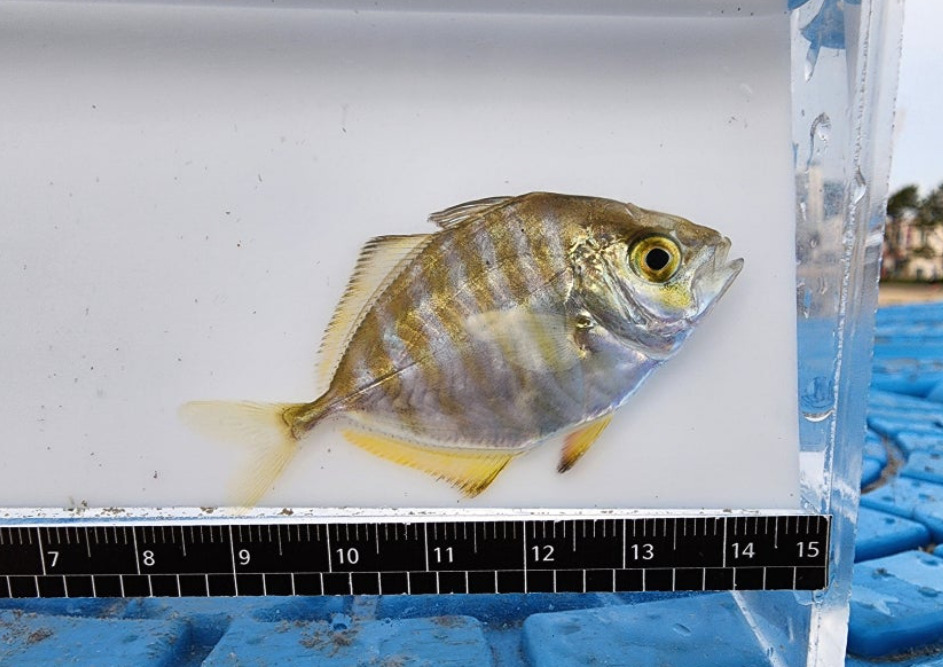
Whitefin trevally
- Family
- Carangiformes
- Depth
- 60–226 m
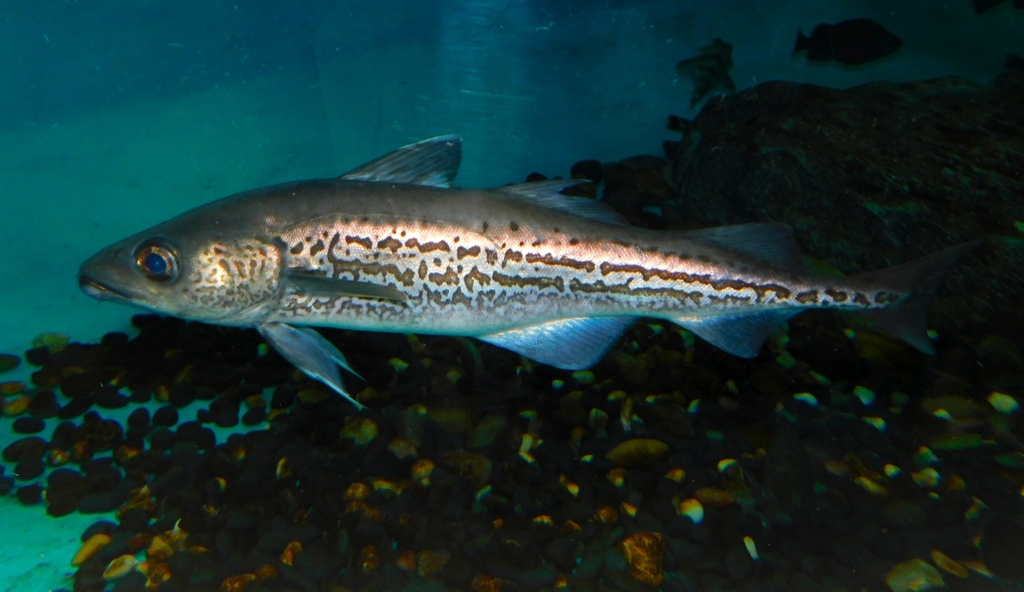
Alaska pollock
- Family
- Gadidae
- Depth
- 0–1280 m
- Season
- Jan, Feb, Mar, Apr, May, Jun, Jul, Aug

Albacore
- Family
- Scombridae
- Depth
- 0–600 m
- Season
- Jan, Feb, Mar, Apr, May, Jun, Jul, Aug, Oct, Nov, Dec
Guides for this water
Technique, gear and safety guides that fit Red barracuda.