
Whitefin trevally
A deep-bodied, diamond-shaped trevally and the only species in its genus. It lives on sand and mud inside 200 m, spawns in autumn, and is a standard boat-fishing target in Kanto and Kanagawa. It is small, but its flesh is compared with striped jack and red sea bream.
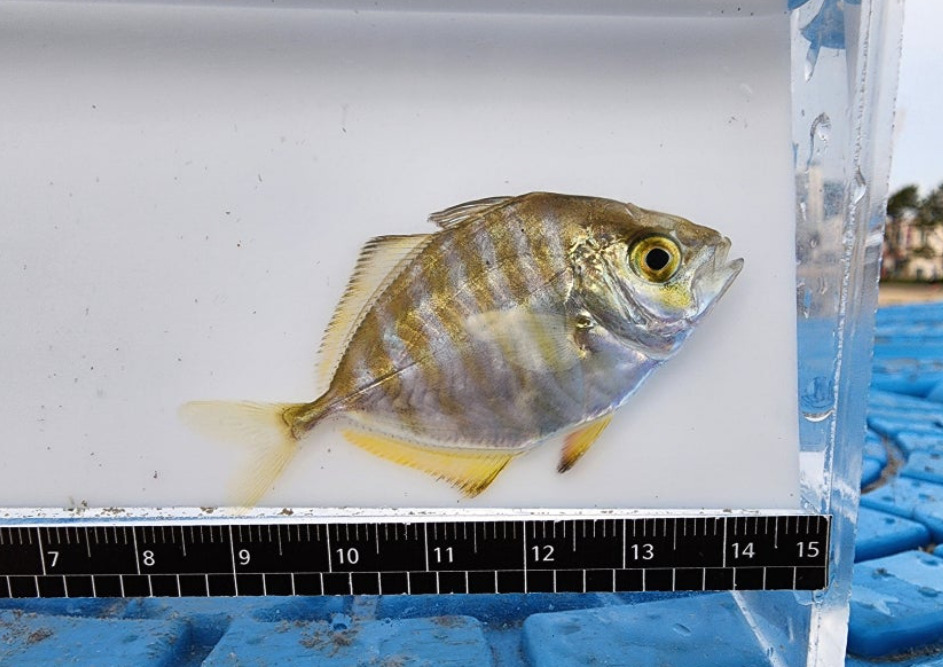
A deep-bodied, diamond-shaped trevally and the only species in its genus. It lives on sand and mud inside 200 m, spawns in autumn, and is a standard boat-fishing target in Kanto and Kanagawa. It is small, but its flesh is compared with striped jack and red sea bream.
A diamond trevally with two lengthwise bands
The body is deep and strongly compressed, rhomboid in outline, with a short snout, soft lips, bands of villiform teeth and small cycloid scales. A black longitudinal band runs along the second dorsal fin and a dark yellow band along the anal fin; those two bands are the quick identification.
Juveniles carry six to eight dark brown vertical bars that fade with growth. Small striped jack and silver trevally are the usual mix-ups: the striped jack has stronger scutes and a narrower caudal peduncle, the silver trevally a more elongate body. Body depth plus the two bands settles it.
The genus holds only this species, so there is no sibling to separate it from. FishBase gives a maximum of 50 cm fork length and a common length of 20 cm.
A wide ocean range fished on a narrow shelf
The FishBase range is broad: the southeast Atlantic off South Africa; the Indo-West Pacific from East Africa, the northern Red Sea and the Gulf of Oman through the Arafura Sea to southern Japan, Hawaii, Australia and New Zealand; and Easter Island in the southeast Pacific.
The Japanese record is more specific: Hokkaido to southern Kyushu on the Sea of Japan, East China Sea and Pacific coasts, the Seto Inland Sea, and the East China Sea shelf, with Ogasawara scarce.
It lives on sand and mud between 60 and 226 m, which the Japanese sources summarise as shallower than 200 m. It takes swimming prey, but also protrudes a funnel-shaped mouth to suck in sand and mud and filter the benthos. That is why sand and mud, not pure reef, is the ground to choose.
Autumn spawning, and a spring season label
Spawning off Japan runs from September to November, with spherical pelagic eggs. Larvae attach to jellyfish, and juveniles stay close to large fish such as groupers for protection, which is one way the species disperses and survives.
The season text says spring to early summer is the peak, but also that the fish eats well all year. In practice boat fishing is steadiest from summer and autumn into early winter, and fish are fat before the autumn spawning. The species is warm-temperate; as winter water cools it moves deeper and shore catches fall away.
Berley cage and willie rig from a boat
Boat and raft fishing are the mainstream. A bishi cage of 120 to 130 is used for berley fishing, or a willie rig is jerked through the water. The mouth is soft, so a 30 cm length of 1.5 mm cushion tube on the rig reduces tearing at the mouth.
Krill is the most common bait, with sardine strips and small fish also taken. The fish usually intercepts the bait in the middle and lower layers. In a slow tide let the bait sink naturally; in a fast tide add cage weight and pay out line, and do not let the rig drift far off the bottom.
The cushion tube is part of the rig
A boat rod of about 1.8 m with a tip-action bend, a 120 to 130 bishi cage, a manual or small electric reel, PE main line of 2 to 3, leader 2 to 3, and sleeve hooks in 8 to 10 or a dedicated kaiwari hook.
The cushion tube is not an optional refinement. The lips are thin, and without the tube a run of lost fish is normal. The rod tip also needs to be soft enough to show the light, repetitive bite.
Good flesh, and an isopod in the mouth
The Japanese guide places it in the best tier of carangid eating, with large fish considered a match for striped jack. The flesh is translucent with little dark muscle, and suits sashimi, salt-grilling, simmering, meuniere and frying. Bleed and ice it at once or the flesh softens quickly. The guide calls spring to early summer the peak while also saying the fish eats well through the year, and the two statements are compatible: one describes the best window, the other the baseline.
An isopod parasite, shima-ajinoe, is common in the mouth cavity. The Japanese source states plainly that it is harmless to humans and no obstacle to eating, though it can look like a lesion on the fish.
Japan has no nationwide recreational size or closed season; sea fishing falls under prefectural fishery adjustment regulations and cooperative rules. No species-level restriction was found, but Kanagawa and Chiba rules were not checked line by line. That item is deferred.
Tropical and warm-temperate, printed side by side
Taxonomy, distribution, depth and length come from FishBase. The Japanese range, spawning period, parasite and eating assessment come from the market guide. Method, rig and cushion-tube detail come from the angling encyclopedia.
FishBase labels the species Tropical while the Japanese guide places it in southern Japan. Both labels are retained rather than merged into one thermal conclusion, because one is a database climate field and the other is a national range description.
How to catch it
Boat bottom fishing
Fished with the listed approach, matched to the recorded depth and size.
Boat fishing
Fished with the listed approach, matched to the recorded depth and size.
Jigging
Fished with the listed approach, matched to the recorded depth and size.
Where these facts come from
Check these pages before you rely on a size, range or protection status.
- FishBase — Kaiwarinus equula — FishBase · T2
- GBIF — Kaiwarinus equula occurrence records — GBIF · T2
- IUCN Red List — Kaiwarinus equula — IUCN · T1
- Photo record — iNaturalist — iNaturalist · T3
Fish in the same water
These fish live in the same place.

Guides for this water
Technique, gear and safety guides that fit Whitefin trevally.