
Yellowmouth barracuda
Yellowmouth barracuda is a slim sphyraenid of the eastern central Atlantic and Mediterranean, recorded from Cape Verde and the Canary Islands. It works the top 100 m of tropical water and preys on crustaceans, fish and molluscs. Adults reach 128 cm FL and 8.2 kg. The yellow around the mouth is the mark the name refers to.
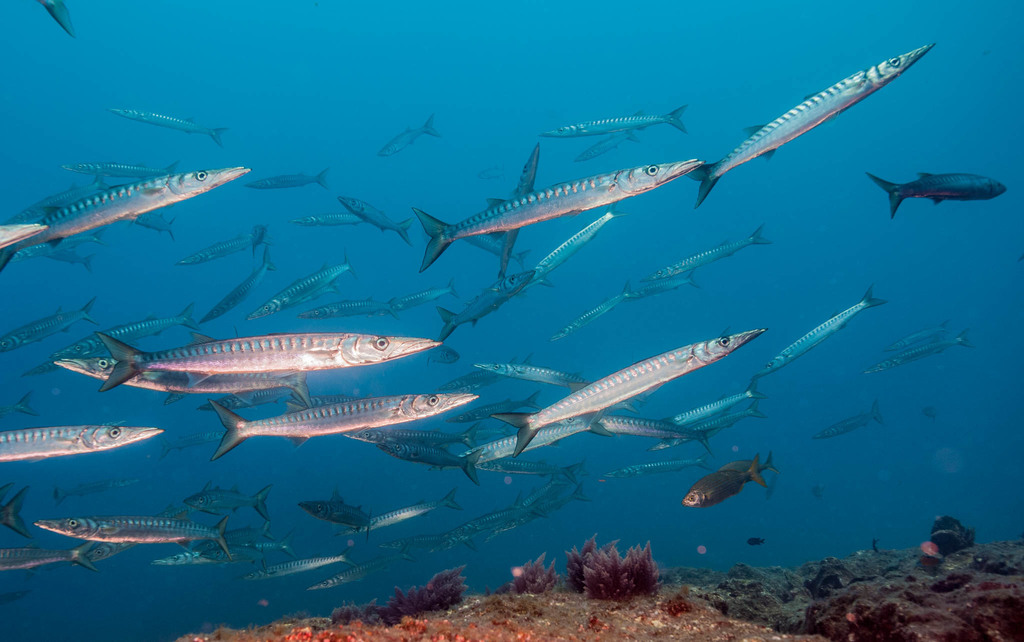
Yellowmouth barracuda (Sphyraena viridensis) is a fish of the family Sphyraenidae. FishBase gives its range as: Eastern Central Atlantic: Cape Verde and the Canary Islands. Also reported from Lebanon in the eastern Mediterranean. Its exact distribution and abundance are unknown because most published records do not separate it from Sphyraena sphyraena. Fork length runs to the notch of the tail, standard length stops at the last vertebra, and the two readings are not interchangeable. It is recorded from 0 to 100 m, in tropical water. The recorded maxima are 128 cm FL, 8.2 kg. Diet includes crustaceans, fishes and molluscs. IUCN status: Least Concern (LC). Chinese name: .
Identification
Sphyraena viridensis carries two published lengths that are not measured the same way: a maximum of 128 cm fork length and a common length of 40 cm standard length. Fork length runs to the notch of the tail, standard length stops at the last vertebra, and the two readings are not interchangeable. A fish taped to the fork reads longer than the same animal measured standard. The 128 cm figure is a record taken by one ruler; the 40 cm figure describes the everyday catch taken by the other. Maximum published weight is 8.2 kg.
The English names in the table all point at the mouth: yellowmouth barracuda, yellow-mouth barracuda and yellow barracuda. Chinese entries read and . iNaturalist prefers Yellowmouth Barracuda and holds 2,194 observations under taxon 47260. Wikipedia opens with the same English names and adds that the fish is often confused with the European barracuda.
Habitat and distribution
The record places the species in the eastern central Atlantic at Cape Verde and the Canary Islands, with a reported presence off Lebanon in the eastern Mediterranean and in the Azores. The country table holds nine territories: Algeria, Cabo Verde, the Canary Islands, France, Greece, Lebanon, Madeira, Syria and Türkiye. Wikipedia gives the warmer waters of the eastern Atlantic and the Mediterranean.
The entry then admits a problem that belongs to the same axis as the lengths: most published records do not separate this fish from Sphyraena sphyraena, so its exact range and abundance are unknown. A map built from those records is a map of two barracudas. The environment line is marine, pelagic-neritic, 0–100 m, tropical, between 44°N and 14°N and 26°W and 36°E. Prey keywords are fishes, crustaceans and molluscs. The range is a band of warm Atlantic and Mediterranean water where the fish is expected, not a set of confirmed points.
Season and fishing approach
The working calendar comes from water and from the size structure of the catch. The common length is 40 cm standard length, so tackle chosen for a 40 cm fish is the sensible default; the 128 cm fork-length maximum belongs to the record book, not to the planned trip. Because the two figures use different rulers, a fish that looks close to the common length on a flat board may still be a modest specimen by the fork measure.
The pelagic-neritic label and the 0–100 m band put the fish in open water above the shelf and around island slopes rather than on the bottom. Fishes, crustaceans and molluscs in the diet support silver spoons, slim plugs and strip baits worked in the upper layers, as does a live bait drifted near current edges. The depth band, not a bottom contour, is the search surface.
Edibility and regulations
FishBase lists commercial fisheries and gamefish status. The Red List assessment is Least Concern, dated 14 July 2014.
A catch reported under the generic barracuda label may belong to either of the two confused species, which is a bookkeeping problem before it is a rules problem. The nine-territory table spans Atlantic islands, North African coasts, the Levant and southern Europe, so any single size or bag figure met online belongs to one of those jurisdictions rather than to the species. The 8.2 kg maximum is a published specimen weight, not a retention threshold.
Where these facts come from
Check these pages before you rely on a size, range or protection status.
- FishBase — Sphyraena viridensis — FishBase · T2
- GBIF — Sphyraena viridensis occurrence records — GBIF · T2
- IUCN Red List — Sphyraena viridensis — IUCN · T1
- Photo record — iNaturalist — iNaturalist · T3
Fish in the same water
These fish live in the same place.

Guides for this water
Technique, gear and safety guides that fit Yellowmouth barracuda.