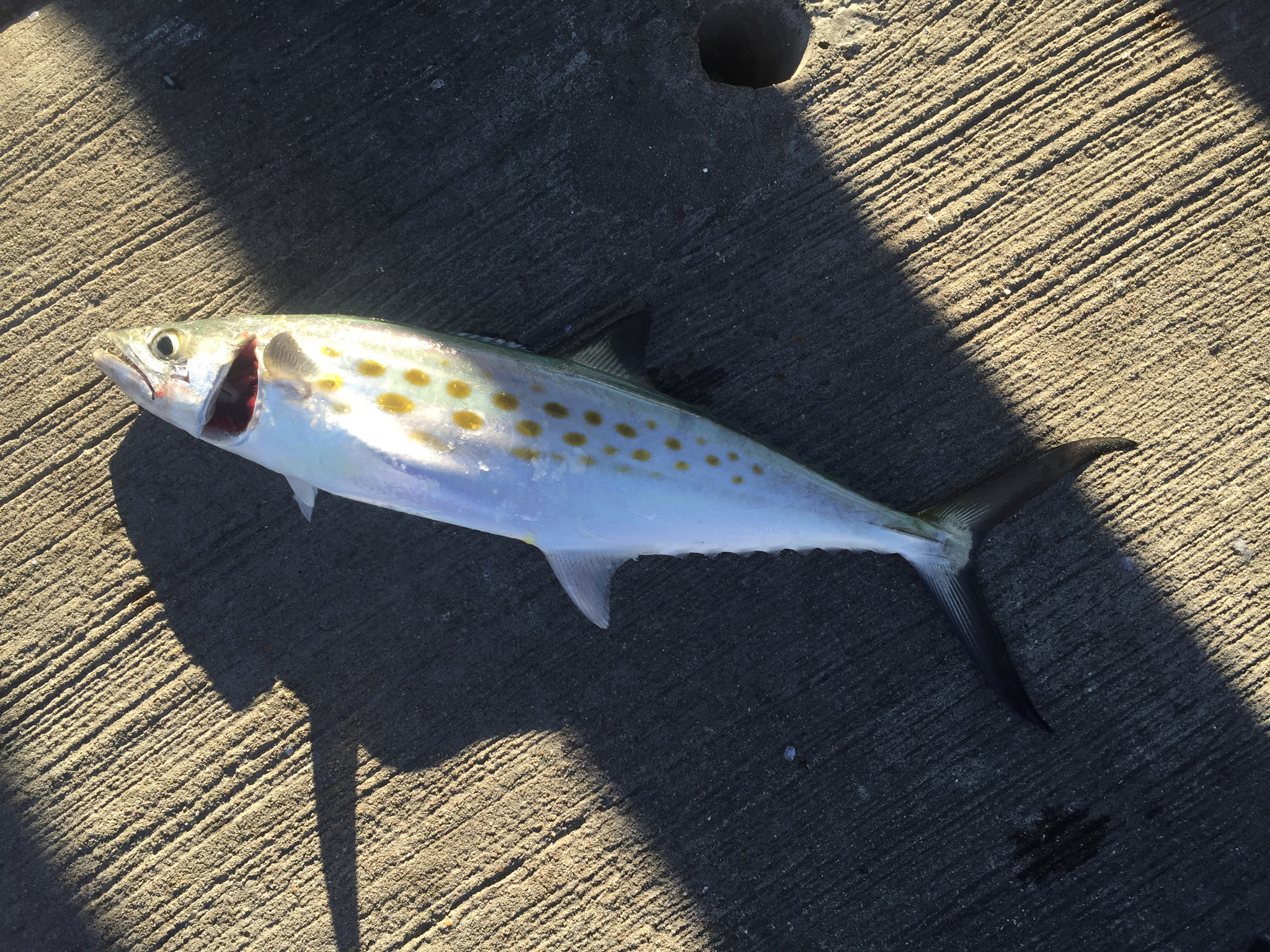
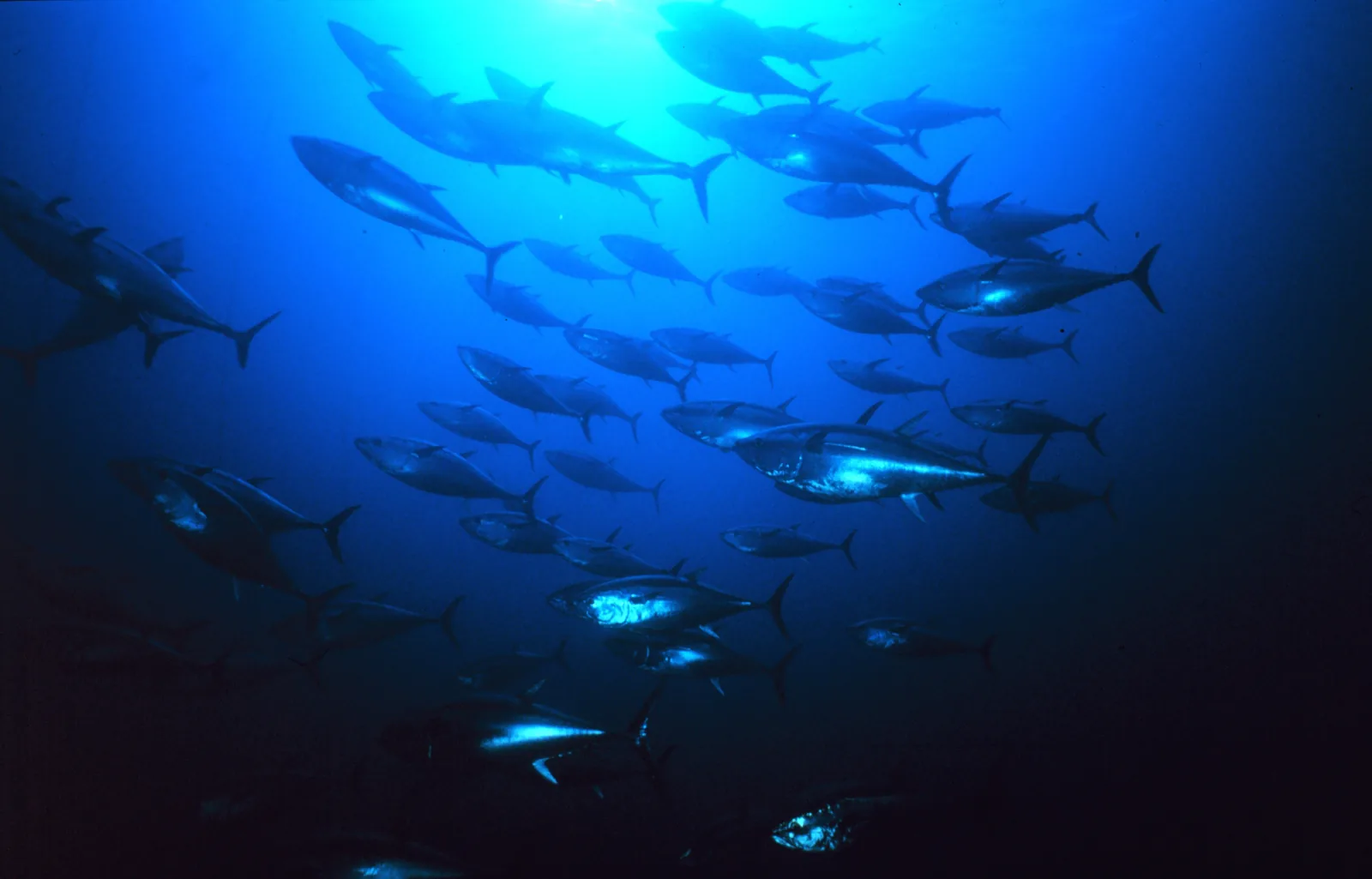
Yellowfin tuna (Thunnus albacares) is a fish of the family Scombridae. FishBase gives its range as: Worldwide in tropical and subtropical seas, but absent from the Mediterranean Sea. Highly migratory species. It is recorded from 1 to 1602 m, in tropical water at 15–31 °C. The recorded maxima are 239 cm FL, 200 kg, 18 years. Diet includes crustaceans and fishes. IUCN status: Least Concern (LC). Chinese name: .
The name on the shelf
FishBase's common-name table runs to more than thirty English variants. Some are descriptive, such as yellowfin, longfin and yellow-fin tuna; some are regional, such as Allison tuna; and one, albacore, is borrowed from another tuna. That matters because the word is used in fish markets for more than one species, and the table records it as an alias rather than as a preferred name.
A label of that kind is not a taxonomic statement. It is a trade category with a history. The binomial is the only label that cannot drift, and the Chinese aliases make the same point: , , and all name one animal in different markets.
What the animal actually is
The page places it in Scombridae, with 39 vertebrae, 11–14 dorsal spines, 12–16 dorsal soft rays, no anal spines and 11–16 anal soft rays; the cross-section is oval. Those counts never appear on a can, but they are what separates this fish from the tunas whose names it borrows.
The milieu is open-water, and the diet is crustaceans and fishes. The method list gives trolling and jigging from a boat. The sea animal is a pelagic hunter; the shelf word is a category that may or may not include it.
The size the label cannot show
Maximum length is 239 cm fork length and maximum published weight 200 kg. The common length is 150 cm fork length, the oldest reported age 18 years. Maturity is given as 103.3 cm, with a range that runs from 78 to 158 cm.
That maturity range is unusually wide, and the page does not explain why. Read as a single figure, 103.3 cm is a working threshold; read with the range, it becomes a band in which different stocks mature at different sizes. The common length sits above the whole band, so the median fish on this page is an adult. A product label carries none of this: no length, no weight, no age. The record describes the whole animal and says nothing about how it is cut or packed.
Absent from one sea
The distribution line is worldwide in tropical and subtropical seas, but absent from the Mediterranean Sea. The page also gives 50°N to 50°S, 15–31°C, and highly migratory. In a record with 161 territories, one missing sea is the most precise statement on it.
The absence is worth more than the presence. A global list tells you the fish is widespread; a named exclusion tells you where the envelope stops. Anyone comparing a Mediterranean catch with this page should check the identification before checking the season.
NOAA's Atlantic page supplies what the species record withholds. The 2024 stock assessment found Atlantic yellowfin neither overfished nor subject to overfishing; ICCAT assesses the stock, and the 2006 Consolidated Atlantic Highly Migratory Species Fishery Management Plan governs the US fishery. A commercial permit, gear restrictions, time/area closures and a minimum size apply, and federal rules reach state waters except in Maine, Connecticut and Mississippi.
Where the records are
GBIF holds 176,213 preserved records. The United States contributes 91,316, an unassigned bucket 29,527, the high seas 6,468, Great Britain 5,648 and Mexico 3,517. FishBase lists 161 territories, but the index is dominated by a few national collections.
Two different questions are being answered. The territory list says which countries report the species; the facet says whose specimens have been digitised. Neither is a population map. If you are choosing water, use the temperature and depth envelope, then let a local source narrow the coast.
Depth without a floor
The depth field runs from 1 m to 1,602 m, with a usual band of 1–250 m. Almost all fishing takes place in the upper part of that range, but the page never places the fish inside those 250 m. That is a gap, not a number to fill in.
The practical reading is a surface-to-250 m working envelope. Trolling covers the top; jigging can go deeper. Temperature is the better guide: the page gives 15–31°C, and a break in that band is a more useful edge than a depth contour copied from a maximum.
A twelve-month table that is not a season
The spawning table reports all twelve months, but the underlying records disagree about which months matter. India: April to August. Brazil: January and February. Mexico and Central America: every month. The eastern Atlantic: February to August, and a second entry February to September. Hawaii: May to September. Japan: April to July. Northeastern Australia: January to March and October to December. The Coral Sea: January and October to December. Indonesia: August to December. Senegal: May to September.
All twelve months is the union of those windows, not a global season. A reader who takes the summary line as "spawns all year everywhere" will plan a trip on a statement no single locality supports. The table is regional, and it should be read region by region.
Fishing the sea fish
iNaturalist holds 1,242 observations for the taxon, a modest photographic record for a fish this widespread. Trolling and jigging are the listed methods; the milieu is open-water; the temperature envelope is 15–31°C. The result is a blue-water plan: find a temperature break, work the top 250 m, and let the sounder tell you where the school sits.
The label contributes nothing to that plan except a warning. Albacore on a price tag, tuna on a menu and yellowfin on a species page are three different claims, and only the last one comes with a binomial. Buy the label if you like; fish the animal.
How to catch it
Trolling
Trolled from a moving boat; suits roaming or pelagic species.
Jigging
Vertical jigging over the recorded depth range.
Live bait
Live bait presented where the fish is likely to feed.
Regulations before you keep it
These are the published regulations for this fish. Read the number first. The notice below it is the actual regulation.
Minimum size1
The minimum size for Yellowfin tuna in Spain is ≥3.2 kg.
| Rabil (Thunnus albacares) | 3,2 kg |
Bag limit1
3.2 kg minimum · 10 fish per person per day
South Africa · ZA
Recreational permit holders in South Africa may take up to ten yellowfin tuna per person per day, with a minimum mass of 3.2 kg.
An overall cumulative limit of ten fish per day applies to species with a bag limit of ten or less (regulation 22(7)(f)).
Yellowfin tuna Thunnus albacares 3.2 kg 10
Every record above names its source and the date it was retrieved. See the regulation register for the full list, or how to read these regulations.
Where these facts come from
Check these pages before you rely on a size, range or protection status.
-
FishBase — Thunnus albacares
— FishBase · T2
-
GBIF — Thunnus albacares occurrence records
— GBIF · T2
-
IUCN Red List — Thunnus albacares
— IUCN · T1
-
Photo record — iNaturalist
— iNaturalist · T3