
Agujon needlefish
The beak is lined with dense, sharp teeth that will cut through an ordinary leader. That is not folklore; it is the most common way this fish is lost after it is hooked. Fast, jumping hard and cruising near the surface, it is easy to interest and hard to bring to the net intact.

The beak is lined with dense, sharp teeth that will cut through an ordinary leader. That is not folklore; it is the most common way this fish is lost after it is hooked. Fast, jumping hard and cruising near the surface, it is easy to interest and hard to bring to the net intact.
A bony beak lined with teeth that cut
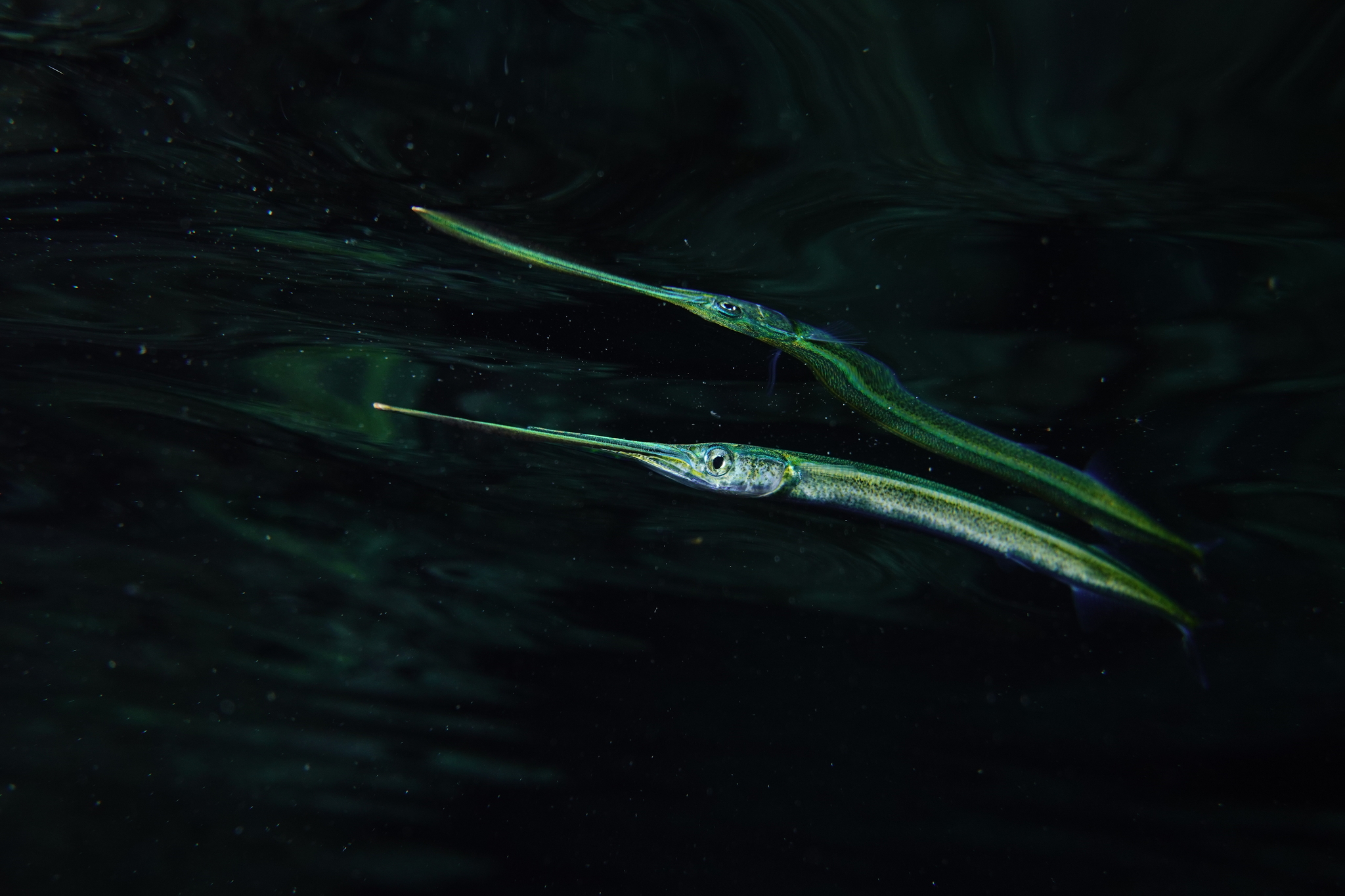
Start at the beak. Both jaws are extremely elongated into one stout beak armed with very sharp teeth; there are no gill rakers; the nostrils sit in a pit in front of the eyes; the dorsal fin has 20 to 26 soft rays and the anal fin is short. The tail is deeply forked with the lower lobe longer than the upper, and a small black keel runs along each side of the caudal peduncle, which is the fastest confirmation at the boat. The back is dark blue, the belly silvery white, and a blue line runs along the flank. Against Belone belone the beak is stouter and the fish larger, up to 153 cm with a common length of 90 cm. The upper and lower jaws are almost equal in length, another detail worth noting.
Surface water from the coast out to open sea
FishBase gives two ranges: the western Atlantic from Massachusetts to Brazil, and the eastern Atlantic off Morocco plus the Mediterranean. It is an oceanic and neritic surface fish, recorded from 0 m with no depth ceiling given. In the Mediterranean it is common but never dense, and it shows up in open water from the coast outwards, at bay mouths and in channels between islands rather than inside a reef. It follows schools of small fish, so its position changes daily. What is worth remembering is surface plus open: the bait belongs in the top few metres, and sending it down is wasted effort.
A warm-water fish with a short inshore window
FishBase gives no month-by-month spawning table and no spawning temperature; maturity is recorded at 47.3 cm, within a 45 to 50 cm range, and maximum weight at 3.7 kg. It is oviparous, with eggs attached to objects in the water by tendrils on the surface. The usable pattern: it appears with warm-season surface baitfish and moves offshore as water cools, which thins the inshore window. It tolerates cold poorly, which is why its Mediterranean range sits on the warmer side. Late evening and early morning in summer are the clearest surface periods.
Floats, livebaits and a slow troll
Everything happens near the surface. The first method is a livebait under a float: a whole small fish or a small squid on a single hook, held a metre or two down so the bait can swim. The second is a slow troll, the boat moving at moderate speed with a slim spoon or soft bait, letting the wake draw fish in. The third is a long cast with a float from a breakwater or rock edge, putting the bait on the current line. It eats small fish, so the bait should be slim and alive in the water. Takes are violent and the hookset needs to be immediate; the fish jumps repeatedly once hooked, and lowering the rod tip reduces thrown hooks. Never hold the line with a finger and never grab the beak by hand.
Heavy leader is the whole rig
Use an 8 to 9 foot medium-heavy rod with a 4000 or 5000 reel and 20 to 30 lb braid. The leader is the point of the exercise: at least 40 to 60 lb fluorocarbon, or a dedicated 60 lb hard leader. The cut comes from the teeth shearing as the beak closes, and a light leader parts in seconds. A 2/0 to 4/0 single hook with a heavy wire is right. The landing net needs depth, because a shallow bag will not hold a fish this long. Unhook with long-nose pliers, coming in from the bend side, and keep hands out of the arc the beak closes through. Support the body on release and never lift by the tail.
Two national size entries that do not apply
The flesh carries a green pigment that shows as soon as the fish is cut, which is the main reason it commands a low price rather than a sign of spoilage. The meat is firm with many fine bones, better cut into sections and fried or minced for fish balls, with the dark blood line removed. EU: Regulation (EU) 2019/1241 Annex IX Part A does not list the Belonidae, so there is no EU minimum conservation reference size. Recreational catch may not be sold and the gear restrictions still apply. Spain: the Aguja entry in RD 560/1995 Annex II refers to Belone belone at 25 cm and does not name this species, so 25 cm must not be applied to the agujon; a regional licence is required from shore and boat. France: the Orphies (Belone spp.) 30 cm entry in the 26 October 2012 arrêté belongs to the Atlantic section, does not cover the Mediterranean and does not name this species; no permit, registration under RecFishing from age 16, no sale of catch. Croatia: no national entry; licence required, 5 kg per day plus one fish over 5 kg. Greece: no recreational licence, 5 kg daily, 10 kg with longlines. No size does not mean no limits. FishBase flags the species as potentially traumatic, and the beak and teeth on deck should be treated as a tool. Check the current year's official notice.
Where the evidence stops
The two-ocean range, the surface depth from 0 m, the 153 cm maximum total length, the 90 cm common length, the 3.7 kg maximum weight, the 47.3 cm maturity length, the diet of small fish, the way the eggs attach and IUCN LC (2012) all come from FishBase. The beak structure, the teeth, the caudal keels, the unequal tail lobes and the potentially traumatic flag come from the same entry, as do the green flesh and the limited market. No source here gives a month-by-month pattern, so the seasonal section is arranged from surface fishing experience rather than a survey.
How to catch it
Float fishing
Fished with the listed approach, matched to the recorded depth and size.
Boat bottom fishing
Fished with the listed approach, matched to the recorded depth and size.
Where these facts come from
Check these pages before you rely on a size, range or protection status.
- FishBase — Tylosurus acus — FishBase · T2
- GBIF — Tylosurus acus occurrence records — GBIF · T2
- IUCN Red List — Tylosurus acus — IUCN · T1
- Photo record — iNaturalist — iNaturalist · T3
Fish in the same water
These fish live in the same place.

Guides for this water
Technique, gear and safety guides that fit Agujon needlefish.