
Yellow-edged lyretail
Everything above the tail says grouper: a robust oblong body, a rounded preopercle with fine serrations, three flat spines on the opercle, one to three large canines at the middle of the lower jaw, nine dorsal spines and thirteen or fourteen soft rays. Then the tail says something else. The caudal fin is lunate, with the upper and lower lobes produced to about twice the length of the middle rays.
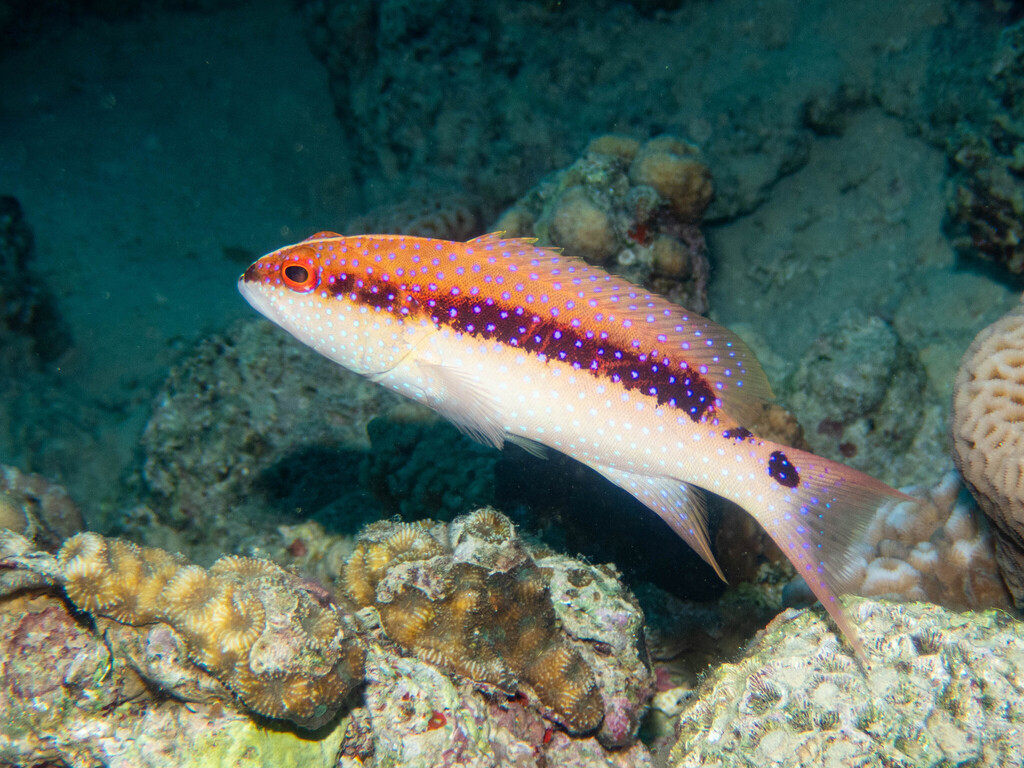
Everything above the tail says grouper: a robust oblong body, a rounded preopercle with fine serrations, three flat spines on the opercle, one to three large canines at the middle of the lower jaw, nine dorsal spines and thirteen or fourteen soft rays. Then the tail says something else. The caudal fin is lunate, with the upper and lower lobes produced to about twice the length of the middle rays. That is a fast-swimming tail, the kind you expect on a trevally or a fusilier, not on a fish that spends its life wedged into a cave. The mismatch is the whole story of how to fish for it. A fish built like a boulder and tailed like a jig is going to behave like neither one entirely, and the file gives you enough to work out which half wins. It also explains the fishing: a fish that can accelerate like a trevally but shelter like a grouper will take a moving lure in open water and then try to reach the wall with it. Knowing which of the two it will do, and when, is most of the skill.
Red is a depth signal
Colour runs from yellowish brown to orange-red, covered with small blue, lavender and pink spots, and the rear margins of the median fins are broadly yellow. FishBase notes that specimens from deeper water are more reddish. On a reef that runs from three metres to three hundred, that single line explains most of the arguments about identification: two anglers comparing photographs from the same wall, one at twenty metres and one at a hundred and fifty, may be looking at the same species in two different liveries. Do not key it out on redness. Use the tail, the jaw canines and the fin counts. Photograph the tail flat against something rigid, because a lunate tail held at an angle in a hand looks like a forked tail.
Three metres to three hundred
The recorded depth range is three to three hundred metres, with usual depths from fifteen downwards. Three hundred metres is unusual for a serranid that is also a sight-fisher's target on shallow reef, and it places the species on steep walls, outer reef slopes and the upper part of the deep drop, not on the flat. It is listed as non-migratory. In practical terms, the fish you meet at twenty metres and the fish at two hundred belong to one population spread across a very large vertical range, and the deep end is rarely fished. That asymmetry is worth remembering when you read landings data: most of what is recorded comes from the shallow edge.
Late maturity, high climate exposure
Maturity comes at 47.6 cm, with the recorded range starting at 41 cm. Common length is 75 cm and the maximum is 83 cm at 12 kg. Growth is slow for a reef predator, with K around 0.18 and a lifespan of seven to fifteen years, giving medium resilience and a vulnerability score of 43. The climate vulnerability score is 72 out of 100, in the high to very high band. Because the common length sits so close to the maximum, almost every fish landed is a mature adult, and there is no small-fish bycatch to absorb the pressure. A 75 cm fish is not a big specimen of this species; it is an ordinary one.
Fishing the wall, not the hole
The standard grouper approach, dropping a bait into a cave and waiting, works poorly here. Fish the wall: live baits drifted a metre or two off the face, metal jigs burned up through the water column, or a slow troll along the outer edge of a steep slope. The strike often comes in open water, well above the reef. Once hooked, the fish turns down and uses the wall, so set the drag before the bite rather than during the run. The first ten seconds decide the fight; after that, either the fish is clear of the coral or it is gone. Keep the boat moving away from the wall as the fish runs, because a stationary boat gives it something to turn back towards.
The ciguatera question comes first
FishBase records ciguatera poisoning for this species. With a trophic level of 4.3 and a diet of fish and crustaceans on reef walls, it sits high enough in the chain to accumulate the toxin. Larger, older individuals carry more, which is precisely the size class this fishery targets. There is no field test, and cooking does not remove the toxin. Numbness around the mouth, vomiting, diarrhoea or reversed temperature sensation after a meal needs medical attention. The species is also a commercial catch, a gamefish and an aquarium fish, and the Red List category is Least Concern as of 22 November 2016, but that assessment says nothing about the toxicity of the individual on your plate. In the four countries covered here the same fish is handled under four different frameworks, from national park closures to Myanmar's thinly documented reef fishery.
How to catch it
Trolling
Fished with the listed approach, matched to the recorded depth and size.
Jigging
Fished with the listed approach, matched to the recorded depth and size.
Boat bottom fishing
Fished with the listed approach, matched to the recorded depth and size.
Where these facts come from
Check these pages before you rely on a size, range or protection status.
- FishBase — Variola louti — FishBase · T2
- GBIF — Variola louti occurrence records — GBIF · T2
- IUCN Red List — Variola louti — IUCN · T1
- Photo record — iNaturalist — iNaturalist · T3
Fish in the same water
These fish live in the same place.

Guides for this water
Technique, gear and safety guides that fit Yellow-edged lyretail.