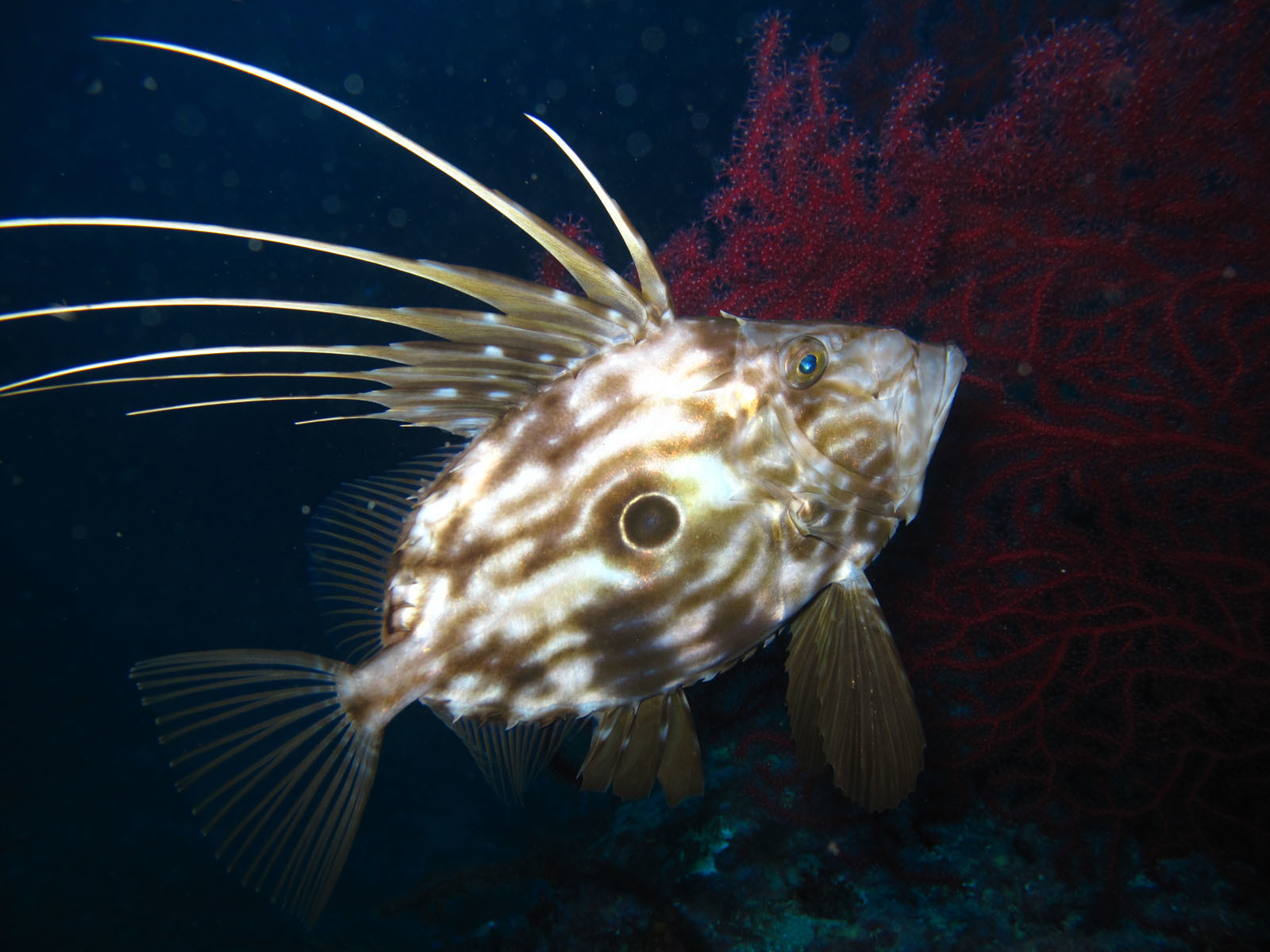
John dory (Zeus faber) is a fish of the family Zeidae. FishBase gives its range as: Worldwide in distribution. Eastern Atlantic: Norway to South Africa, also the Mediterranean and Black Sea. Western Pacific: Japan, Korea, Australia and New Zealand. It is recorded from 5 to 400 m, in temperate water. The recorded maxima are 90 cm TL, 8 kg, 12 years. Diet includes crustaceans, fishes and molluscs. IUCN status: Data Deficient (DD). Chinese name: .
Ten names and one scientific name
FishBase attaches ten English aliases to Zeus faber: Atlantic John dory, Doorkeeper's fish, Doree, Dory, Gallocristo, Girti, John dory, Keparu, Saint Pierre and St. Peter's fish. The Chinese column is just as crowded, with , , , , and their traditional-character variants. None of these names is wrong at the dock. The problem starts when a name is used as a search key: a query for "Dory" returns blue tangs and freshwater dories as readily as this fish, and a query for "Saint Pierre" returns a different animal in several languages.
Only the binomial survives the trip between sources. FishBase and the GBIF backbone agree on Zeus faber Linnaeus, 1758 and the same author. OBIS files 38,112 records under AphiaID 127427, drawn from 154 datasets. That agreement is not decorative; it is what makes a record traceable when the common name changes from port to port.
The name that points at the wrong family
One of the Chinese aliases is , literally "Japanese sea bream". A bream belongs to Sparidae; Zeus faber sits in Zeidae, the dories. The alias is a name, not a classification, and the page itself keeps the family in Zeidae. A reader who carries into a market or a regulations page can end up looking at the wrong family's size rules. The same risk runs the other way: the FishBase Chinese reference name is , and the page's taxonomy line places it in Zeidae.
This is the practical reason the article keeps returning to the binomial. The aliases tell you what people call the fish; the family tells you which rulebook applies. They are not interchangeable fields.
What the body actually shows
The morphology section is compact and useful at the rail. Dorsal spines number 9–11, dorsal soft rays 22–24, anal spines 4 and anal soft rays 20–23. The gill rakers are rudimentary, the scales minute, and the body highly compressed. The mark that settles most identifications is a large dark spot surrounded by a light ring on each flank.
At 40 cm common length and 90 cm maximum total length, the fish sits in the "short and/or deep" body class. The compressed profile and the thin scales mean a wet hand damages the surface quickly; the dark spot is easier to read in the water than on deck. The page gives no fin-ray count for the second dorsal or the caudal, so a count of the first dorsal and the anal fin is the part that can be verified.
Where the names travel
The distribution sentence is broad: eastern Atlantic from Norway to South Africa, including the Mediterranean and Black Sea; western Pacific from Japan and Korea to Australia and New Zealand; also the Indian Ocean. The FishBase country list contains 80 entries. That list is a set of national records, not a map of where the fish is common.
A GBIF present-records query on 2026-11-08 returned 54,364, with Ireland at 11,402, Great Britain at 9,757, France at 8,067, Spain at 6,530, Australia at 6,411, New Zealand at 5,195, Portugal at 2,448, Croatia at 512 and Japan at 504. The record centre sits in the northeast Atlantic, while the distribution text gives equal weight to the western Pacific. The difference is a sampling pattern: North Sea and Channel surveys submit far more records than Japanese coastal programmes do. That gap reflects who files records, not how many John dory live off Ireland.
The 5–400 metre envelope
FishBase gives a depth range of 5–400 m, usually 50–150 m. The biology text adds the behaviour that matters more than the envelope: the fish stays close to the sea bed and is generally solitary. A 400 m maximum does not mean a 400 m fish is waiting everywhere; the usual band is the part a line can reach on a normal day.
The same page records the species as benthopelagic and oceanodromous, and notes that it tolerates brackish water. That combination explains why the catches cluster around shelf edges and why an estuary record is possible without the fish being an estuarine resident. The depth figure and the habitat words describe different things: one is a limit, the other is a position in the water column.
Two spawning calendars
The spawning table holds two records: the western English Channel and Bay of Biscay in June–August, and New South Wales in January–April and December. Reproduction, according to the biology note, takes place at the end of winter and the start of spring in the northeastern Atlantic, and earlier in the Mediterranean, with pelagic eggs and maturity at four years.
Those statements are not a single season. The English Channel record is a summer event, the Australian record is a southern-summer event, and the Mediterranean note says "earlier" without giving months. For trip planning, the safe conclusion is that spawning is local: the table is a list of observations, not a global calendar. A fisherman who wants to avoid spawning fish has to use the record nearest the coast he sails from.
A commercial fish with a data gap
It is taken commercially, sought by anglers and kept in public aquariums. The flesh is described as excellent, sold fresh and frozen, and little used in West Africa. The IUCN assessment is Data Deficient, dated 20 May 2013. CITES and CMS both return Not Evaluated.
Data Deficient is not a synonym for rare, and it is not a licence to take everything. It means the assessment could not place the species in a threatened category with the evidence available. The commercial and gamefish flags sit alongside that gap, so the page supports a statement about use but not a statement about stock health. For a Greek, Portuguese or British landing, the size and bag figures would have to be read from that country's rulebook: the FishBase entry ends at the IUCN and CITES columns and carries no landing figure of its own.
Searching with the name that works
The practical search key is the binomial plus the database ID. FishBase summary 1370, GBIF taxon key 7744449 and OBIS taxonid 127427 all point at Zeus faber. iNaturalist holds 586 observations under the name John Dory. Those identifiers are stable in a way that "Dory" is not.
For a reader who is checking a local name, the order is: confirm the binomial on the fish, then match the family (Zeidae), then look up the national rule under the binomial. The alias list is useful for recognising what the person beside you is saying. It is not useful for deciding which regulation applies. That distinction is the whole reason a fish with ten English names still needs one scientific name.
Regulations before you keep it
These are the published regulations for this fish. Read the number first. The notice below it is the actual regulation.
Bag limit1
2 per day (West Coast) · 1 (Abrolhos Islands) · 4 (other bioregions)
Australia — Western Australia · AU-WA
Western Australia allows John dory within the demersal scalefish bag limit: 2 per fisher per day in the West Coast bioregion, 1 at the Abrolhos Islands and 4 in other bioregions.
The 4-fish figure for other bioregions commenced on 1 November 2026. Boat-based demersal fishing in the West Coast bioregion is closed until spring 2027, and demersal fish may not be on a boat there.
"Dory, John† Zeus faber N/A 2 1 4"
Every record above names its source and the date it was retrieved. See the regulation register for the full list, or how to read these regulations.
Where these facts come from
Check these pages before you rely on a size, range or protection status.
-
FishBase — Zeus faber
— FishBase · T2
-
GBIF — Zeus faber occurrence records
— GBIF · T2
-
IUCN Red List — Zeus faber
— IUCN · T1
-
Photo record — iNaturalist
— iNaturalist · T3