
Japanese eel in Japan — Hiroshima: ≤30 cm total length may not be taken · year-round — Hiroshima Prefecture sea area.
Regulation guide
Official sourcesWho manages Japanese eel
Japanese eel, Anguilla japonica, is caught in rivers, lakes, estuaries and coastal waters, and the rules are split between national law and prefectural fishing adjustment rules. The Fisheries Agency explains that catching aquatic animals in Japan is governed by the Fishery Act, the Aquatic Resources Protection Act, prefectural fishing adjustment rules and instructions issued by sea-area fisheries adjustment committees.
Those instruments set the species and sizes that may be taken, the gear and methods allowed, closed seasons and closed areas, and they bind recreational anglers as well as commercial fishers. For eel, the prefecture and the water body matter as much as the size of the fish.
Eel farming is a separate layer. Since 1 June 2015 eel aquaculture has been a designated aquaculture business requiring the permission of the Minister of Agriculture, Forestry and Fisheries, with limits on the number of glass eels put into ponds.
Source: 水産庁 遊漁・海面利用の基本的ルール · 水産庁 ウナギに関する情報
Glass eels: national protection and prefectural licences
Glass eels, shirasu-unagi, are the most tightly controlled stage. Since 1 December 2023 they have in principle been caught under a prefectural governor's fishery licence, rather than through general recreational access.
The Fisheries Agency also records that eel fry with a total length of 13 cm or less were designated as 特定水産動植物 under the Fishery Act, with the prohibition applying from December 2023. Kumamoto Prefecture states that recreational capture is prohibited and that a breach can bring up to three years' imprisonment or a fine of up to ¥30 million.
National pond-in limits cap how many glass eels the aquaculture sector may take in, and capture can be stopped when the national pond-in volume is expected to reach the cap. The agency asks prefectures to require catch and shipment reports, and the distribution of eel fry is also subject to traceability rules under the distribution law.
Source: 水産庁 ウナギの持続的利用のための資源管理の推進について(令和8年9月10日) · 熊本県 海面における遊漁のルール・マナーについて
Osaka: no eel of 20 cm or less
Osaka Prefecture's fishing adjustment rules define an eel fry fishery as a fishery targeting eel of 20 cm total length or less, and require a governor's licence for it. Article 34 then prohibits any person from taking eel of 20 cm total length or less, with an exception only for that licensed fishery.
The same article forbids possessing or selling eel taken in breach. A licensed eel fry fisher must report the result of the fishery to the governor within 30 days of the end of the fishing period, under Article 21.
Osaka's threshold is wider than the national 13 cm designation because it is a prefectural conservation rule, not the definition of the nationally protected fry class. Anglers should apply the stricter local figure.
Source: 大阪府漁業調整規則(令和2年大阪府規則第126号)
Kumamoto: 21 cm, and a winter ban on larger eels
Kumamoto Prefecture's sea-water guidance lists eel at 21 cm total length or less as prohibited year-round under the prefectural fishing adjustment rules. It also records a sea-area fisheries adjustment committee instruction: from 1 October to 31 March, taking eel longer than 21 cm is prohibited in the prefecture's sea waters and in rivers and lakes.
Read together, the two rules leave a narrow window. In Kumamoto's sea waters, rivers and lakes, an eel longer than 21 cm may be taken only from 1 April to 30 September, and an eel of 21 cm or less may not be taken at any time.
The instruction is aimed at downstream silver eels, the fish that migrate to spawn. It shows how a prefectural committee can add a seasonal layer that is not visible in the size table alone.
Source: 熊本県 海面における遊漁のルール・マナーについて
Downstream eels and local measures
The Fisheries Agency's 2026 notice to prefectures asks them to promote restrictions on catching downstream eels, including in coastal fisheries. It notes that closed seasons set by inland-water fisheries management committee instructions and sea-area committee instructions, voluntary closures and re-release are in place in some areas but not yet everywhere.
Tokyo's fisheries section describes the same approach. Since 2015 an eel resource management council has organised re-release of downstream eels by fishers, and anglers are asked to release any downstream eel they catch.
These measures can be voluntary or binding. A closed season or release rule may therefore apply on top of the size limit, and the local committee is the body to check.
Source: 水産庁 ウナギの持続的利用のための資源管理の推進について(令和8年9月10日) · 東京都産業労働局 うなぎの資源管理
Before you keep an eel
Measure total length, from the tip of the snout to the tip of the tail, because the Japanese rules are written as 全長. Osaka uses 20 cm, Kumamoto 21 cm, and the national fry designation uses 13 cm.
Check the prefecture and the water body, then the date. Kumamoto's larger-eel season closes from October to March; other prefectures may use different dates or voluntary measures, so the local rule has to be read before the fish is kept.
Do not keep glass eels: they are outside recreational take and are handled under the licensed fry fishery. A silver eel on its way downstream should be released, both because of local rules and because it is the spawning stock.
Source: 大阪府漁業調整規則(令和2年大阪府規則第126号) · 熊本県 海面における遊漁のルール・マナーについて · 水産庁 ウナギに関する情報
Official pages: 水産庁 ウナギに関する情報 · 水産庁 ウナギの持続的利用のための資源管理の推進について(令和8年9月10日) · 水産庁 遊漁・海面利用の基本的ルール · 大阪府漁業調整規則 · 熊本県 海面における遊漁のルール・マナーについて · 東京都産業労働局 うなぎの資源管理
Japanese eel regulations at a glance
6 jurisdictions| Jurisdiction | Area | Size | Bag | Season / closure | Closed area | Other |
|---|---|---|---|---|---|---|
| Japan — Fukuoka | Fukuoka Prefecture sea and inland waters | ≤21 cm total length may not be taken · year-round · sea and inland waters | — | — | — | — |
| Japan — Hiroshima | Hiroshima Prefecture sea area | ≤30 cm total length may not be taken · year-round | — | — | — | — |
| Japan — Mie | Mie Prefecture waters; Kumano River system has a 30 cm limit | ≤20 cm total length may not be taken · Kumano River system: ≤30 cm | — | — | — | — |
| Japan — Nagasaki | Nagasaki Prefecture waters | ≤21 cm total length may not be taken | — | — | — | — |
| Japan — Shizuoka | Shizuoka Prefecture sea area | ≤13 cm total length may not be taken | — | — | — | — |
| Japan — Tokyo | Tokyo sea area | ≤24 cm total length may not be taken | — | — | — | — |
Japanese eel
Anguilla japonica · Anguillidae
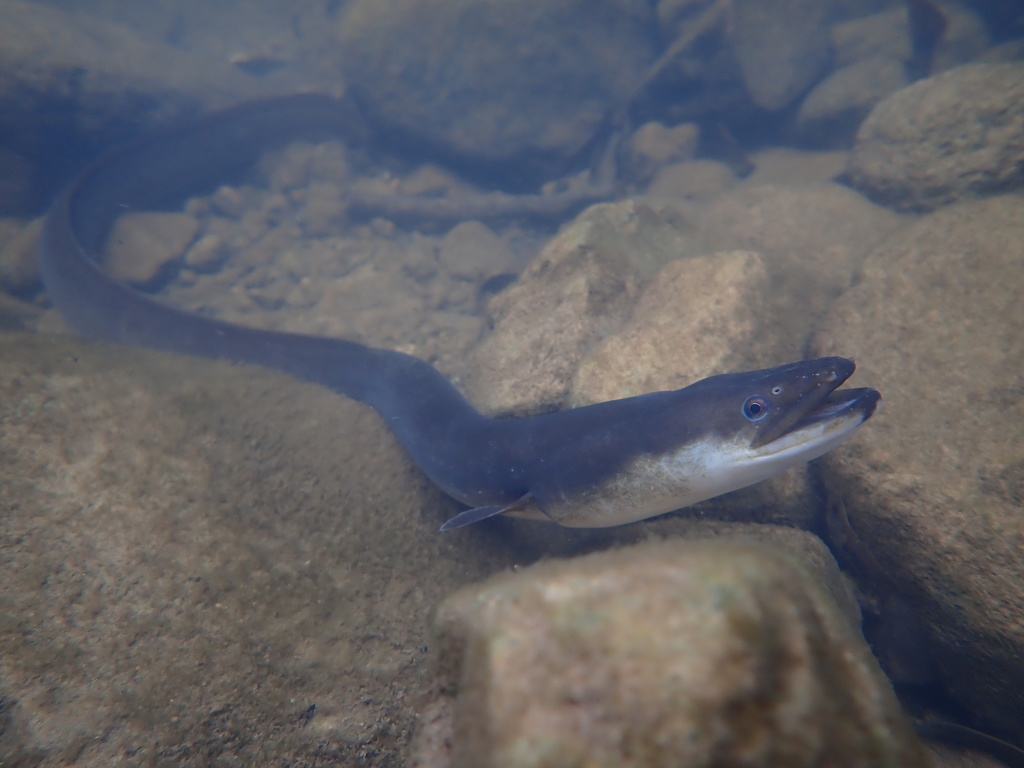
Japanese eel is a long, snakelike fish of East Asian coasts, from Japan and Korea through the East China Sea to Taiwan, China and the northern Philippines. It reaches 150 cm, feeds on crustaceans and fish, and prefers water of 4 to 27 °C. Night fishing and bottom fishing are the usual approach.
- Family
- Anguillidae
- Max length
- 150 cm TL
- Depth
- 1–400 m
- IUCN
- EN
- Climate
- Subtropical · 4–27 °C
- Diet
- crustaceans, fishes
Japanese eel (Anguilla japonica) is a fish of the family Anguillidae. FishBase gives its range as: Asia: Japan to the East China Sea, Taiwan, Korea, China and northern Philippines. Spawning grounds of this species are presumed to be in the western Mariana Islands, at a salinity front near 15°N and 140°E. It is recorded from 1 to 400 m, in subtropical water at 4–27 °C. The recorded maximum is 150 cm TL. Common length is recorded at 40 cm. Diet includes crustaceans and fishes. IUCN status: Endangered (EN). Chinese name: .
Techniques
- Night fishing —
- Bottom fishing —
Seasonality
Other JP-34 regulations
Same jurisdictionBefore you keep a fish
- Read the recorded value. It is copied from the notice; if the number and the notice disagree, the notice wins.
- Check the area. Federal, state and local waters can set different limits for the same fish.
- Check the date. Seasons, quotas and closures change; confirm the current notice before you go.
Common questions
- What is the minimum size for Japanese eel in Japan — Hiroshima?
- ≤30 cm total length may not be taken · year-round
- Where does this regulation apply?
- Hiroshima Prefecture sea area
- When was it checked?
- 2026-11-18, against www.pref.hiroshima.lg.jp.
- Do other jurisdictions set different limits?
- Yes. This register lists 6 jurisdictions for Japanese eel; compare them in the table above.