
Atlantic cod in United States — Rhode Island: Recreational harvest, landing and possession prohibited — Rhode Island marine waters.
3.19.1 Recreational A.The harvest, landing, and possession of Cod in the marine waters of Rhode Island is prohibited while fishing recreationally.
Quoted from 250-RICR-90-00-3 Finfish
Regulation guide
Official sourcesHow Atlantic cod is managed
There are four Atlantic cod stocks in U.S. waters: Eastern Gulf of Maine, Western Gulf of Maine, Georges Bank and Southern New England. All four are classified as overfished, and the Western Gulf of Maine and Southern New England stocks are also subject to overfishing, according to NOAA Fisheries. NOAA Fisheries and the New England Fishery Management Council manage the species under the Northeast Multispecies Fishery Management Plan.
The plan combines annual catch limits, minimum fish sizes, year-round and seasonal area closures, gear restrictions and separate rules for recreational vessels. Georges Bank cod is managed jointly with Canada because the stock crosses the international boundary. Because the stocks are rebuilding, the recreational fishery is deliberately narrow: a short autumn season in the northern stock areas and no retention at all in Southern New England.
Source: NOAA Fisheries: Atlantic Cod · NOAA Fisheries: Northeast Multispecies (Groundfish), Recreational Fishing
Federal waters: one cod in the autumn
Federal recreational measures apply to private vessels in the exclusive economic zone, generally 3 to 200 nautical miles offshore, to federally permitted charter and party vessels, and to groundfish limited-access vessels fishing under charter, party or recreational rules. In the Eastern Gulf of Maine, Western Gulf of Maine and Georges Bank stock areas the limit is one cod per person per day, the minimum size is 23 inches total length, and the season is September 1 through October 31. There is no maximum size.
Each angler may fish one line, with no limit on the number of hooks, and all other gear must be stowed. Cod must be kept so they are readily available for inspection, and fish caught on a recreational trip may not be sold, bartered or traded. Fillets must carry at least two square inches of contiguous skin for identification; two fillets count as one whole fish and a butterfly fillet counts as one fish.
On multi-day trips the daily limit may be multiplied by the number of calendar days fished. A two-day trip must last at least 15 hours, and the second day's limit may be possessed only after the second day begins. A vessel with a legal cod limit from one stock area may transit another stock area if bait and hooks are removed from the rods and the cod are gutted and stored.
Source: NOAA Fisheries: Northeast Multispecies (Groundfish), Recreational Fishing
Southern New England is closed
The Southern New England stock area is closed to recreational cod retention. NOAA lists the possession limit as no retention and the season as closed, and the stock-area boundaries are set out at 50 CFR 648.88.
The rule bars retention in that area rather than allowing a reduced bag, and the transit provision above is the limited exception for fish already legally taken in another stock area. Anglers crossing the boundary should remove bait and hooks and store any cod on board as gutted fish.
Source: NOAA Fisheries: Northeast Multispecies (Groundfish), Recreational Fishing · 50 CFR 648.88: Atlantic cod stock areas
Massachusetts state waters
Massachusetts manages cod in state waters under 322 CMR, with separate rules for the Western Gulf of Maine and Southern New England. In the Western Gulf of Maine the state limit is 23 inches, one fish and September 1 through October 31, matching the federal measures. State waters in the Southern New England Cod Management Area are closed to cod retention.
Two conservation closures also apply. Hook-and-line fishing is prohibited in the Winter Cod Conservation Closure from November 15 through January 31, and cod may not be taken from the Spring Cod Conservation Closure from April 16 through July 21. The Division of Marine Fisheries describes its online table as an unofficial copy of 322 CMR and notes that vessels fishing lawfully in federal waters may possess and land fish under federal rules.
Source: Massachusetts Division of Marine Fisheries: Recreational Saltwater Fishing Regulations
New Jersey
New Jersey sets a different season in its marine waters: 23 inches, five fish per person per day, open January 1 through May 31 and September 1 through December 31. Fish are measured from the tip of the snout to the tip of the tail. Cleaning or filleting cod at sea is prohibited because the species has a minimum size.
New Jersey also requires saltwater anglers to register with the New Jersey Saltwater Recreational Registry before fishing; the state describes registration as free and mandatory. The state summary covers New Jersey marine waters, while the federal measures above govern the exclusive economic zone, so anglers crossing offshore need to check both sets of rules.
Source: New Jersey Division of Fish and Wildlife: Attention Anglers 2026 · New Jersey Division of Fish and Wildlife: Marine Seasons and Regulations
United Kingdom
The UK Marine Management Organisation publishes statutory guidance on minimum conservation reference sizes. Cod is listed at 35 cm for UK waters, in Region 2 as defined by Council Regulation (EC) No 850/98. The guidance was updated on 3 February 2026.
The table is the reference size for cod in UK waters. The guidance addresses size only, so anglers should check any additional national or local measures before retaining a fish.
Source: GOV.UK / Marine Management Organisation: Minimum Conservation Reference Sizes in UK Waters
France
France sets a 42 cm minimum for cod (cabillaud) in the North Sea, Channel and Atlantic. The rule appears in the arrêté of 26 October 2012 on minimum catch sizes for recreational sea fishing, which was last updated on 14 January 2026 and was in force on 16 November 2026. The same order lists separate minima for other species, such as 42 cm for seabass and 35 cm for saithe.
The French minimum is larger than the 35 cm reference used in UK waters, so a cod that can be kept in one jurisdiction may be undersized in the other. Anglers fishing French waters should measure the fish before retaining it and check the current version of the order.
Source: Légifrance: Arrêté du 26 octobre 2012 (tailles minimales de capture, pêche maritime de loisir) · GOV.UK / Marine Management Organisation: Minimum Conservation Reference Sizes in UK Waters
Official pages: NOAA Fisheries: Atlantic Cod · NOAA Fisheries: Northeast Multispecies (Groundfish), Recreational Fishing · 50 CFR 648.88: Atlantic cod stock areas · Massachusetts Division of Marine Fisheries: Recreational Saltwater Fishing Regulations · New Jersey Division of Fish and Wildlife: Attention Anglers 2026 · GOV.UK / Marine Management Organisation: Minimum Conservation Reference Sizes · Légifrance: Arrêté du 26 octobre 2012
Atlantic cod regulations at a glance
11 jurisdictions| Jurisdiction | Area | Size | Bag | Season / closure | Closed area | Other |
|---|---|---|---|---|---|---|
| France | France — North Sea, Channel and Atlantic | ≥42 cm | — | — | — | — |
| Spain | Spain — Cantabrian/Northwest and Gulf of Cadiz | ≥35 cm | — | — | — | — |
| United Kingdom | UK waters (Region 2 as defined by Council Regulation (EC) No 850/98) | ≥35 cm | — | — | — | — |
| United States — Maine | Maine territorial waters | — | 23 in · 1 fish per angler per day · Sept 1 – Oct 31 | — | — | — |
| United States — Massachusetts | Massachusetts Southern New England state waters | — | — | — | Southern New England state waters: recreational cod prohibited | — |
| United States — Massachusetts | Massachusetts state waters — Western Gulf of Maine | — | 23 in minimum size · 1 fish per day · September 1 – October 31 | — | — | — |
| United States — New Jersey | New Jersey marine waters | — | 23 in · 5 fish per person per day · January 1 – May 31 and September 1 – December 31 | — | — | — |
| United States — New York | New York Marine and Coastal District | — | 23 in · 5 fish per person per day · Sept 1 – May 31 | — | — | — |
| United States — Rhode Island | Rhode Island marine waters | — | — | — | — | Protected species: Recreational harvest, landing and possession prohibited |
| United States — federal (Gulf) | — | 23 in total length · 1 fish per person per day · September 1 – October 31 | — | — | — | |
| United States — federal (Northeast) | — | — | — | No retention · closed | — |
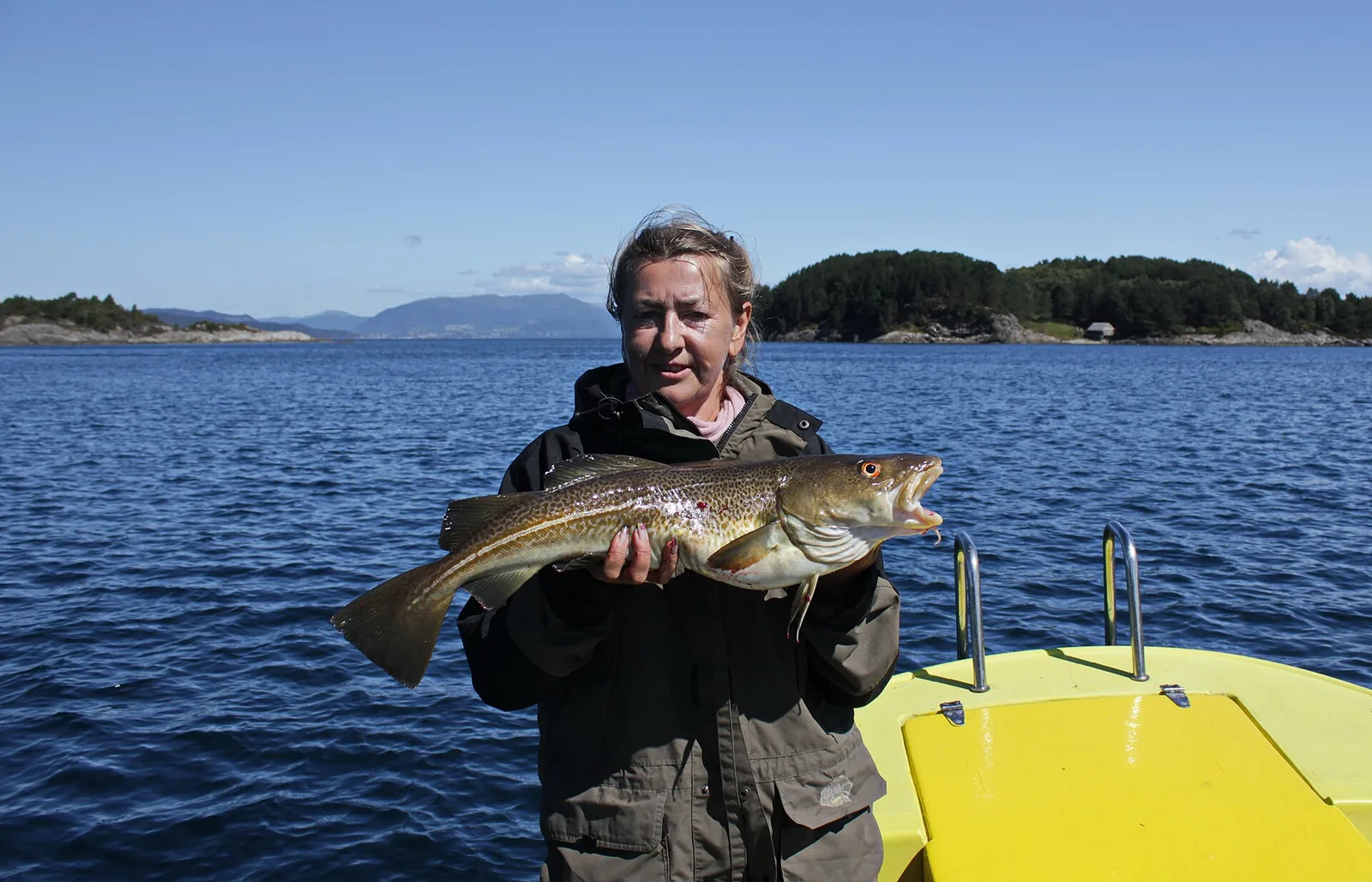
Atlantic cod
Gadus morhua · Gadidae
Atlantic cod exists twice in the North Atlantic: as a commodity sold by weight, and as a wild fish holding hard bottom at 180 m. FishBase gives 200 cm and 96 kg maximum, 100 cm common length, maturity at 65.4 cm and a 25-year lifespan. Those numbers describe different fisheries, and confusing them is how cod trips fail.
- Family
- Gadidae
- Max length
- 200 cm TL
- Max weight
- 96 kg
- Max age
- 25 years
- Depth
- 0–600 m
- IUCN
- VU
- Climate
- Temperate · 0–15 °C
- Diet
- fishes
Atlantic cod is the clearest case in the North Atlantic of a fish that exists twice: as a commodity with a price per kilogram, and as a wild animal on a reef edge at 180 m. FishBase puts the maximum at 200 cm total length and 96 kg, the common length at 100 cm, maturity at 65.4 cm, and the maximum reported age at 25 years. It also lists the species as highly commercial, commercially farmed and a gamefish. Those four descriptions are not interchangeable, and the gap between them is where most anglers get the wrong mental picture of the fish they are hunting.
Techniques
- Boat bottom fishing —
- Slow pitch jigging —
Baits
- Clam
- Squid strip
- Mackerel fillet
- Slow-pitch jig
Seasonality
Peak Jan–DecCurrent matters more than tide height. Fish the middle of the tide when the drift is controlled and scent travels.
Cold, stable air and low wind are ideal. A big pressure drop ahead of a gale usually ends the bite.
Other US-RI regulations
Same jurisdictionBefore you keep a fish
- Read the recorded value. It is copied from the notice; if the number and the notice disagree, the notice wins.
- Check the area. Federal, state and local waters can set different limits for the same fish.
- Check the date. Seasons, quotas and closures change; confirm the current notice before you go.
Common questions
- What is the protected species for Atlantic cod in United States — Rhode Island?
- Recreational harvest, landing and possession prohibited
- Where does this regulation apply?
- Rhode Island marine waters
- When was it checked?
- 2026-11-18, against 250-RICR-90-00-3 Finfish.
- Do other jurisdictions set different limits?
- Yes. This register lists 11 jurisdictions for Atlantic cod; compare them in the table above.