Atlantic cod is the clearest case in the North Atlantic of a fish that exists twice: as a commodity with a price per kilogram, and as a wild animal on a reef edge at 180 m. FishBase puts the maximum at 200 cm total length and 96 kg, the common length at 100 cm, maturity at 65.4 cm, and the maximum reported age at 25 years. It also lists the species as highly commercial, commercially farmed and a gamefish. Those four descriptions are not interchangeable, and the gap between them is where most anglers get the wrong mental picture of the fish they are hunting.
Two cod: the one in the shop and the one on the reef
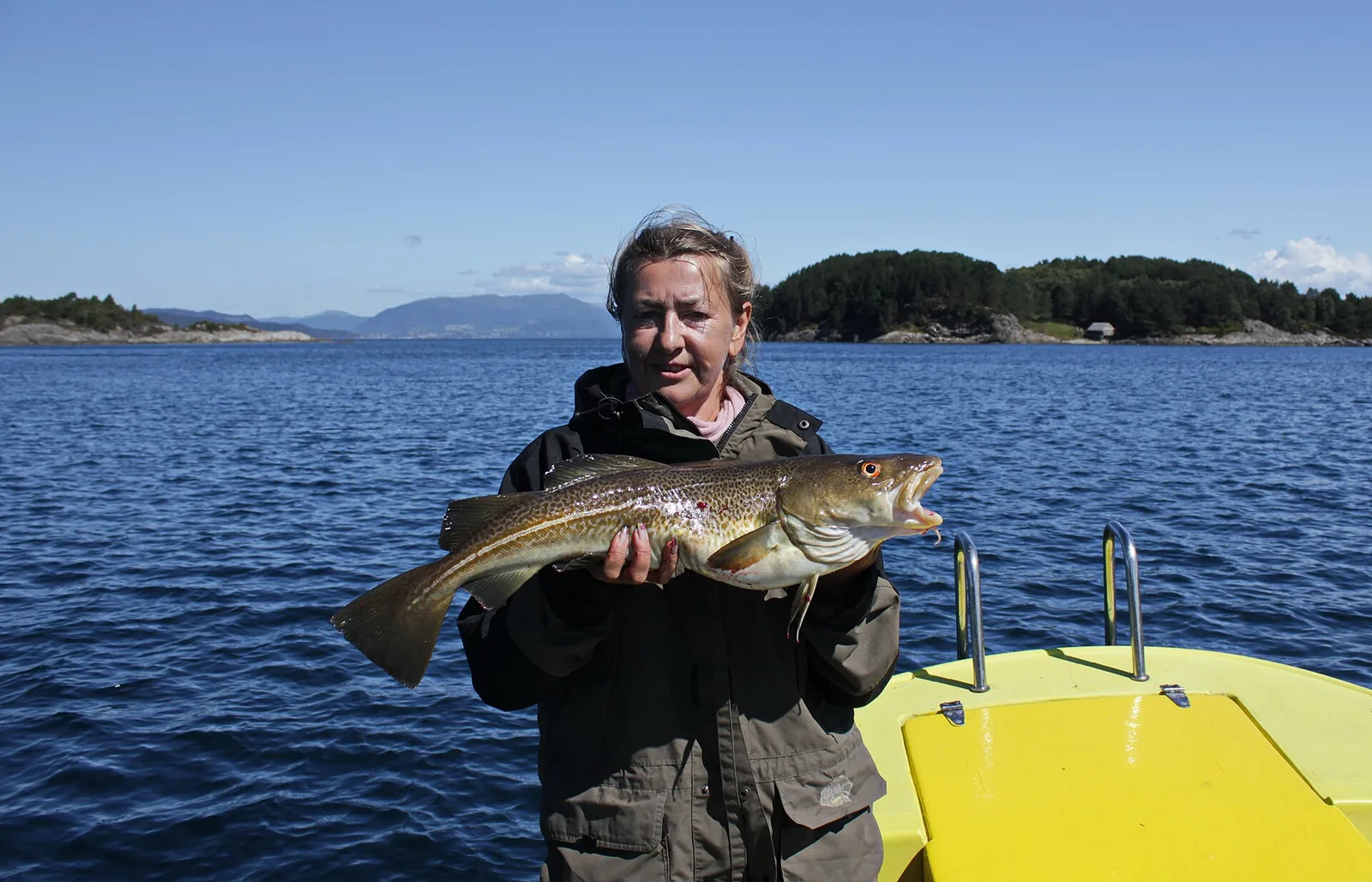
The cod in a fishmonger's window is usually 40–70 cm, filleted, and sold by weight. The cod that a rod-and-line angler meets offshore is a different size class entirely: a mature fish of 3–10 kg, holding over hard bottom in 100–200 m, and old enough to be a decade or more into a 25-year lifespan. FishBase's 100 cm common length sits between those two worlds and describes neither.
That matters when planning. A mark that produces 45 cm cod is a nursery-adjacent mark; a mark that produces 8 kg fish is a spawn aggregation or a hard-bottom holding area, and the two are rarely the same place. Treating the first as evidence that the second is nearby is the single most common way a cod trip fails.
Why the record fish is an old measurement
The 200 cm and 96 kg maxima belong to a period when large cod were common enough to be landed and weighed. A 25-year maximum age explains how such a fish can exist: cod grow slowly after maturity, and a fish that reaches 15 kg has spent a long time converting food into length rather than into eggs. A 96 kg fish is not a scaled-up 10 kg fish; it is a different life history.
For tackle this is a margin question, not a target. Build for fish of 5–15 kg and accept that a 30 kg fish will take line. The usual failure is not a broken rod but a hook straightened or a leader abraded on rock after a long fight.
What a 65 cm maturity length means for a stock
FishBase gives length at first maturity as 65.4 cm, with a reported range of 31–74 cm. A range that wide is a statement about how variable cod is across the North Atlantic: Barents Sea fish mature at a different size from Baltic fish, and the range reflects that. A management measure written as one number in one sea area does not transfer to the next.
For an angler the practical translation is simple. A 60 cm cod in a northern sea is likely immature and belongs back in the water; a 60 cm cod in a southern stock may already have spawned once. Know which stock is in front of you before deciding what a "small" fish is.
Depth: 0–600 m, usually 150–200 m
The catalogue's depth field runs 0–600 m, with a working band at 150–200 m. The extremes are real but not useful: the 0 m figure covers juveniles in shallow, often brackish water, and the 600 m figure is an edge case. The working band is 150–200 m over hard bottom, which is where the fishable concentrations sit.
That depth band decides gear more than any other number. At 150 m, a 300 g jig needs a slow drift to reach bottom and a fast one to stay there; a 500 g jig fishes better in current and worse in slack. Braid diameter matters more than rod action because water load on the line, not the fish, sets the feel. A 0.20 mm braid at 180 m is a different tool from 0.30 mm at the same depth.
Cod also rise off the bottom to meet a bait, sometimes 20–30 m up. A sonar mark that sits well above the seabed is worth dropping to, and a bait fished 5 m off bottom in a slow drift often outfishes one pinned to the rocks.
Spawning across the whole year in the Baltic and Barents
The spawning table attached to the record carries entries in every month: the Bornholm Basin from April to August, the Belt Sea and Kiel Bay from January to June, the Gdansk Deep and Gotland Basin from April to November, and the Barents Sea in March to May. The pattern is not one season but several, each tied to a local stock and a local temperature window.
In practice the Baltic spawn is a spring event in brackish water, and the Barents spawn is a late-winter event in cold, fully marine water. A trip planned around "cod spawning" needs to specify which sea. The relevant local signal is water temperature: FishBase gives the species a 0–15 °C range, and spawning tends to sit in the upper part of whatever range the local stock tolerates.
Fishing: bait, rig, drift
Cod take bait more reliably than lures in cold water. A single 8/0 circle hook on a 1 m mono leader, baited with a fillet strip or a whole small fish, fished on a running boom, is the baseline. The circle hook matters: cod swallow and turn, and a J-hook in the gut is a dead fish.
Lures work when fish are feeding up in the water column. A 200–400 g slow-pitch jig, worked with two sharp lifts and a controlled fall, covers the 150–200 m band efficiently. Add a small glow bead or a short squid skirt in low light; the difference is visible on the same drift.
Drift control is the skill that separates good cod days from average ones. The boat should move at 0.5–1.5 knots over the ground so the line stays near vertical; faster and the jig planes away from the structure, slower and you snag. Watch the sounder for the hard-to-soft transition and drop on the hard side.
The 1996 VU listing and what happened after
The conservation field in the catalogue reads Vulnerable, dated 1 August 1996. A listing that old is historical context rather than a current stock summary: cod stocks across the North Atlantic have been assessed, closed and reopened many times since, and the global category has been revised in later assessments that are not reflected in this record.
Read it as a signal that the species has a history of depletion, not as a rule for today. The operative rules — minimum sizes, bag limits, closed areas and seasonal closures — are set per stock by the coastal state, and they change on a different cycle from the Red List.
Reading the North Atlantic record
The GBIF occurrence index holds 3,299,713 cod records, headed by Canada at 2,156,084, then Poland at 178,983, Denmark at 161,714, Sweden at 161,082 and Britain at 155,196. That distribution is a map of survey effort, not abundance: Canadian records come from long-running trawl surveys on the Grand Banks and the Scotian Shelf, and the European numbers come from ICES-coordinated groundfish surveys.
iNaturalist's 1,717 observations point the other way, toward accessible water and recreational divers. Neither dataset tells you where to fish. What they do say is that cod is a continental-shelf fish with a northern centre of gravity, and that the southern edge of its range — the Bay of Biscay and the Celtic Sea — is where the record thins out. Plan a trip on the northern shelf, and check the local stock rules before you book.
Where and when it feeds
Tide. Current matters more than tide height. Fish the middle of the tide when the drift is controlled and scent travels.
Weather. Cold, stable air and low wind are ideal. A big pressure drop ahead of a gale usually ends the bite.
How to catch it
Boat bottom fishing
Anchored or drifting boat, bait or lure worked near the recorded bottom.
Slow pitch jigging
Slow-pitch jigging with a controlled fall and short lifts.
Bait and lures
ClamSquid stripMackerel filletSlow-pitch jig
Regulations before you keep it
These are the published regulations for this fish. Read the number first. The notice below it is the actual regulation.
Minimum size3
The minimum size for Atlantic cod in Spain is ≥35 cm.
| Bacalao (Gadus morhua) | 35 |
France's minimum capture size for cod (cabillaud) is 42 cm in the North Sea, Channel and Atlantic.
The arrêté sets the minimum sizes applicable to recreational sea fishing (pêche maritime de loisir).
| CABILLAUD | Gadus morhua | 42 cm |
≥35 cm
United Kingdom · UK
The UK minimum conservation reference size for Atlantic cod is 35 cm.
Listed in the Fish table of the MCRS statutory guidance, updated 3 February 2026.
| Cod | Gadus morhua | 35 cm |
Bag limit5
23 in total length · 1 fish per person per day · September 1 – October 31
United States — federal (Gulf) · US-FED-GOM
US federal (NOAA) recreational rule: Atlantic cod in the Eastern Gulf of Maine, Western Gulf of Maine and Georges Bank may be kept at 1 fish per person per day, minimum total length 23 inches, from September 1 through October 31.
Atlantic cod | Eastern Gulf of Maine, Western Gulf of Maine, Georges Bank¹ | 1 fish per person per day | 23 | N/A | September 1 - October 31
23 in minimum size · 1 fish per day · September 1 – October 31
United States — Massachusetts · US-MA
Massachusetts state waters follow the Gulf of Maine cod season: minimum size 23 inches, 1 fish per person per day, September 1 through October 31.
The Massachusetts DMF page was last updated on April 28, 2026.
Cod (4, 5) * Western Gulf of Maine | Min: 23" | Sept 1 - Oct 31 | 1 fish
23 in · 1 fish per angler per day · Sept 1 – Oct 31
United States — Maine · US-ME
Maine allows one Atlantic cod per angler per day from Sept 1 to Oct 31 at 23 inches.
ATLANTIC COD (Gadus morhua)
Size: Minimum size 23 inches.
Bag limit: 1 fish per angler per day.
Season: Sept 1 – Oct 31, inclusive.
23 in · 5 fish per person per day · January 1 – May 31 and September 1 – December 31
United States — New Jersey · US-NJ
New Jersey allows five cod per person per day at 23 inches, in two open periods: January 1 to May 31 and September 1 to December 31.
Cod | 5 fish: Jan 1 - May 31 & Sept 1 - Dec 31 | 23"
23 in · 5 fish per person per day · Sept 1 – May 31
United States — New York · US-NY
New York allows 5 Atlantic cod per person per day from Sept 1 to May 31 at 23 inches.
Atlantic cod 23" 5 Sept 1 - May 31
Closed area2
No retention · closed
United States — federal (Northeast) · US-FED-SNE
US federal (NOAA) recreational rule: there is NO RETENTION of Atlantic cod in the Southern New England stock area; that area is CLOSED.
Stock-area boundaries are in 50 CFR 648.88 and the NOAA page maps.
| Southern New England¹ | NO RETENTION | N/A | N/A | CLOSED
Southern New England state waters: recreational cod prohibited
United States — Massachusetts · US-MA
Massachusetts prohibits recreational retention of cod in Southern New England state waters.
Cod (4,5) *
Southern New England N/A N/A Prohibited
Protected species1
Recreational harvest, landing and possession prohibited
United States — Rhode Island · US-RI
Rhode Island prohibits recreational harvest, landing or possession of cod in marine waters.
3.19.1 Recreational
A.The harvest, landing, and possession of Cod in the marine waters of Rhode Island is prohibited while fishing recreationally.
Every record above names its source and the date it was retrieved. See the regulation register for the full list, or how to read these regulations.
Where these facts come from
Check these pages before you rely on a size, range or protection status.
-
FishBase — Gadus morhua
— FishBase · T2
-
GBIF — Gadus morhua occurrence records
— GBIF · T2
-
IUCN Red List — Gadus morhua
— IUCN · T1
-
Photo record — iNaturalist
— iNaturalist · T3