
Geelbek in South Africa: 60 cm minimum · 2 fish per person per day — South African marine waters.
Geelbek (Cape salmon) Atractoscion aequidens 60 cm 2
Quoted from Regulations in terms of the Marine Living Resources Act, 1998 — Annexure 7
Size is measured in a straight line from the tip of the snout to the extreme end of the tail (regulation 22(8)).
Regulation guide
Official sourcesHow geelbek is managed
Geelbek (Atractoscion aequidens), also called Cape salmon, is a linefish managed nationally under the Marine Living Resources Act 18 of 1998 and the regulations published as GNR 1111 of 2 September 1998. DFFE administers the recreational table in Annexure 7 of those regulations.
Geelbek is also a commercial traditional linefish species, and DFFE issues separate permit conditions for that sector. A recreational angler is bound by the recreational entry, not by the commercial table, even when both appear to describe the same fish.
Source: DFFE: Regulations in terms of the Marine Living Resources Act, 1998 (GNR 1111, consolidated)
The 60 cm minimum
The recreational table sets a minimum size of 60 cm for geelbek. DFFE's consolidated table lists the species with that figure and a daily bag of two, and the same size appears in the commercial Zone B conditions for 2025/2026.
Size is measured in a straight line from the tip of the snout to the extreme end of the tail, which is total length. A fish measured to the fork will read short, and a geelbek close to the line should be measured along the full body before any decision is made.
Source: DFFE: Regulations in terms of the Marine Living Resources Act, 1998 (GNR 1111, consolidated) · DFFE: Permit Conditions, Commercial Traditional Linefish, Zone B 2025/2026
Two fish per person per day
The recreational bag is two geelbek per person per day. The limit is attached to the person, so a boat carrying three licensed anglers can lawfully hold six geelbek, provided that every fish reaches 60 cm.
The bag is small enough that a single good fish makes a trip, and an angler should count the day's geelbek before adding another species to the box. A mixed bag of geelbek and kob has to be counted against each species separately.
Source: DFFE: Regulations in terms of the Marine Living Resources Act, 1998 (GNR 1111, consolidated)
Recreational and commercial rules are separate
DFFE's Zone B commercial traditional linefish conditions for 2025/2026, covering Cape Infanta to Port St Johns, list geelbek at 60 cm with an unlimited bag. That column belongs to a commercial permit holder operating under a linefish right.
An unlimited commercial figure is not available to a recreational angler. The recreational table caps geelbek at two per person per day, and a recreational permit may not be used to sell fish, so the commercial allowance has no application to a sport or subsistence trip.
The two documents nevertheless agree on the size. That agreement is useful: a geelbek that is under 60 cm is unlawful in both sectors, whatever else the permit says.
Source: DFFE: Permit Conditions, Commercial Traditional Linefish, Zone B 2025/2026 · DFFE: Regulations in terms of the Marine Living Resources Act, 1998 (GNR 1111, consolidated)
Permits, sale and landing
A recreational fishing permit is required to fish in South African marine waters, and it must be obtained from an office authorised by the Minister on payment of the prescribed fee. The permit holder may not sell fish caught under it.
Fish must be landed whole, with head and tail intact, although they may be gutted. Geelbek are often gutted at sea, and that is permitted; filleting is not, because it destroys the evidence an inspector needs to confirm the species and the length.
Keeping the head and tail also settles the identification question. A trunk with no head cannot be measured against the 60 cm line, and the angler carries the risk of that uncertainty.
Source: DFFE: Regulations in terms of the Marine Living Resources Act, 1998 (GNR 1111, consolidated)
Telling geelbek from kob
The recreational table lists geelbek and kob as separate entries with different size rows. Geelbek carries 60 cm, while kob carries 50 cm in the boat sector between Cape Agulhas and the Umtamvuna River and 60 cm in estuaries and from the shore east of Cape Agulhas.
That difference makes identification part of the rule. A 55 cm fish that is a kob in the boat sector may be legal, while a geelbek of the same length is short; measuring first and identifying second can produce the wrong answer.
The practical check is to look at the fish before opening the tape. If the species is uncertain, treat the fish as the more restrictive of the two and return it.
Source: DFFE: Regulations in terms of the Marine Living Resources Act, 1998 (GNR 1111, consolidated)
What to check before keeping a geelbek
Confirm the area and the sector, measure the fish from snout to tail against 60 cm, and count the day's geelbek against two per person. Check that the fish is whole apart from gutting, and that the permit is on board.
The regulations also contain closed seasons and closed areas, so a legal size does not make a fish legal in a marine protected area or another closed zone. Those spatial rules sit alongside the bag and size table and can close a piece of water entirely.
If any of those checks is doubtful, the fish should go back. A released geelbek costs nothing; a short or excess fish at the slipway costs the trip.
Source: DFFE: Regulations in terms of the Marine Living Resources Act, 1998 (GNR 1111, consolidated)
Official pages: DFFE: Regulations in terms of the Marine Living Resources Act, 1998 (GNR 1111) · DFFE: Commercial Traditional Linefish Permit Conditions, Zone B 2025/2026 · DFFE: Recreational fishing permits
Geelbek regulations at a glance
1 jurisdictions| Jurisdiction | Area | Size | Bag | Season / closure | Closed area | Other |
|---|---|---|---|---|---|---|
| South Africa | South African marine waters | — | 60 cm minimum · 2 fish per person per day | — | — | — |
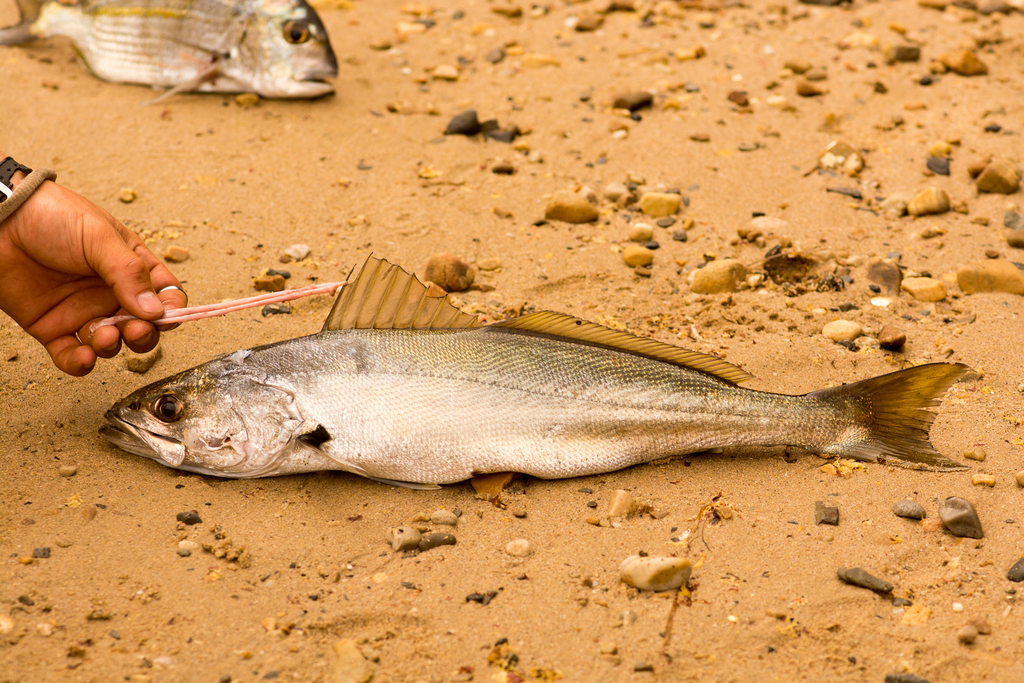
Geelbek
Atractoscion aequidens · Sciaenidae
Geelbek is a large sciaenid of the western Indian Ocean, recorded off Mozambique and South Africa between 14 degrees north and 28 degrees south. It works 15 to 200 m, usually 100 to 200, in tropical water. It reaches 130 cm TL with a common length of 90 cm, publishes at 25 kg and matures around 65 cm. IUCN assessed it as Near Threatened in September 2018, and boat bottom fishing and jigging are the methods listed.
- Family
- Sciaenidae
- Max length
- 130 cm TL
- Max weight
- 25 kg
- Depth
- 15–200 m
- IUCN
- NT
- Climate
- Tropical
FishBase gives *Atractoscion aequidens* 130 cm TL maximum, 90 cm SL common, 25 kg published weight, and a maturity entry of Lm unknown with a range starting at 65 cm. The environment line is 15–200 m, usually 100–200 m, in tropical water from 14°N to 28°S, and the IUCN assessed it as Near Threatened on 25 September 2018. It is a croaker, not a kob: the word geelbek belongs to *Atractoscion*, and none of the kob rules are written for it.
Techniques
- Boat bottom fishing —
- Jigging —
Seasonality
Other ZA regulations
Same jurisdictionBefore you keep a fish
- Read the recorded value. It is copied from the notice; if the number and the notice disagree, the notice wins.
- Check the area. Federal, state and local waters can set different limits for the same fish.
- Check the date. Seasons, quotas and closures change; confirm the current notice before you go.
Common questions
- What is the bag limit for Geelbek in South Africa?
- 60 cm minimum · 2 fish per person per day
- Where does this regulation apply?
- South African marine waters
- When was it checked?
- 2026-11-18, against Regulations in terms of the Marine Living Resources Act, 1998 — Annexure 7.