
Cobia in United States — Rhode Island: 43 in · 1 fish per person per day · 2 per vessel per day · year round — Rhode Island state waters.
3.34.1 Recreational A.Minimum size: Forty three inches (43”). B.Season: January 1 through December 31. C.Possession limit: One (1) fish per person per day. D.Maximum per vessel possession limit: The possession limit shall be per person per day, as stated above, with a maximum of two (2) fish per vessel per day.
Quoted from 250-RICR-90-00-3 Finfish
Regulation guide
Official sourcesTwo stocks, two management systems
Cobia in U.S. waters are split into two management groups. NOAA Fisheries and the Gulf of Mexico Fishery Management Council manage cobia in the Gulf and off the east coast of Florida. The Atlantic migratory group, from Georgia through New York, is managed by the Atlantic States Marine Fisheries Commission.
The Gulf group is managed under the Fishery Management Plan for Coastal Migratory Pelagics in the Atlantic and Gulf of Mexico, while the Atlantic group has its own ASMFC interstate plan. Recreational anglers do not need a federal permit to harvest cobia, but the two groups do not always carry the same size or bag rules.
Cobia are most abundant from Virginia south through the Gulf, and they migrate seasonally, moving south and offshore in late fall and winter. They are structure-oriented fish, found around buoys, wrecks, reefs and large animals such as sharks and rays.
Source: NOAA Fisheries: Cobia · ASMFC: Cobia
Federal rules for the Gulf group
For the Gulf group, federal rules require cobia to be landed with the head and fins intact, and the current minimum size is 33 inches fork length; NOAA notes that Amendment 7 will raise it to 36 inches fork length. Drift gillnets are prohibited, while authorized gear includes rod and reel, handline, bandit gear, automatic reel and pelagic longline.
Commercial and recreational fishermen fish under size limits, trip limits and per-person or per-vessel bag limits. The federal plan also sets annual catch limits based on the best available science, and the two groups are assessed separately. The Gulf stock is not overfished but is subject to overfishing, according to NOAA's summary of the 2020 assessment.
Source: NOAA Fisheries: Cobia
The Atlantic states' baseline
For the Atlantic migratory group, ASMFC's baseline is one fish per person per day and a minimum size of 36 inches fork length or 40 inches total length. Season restrictions and vessel limits are set by individual states, but a state vessel limit may not exceed six fish.
ASMFC's 2020 benchmark assessment found the Atlantic stock not overfished and not experiencing overfishing. That division is why a cobia trip can produce different limits in North Carolina and New Jersey. An angler fishing the Atlantic group should check the state rule for the port and the federal rule for the EEZ separately.
Source: ASMFC: Cobia · NOAA Fisheries: Cobia
North Carolina
North Carolina sets cobia measures by proclamation, and the state's size-and-bag table directs anglers to the latest proclamation rather than printing a fixed limit. The 2021 season illustrates the framework: it opened on May 1 with a 36-inch fork-length minimum, one fish per person per day, and private-vessel limits that tightened from two fish to one on July 1.
For-hire vessels could keep one fish per person, up to four fish when four or more anglers were aboard. The season closed on December 31. A Coastal Recreational Fishing License is required for recreational fishing in North Carolina coastal waters. ASMFC reallocated the Atlantic group quota in 2020 from 92 percent recreational and 8 percent commercial to 96 percent recreational and 4 percent commercial, which changed the harvest target behind the state's measures. Anglers should read the current proclamation before relying on those numbers, because the state can adjust the vessel limit by proclamation.
Source: NC DEQ: Recreational cobia season opens May 1 with changes to private vessel regulations · NC DEQ Division of Marine Fisheries: Recreational Size and Bag Limits
New Jersey
New Jersey's 2026 marine digest sets cobia at a 43-inch minimum, one fish per person and two fish per vessel, with no closed season. The state measures finfish in total length, from the tip of the snout with the mouth closed to the longest part of the tail.
New Jersey rules apply to any fish possessed in state waters or landed in the state, regardless of where it was caught. Saltwater anglers must also comply with the New Jersey Saltwater Recreational Registry Program. Species with a minimum size may not be filleted or cleaned at sea, apart from limited party-boat permits. The 2026 digest marks the cobia change as new for the year, so older summaries may still show a 40-inch minimum and a June-to-September season.
New South Wales
New South Wales, Australia, lists cobia in its saltwater bag and size limits with no minimum size and a bag limit of five fish per person per day. The general possession limit rule applies, so the possession limit equals the daily bag limit.
Anglers fishing NSW waters must pay the NSW recreational fishing fee and carry the receipt. The state's cobia notes describe the species as a northern NSW fish that has been recorded as far south as Jervis Bay.
Source: NSW Department of Primary Industries and Regional Development: Saltwater bag and size limits · NSW Department of Primary Industries and Regional Development: Cobia
Measuring cobia and checking the rules
Cobia are measured differently depending on the rule: North Carolina's 36-inch limit is fork length, from the snout to the fork of the tail, while New Jersey's 43-inch limit is total length. A fish that is legal under one measurement can be short under the other, so measure before deciding a fish is legal.
Cobia are often mistaken for sharks or remoras, so identify the fish before retaining it. Confirm whether you are inside state waters or the EEZ, check the current state proclamation or digest, and keep the head and fins intact where federal rules apply. In state waters the state's measurement rule controls; in the EEZ the federal rule controls.
Source: NC DEQ Division of Marine Fisheries: How to Measure a Fish · New Jersey Division of Fish and Wildlife: 2026 New Jersey Marine Digest, Marine Regulations - Finfish · NOAA Fisheries: Cobia
Official pages: NOAA Fisheries: Cobia · ASMFC: Cobia · NC DEQ: Recreational cobia season opens May 1 · NC DEQ Division of Marine Fisheries: Recreational Size and Bag Limits · New Jersey Division of Fish and Wildlife: 2026 New Jersey Marine Digest · NSW Department of Primary Industries and Regional Development: Saltwater bag and size limits · NSW Department of Primary Industries and Regional Development: Cobia
Cobia regulations at a glance
8 jurisdictions| Jurisdiction | Area | Size | Bag | Season / closure | Closed area | Other |
|---|---|---|---|---|---|---|
| Australia — New South Wales | — | No size limit · 5 fish per day | — | — | — | |
| Australia — Queensland | Queensland tidal waters | ≥75 cm | 2 fish possession limit | — | — | — |
| Australia — Western Australia | Western Australia — statewide | ≥750 mm | — | — | — | — |
| United States — New Jersey | New Jersey marine waters | — | 43 in · 1 fish per person, 2 per vessel · all year | — | — | — |
| United States — New York | New York Marine and Coastal District | — | 43 in · 1 fish per person per day · 2 per vessel per day · all year | — | — | — |
| United States — North Carolina | North Carolina state waters | — | 1 fish per person · 1 fish per vessel · 36 in fork length | Closed January 1 – April 30 | — | — |
| United States — Rhode Island | Rhode Island state waters | — | 43 in · 1 fish per person per day · 2 per vessel per day · year round | — | — | — |
| United States — Virginia | Virginia marine waters | — | 43 in total length · 1 fish per person or 2 per vessel, whichever is more restrictive · Jun 15 – Sept 20 | — | — | — |
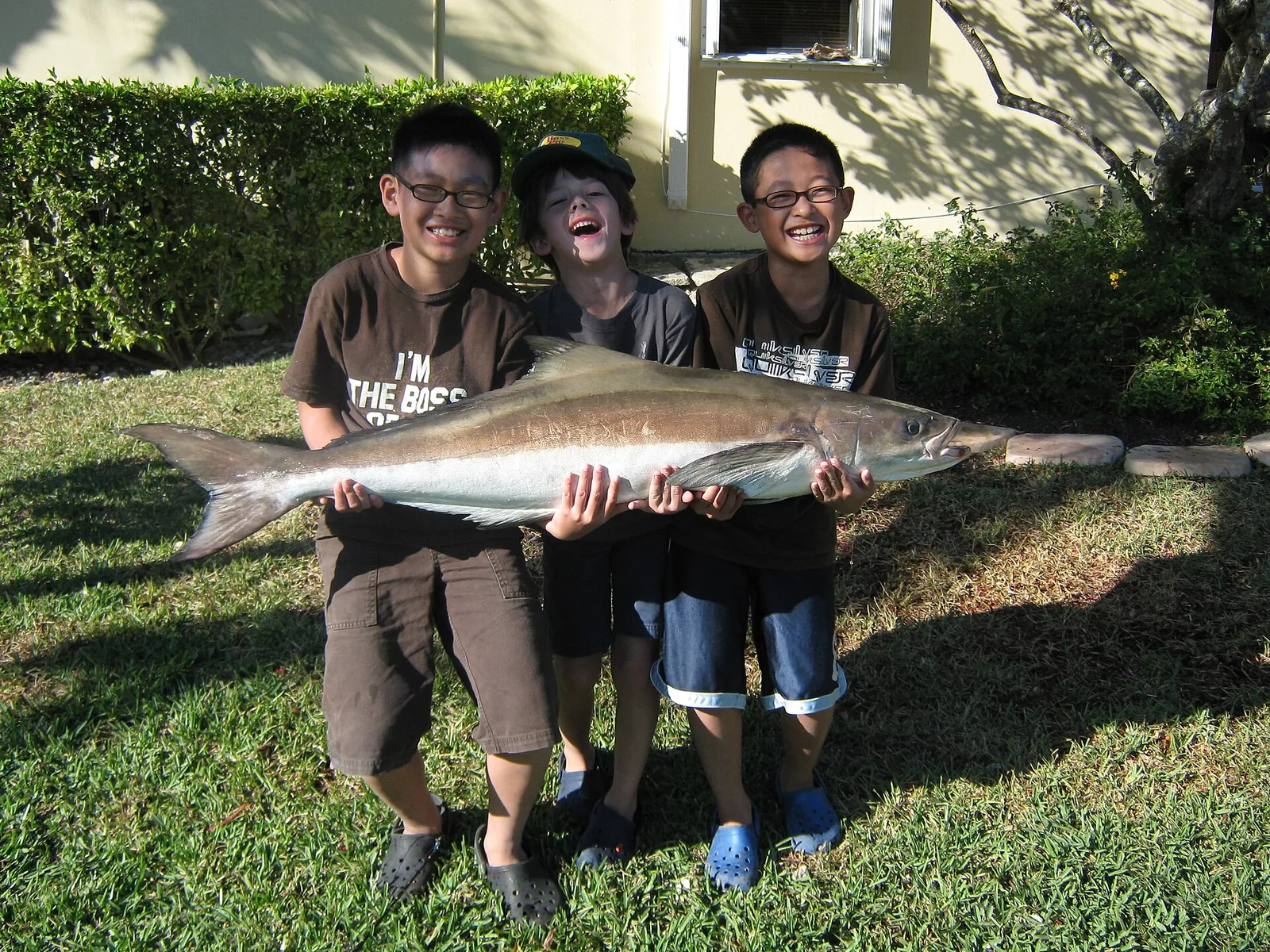
Cobia
Rachycentron canadum · Rachycentridae
Cobia is catalogued as reef-associated, brackish-tolerant and oceanodromous, over 0–1200 m and 17–32 °C. Those labels only fit once you watch the fish: a strong open-water swimmer that spends its fishable life beside something solid. The structure is the method. A cobia trip without a plan for which object you will find is just a boat ride.
- Family
- Rachycentridae
- Max length
- 200 cm TL
- Max weight
- 68 kg
- Max age
- 15 years
- Depth
- 0–1200 m
- IUCN
- LC
- Climate
- Subtropical · 17–32 °C
- Diet
- crustaceans, fishes, zooplankton
Cobia is described in the catalogue as reef-associated, brackish-tolerant and oceanodromous, with a depth range of 0–1200 m and a recorded temperature window of 17–32 °C. Those four labels do not sit comfortably together until you watch the fish: cobia is a strong, open-water swimmer that spends most of its fishable life beside something solid. The structure is the whole method. A cobia trip without a plan for which object you are going to find is a boat ride.
Techniques
- Trolling —
- Jigging —
Baits
- Live croaker
- Bucktail jig
- Fresh crab
- Cut mullet
Seasonality
Peak May–SepCurrent edges around buoys and wrecks are the key. Fish the first of the tide.
Warm, clear water and light wind. Cobia are easiest to sight on calm days.
Other US-RI regulations
Same jurisdictionBefore you keep a fish
- Read the recorded value. It is copied from the notice; if the number and the notice disagree, the notice wins.
- Check the area. Federal, state and local waters can set different limits for the same fish.
- Check the date. Seasons, quotas and closures change; confirm the current notice before you go.
Common questions
- What is the bag limit for Cobia in United States — Rhode Island?
- 43 in · 1 fish per person per day · 2 per vessel per day · year round
- Where does this regulation apply?
- Rhode Island state waters
- When was it checked?
- 2026-11-18, against 250-RICR-90-00-3 Finfish.
- Do other jurisdictions set different limits?
- Yes. This register lists 8 jurisdictions for Cobia; compare them in the table above.