≥75 cm
Australia — Queensland · AU-QLD
Queensland sets a 75 cm minimum size for cobia (black kingfish).
Cobia (black kingfish) | Min: 75cm | Limit: 2

Cobia is catalogued as reef-associated, brackish-tolerant and oceanodromous, over 0–1200 m and 17–32 °C. Those labels only fit once you watch the fish: a strong open-water swimmer that spends its fishable life beside something solid. The structure is the method. A cobia trip without a plan for which object you will find is just a boat ride.
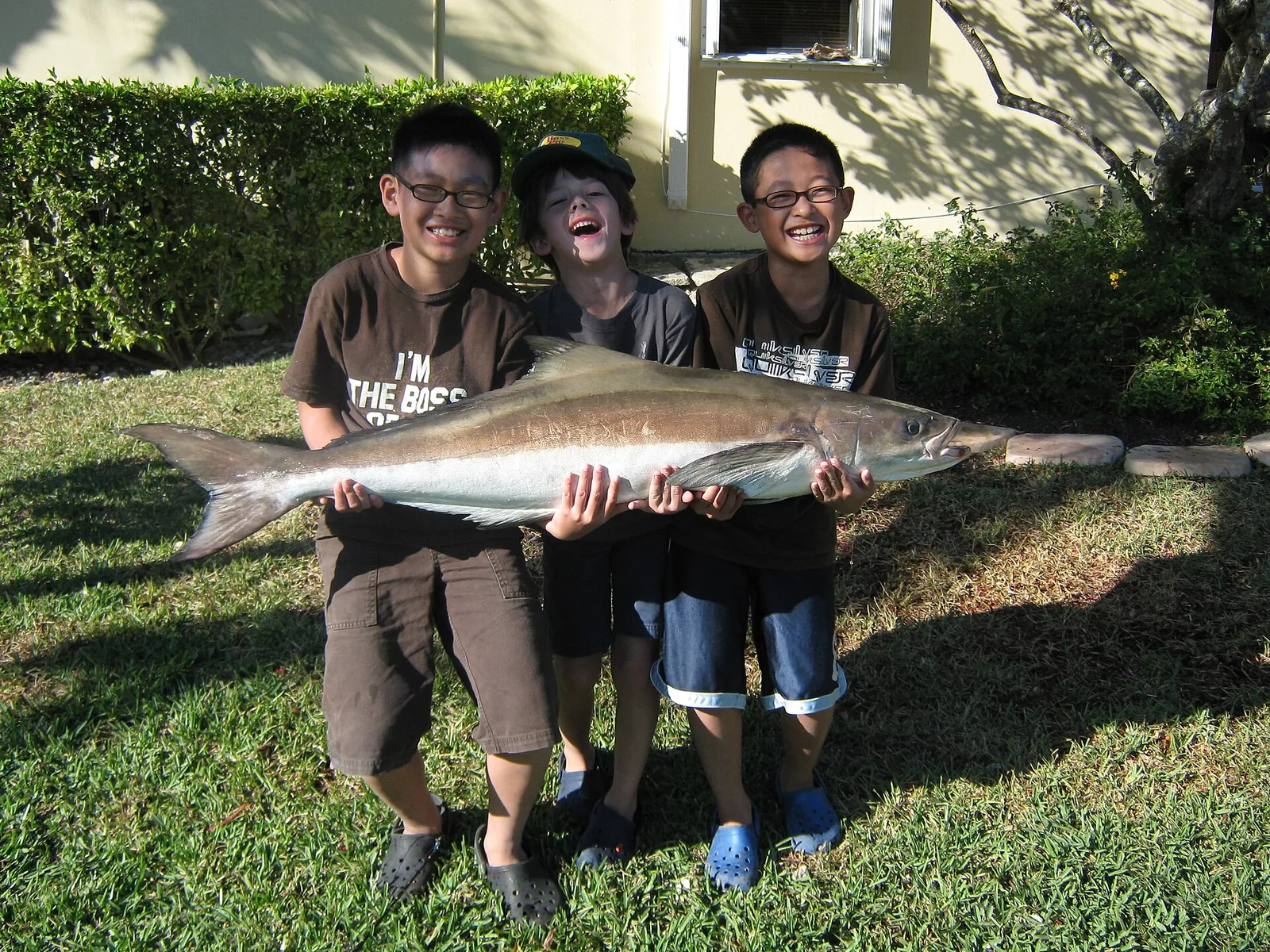
Cobia is described in the catalogue as reef-associated, brackish-tolerant and oceanodromous, with a depth range of 0–1200 m and a recorded temperature window of 17–32 °C. Those four labels do not sit comfortably together until you watch the fish: cobia is a strong, open-water swimmer that spends most of its fishable life beside something solid. The structure is the whole method. A cobia trip without a plan for which object you are going to find is a boat ride.
The body is built for swimming: elongated, oval in cross-section, with 7–9 dorsal spines and 26–33 soft rays, 2–3 anal spines and 22–28 soft rays. The head is broad and flat, the eye is small, and the first dorsal fin is a row of short, free spines rather than a connected fin. None of that suggests a bottom fish.
And yet the fish is almost always found near a surface or mid-water object. Buoys, channel markers, wrecks, oil platforms, floating debris, and large animals — rays, sharks, turtles — all hold cobia. The association is not shelter; cobia do not hide. It is a feeding station: the object attracts bait, and the cobia patrols the edge of the school.
The habitat keywords are reef, rocky, sandy, muddy, estuary, coastal, open-water and continental-shelf, which is a list that covers nearly everything. The 1200 m depth maximum is an outlier from deep tagging or deep-set gear; the fishable part of the range is the surface and the upper 50 m, with occasional fish deeper around structures.
The practical reading is that depth is not the search variable for cobia — structure is. Two boats can fish the same depth on the same day and only one will find fish, because one is drifting over open water and the other is working a line of buoys. Start from a structure, then read the current and the bait around it.
The maximum is 200 cm total length and 68 kg, with a common length of 110 cm and a maximum age of 15 years. For a fish that grows that fast, a 200 cm individual is not necessarily ancient; cobia grow quickly in their first years and the largest fish are often not the oldest.
The 110 cm common length is the number to build tackle around. A 110 cm cobia weighs roughly 15–25 kg and fights with a long, powerful run followed by a stubborn circling phase near the boat. A 5000-size reel with 0.20 mm braid and a 60 lb leader handles that fish; a 200 cm fish will test the same gear to its limit.
Three search patterns cover most cobia fishing. The first is structure: run a line of channel markers or buoys and look for a fish holding in the shadow, then cast a live bait or a soft plastic past it and bring the lure across its nose. The second is sight fishing: on a calm day, a cobia's brown back and broad head are visible just under the surface, often beside a ray. The third is chumming at anchor near a wreck, which brings fish up in the water column.
Sight fishing is the most productive when conditions allow. Polarised glasses, a high casting platform and an electric motor matter more than the lure. A cobia that has seen the boat is difficult; one that has not seen anything but a baitfish is easy.
The spawning table lists January and February in Ceará, Brazil; April to October in the Gulf of Mexico; April to September on the southern US coast; and June to December from a Texas mariculture facility. Eleven of twelve months appear somewhere in the record.
That is not one long spawning season; it is a species with a wide latitudinal range and local spawning windows. In the Gulf the window is spring to autumn; in equatorial Brazil it is the first part of the year. For trip planning, the local window matters more than the global table: cobia arrive on the northern Gulf coast in spring and leave in autumn, and the timing shifts by weeks from year to year with water temperature.
One of the English common names is crabeater, and the diet keywords are crustaceans, fishes and zooplankton. Cobia are opportunistic and will take crabs, shrimp, squid and fish; they also follow rays to pick up what the ray disturbs.
For lure selection that means a natural profile and a slow, confident presentation. A 15–20 cm soft plastic on a 30–50 g jig head, a live crab, or a live mullet all work. Cobia are not leader-shy in the way that a tuna is, but they are curious, and a lure that stops and sinks in front of them often gets eaten where a fast retrieve does not.
Cobia is both farmed and taken by a small commercial fishery, and it is a recognised gamefish. Cobia is one of the few marine fish with a short enough life cycle and a fast enough growth rate to be attractive to aquaculture, and cage culture is established in Asia and the Americas.
The consequence for anglers is small but real: farmed fish escape, and escaped cobia turn up around cages and coastal structures. They behave like wild fish and cannot be told apart by eye. In areas with cage culture, expect fish where the record's distribution map shows none.
The GBIF index holds 10,423 cobia records: the United States at 6,574, Australia at 1,480, Thailand at 190, India at 150 and Nigeria at 122. The Australian figure is large relative to the country's cobia fishery and reflects survey and museum recording rather than abundance.
iNaturalist's 805 observations are spread thinly across the tropics, which fits a fish that is common enough to be familiar and rarely the target of a dedicated photo trip. Neither dataset finds a fish for you. They confirm the tropical and subtropical range and the absence from the eastern Pacific, and then the search becomes what it always was: a structure, a current, and something swimming beside it.
Tide. Current edges around buoys and wrecks are the key. Fish the first of the tide.
Weather. Warm, clear water and light wind. Cobia are easiest to sight on calm days.
Trolled from a moving boat; suits roaming or pelagic species.
Vertical jigging over the recorded depth range.
These are the published regulations for this fish. Read the number first. The notice below it is the actual regulation.
Queensland sets a 75 cm minimum size for cobia (black kingfish).
Cobia (black kingfish) | Min: 75cm | Limit: 2
Western Australia sets a 750 mm minimum legal size for cobia.
"Cobia Rachycentron canadum 750 mm"
New South Wales, Australia: Cobia has no size limit and a daily bag limit of 5.
Cobia | Cobia | - | 5
Queensland sets a possession limit of 2 Cobia.
A possession limit is the total number of fish you may keep at any time, including fish at home or in the freezer; it is not a daily take limit.
Cobia (black kingfish) | Min: 75cm | Limit: 2
North Carolina's recreational cobia limit is 1 fish per person and 1 fish per vessel, with a 36-inch fork-length minimum.
The private vessel limit is 1 fish; the for-hire vessel limit is 6 fish.
1 Bag Limit | 1 Vessel Limit | Min. Size: 36 in Fork Length
New Jersey allows one cobia per person and no more than two per vessel, with a 43-inch minimum.
Cobia | 1 per person, 2 per vessel | 43"
New York allows one cobia per angler and two per vessel per day at 43 inches.
Cobia 43" Fishing from shore: 1 per angler Fishing from vessel: 1 per angler and a maximum of 2 per vessel All year
Rhode Island allows one cobia per person and two per vessel per day at 43 inches.
3.34.1 Recreational A.Minimum size: Forty three inches (43”). B.Season: January 1 through December 31. C.Possession limit: One (1) fish per person per day. D.Maximum per vessel possession limit: The possession limit shall be per person per day, as stated above, with a maximum of two (2) fish per vessel per day.
Virginia allows one cobia per person or two per vessel from June 15 to Sept 20 at 43 inches.
COBIA Minimum Size Limit: 43 inches total length Possession Limit: 1 per person, 2 per vessel; whichever is more restrictive Season: June 15 through Sept 20
North Carolina closes recreational cobia fishing from January 1 through April 30.
The closure is listed for 2026 and again for 2027.
Season Closed: January 01, 2026 – April 30, 2026
Every record above names its source and the date it was retrieved. See the regulation register for the full list, or how to read these regulations.
Check these pages before you rely on a size, range or protection status.
These fish live in the same place.
Technique, gear and safety guides that fit Cobia.