
Annular seabream in France: ≥12 cm — France — Mediterranean.
| SPARAILLON | Diplodus annularis | 12 cm |
Quoted from Arrêté du 26 octobre 2012 — tailles minimales de capture (pêche maritime de loisir)
Regulation guide
Official sourcesHow annular seabream is regulated in France
Annular seabream, Diplodus annularis, is sparaillon in French. Its size is fixed by the arrêté of 26 October 2012, the order that determines the minimum size or weight of fish and other marine organisms taken in recreational sea fishing.
Article 1 sets the scope. The order applies to recreational fishing from vessels other than those holding a commercial fishing permit, to fishing while swimming or diving, and to fishing on foot on the public maritime domain, including the salt-water parts of rivers and canals.
It also applies to French-flagged pleasure craft wherever they fish and to foreign pleasure craft in waters under French sovereignty or jurisdiction. The order applies without prejudice to stricter international, EU or national rules on minimum sizes.
Source: Légifrance: Arrêté du 26 octobre 2012, tailles minimales de capture
12 cm in the Mediterranean
Annex I of the order is divided into two parts. Part II, for the Mediterranean, lists SPARAILLON (Diplodus annularis) at 12 cm. Part I, for the North Sea, Channel and Atlantic, contains no sparaillon row.
The French figure is therefore Mediterranean only. There is no national annular seabream size in the Atlantic part of the order, so an angler fishing the Atlantic coast has no size from this instrument to apply to the species.
The annex states that common names are given for information only, so the scientific name is the reliable check. The version in force dates from 14 January 2026.
The 12 cm is also the EU minimum
The Mediterranean table published by the DIRM Méditerranée compares the EU minimum with the French recreational figure. For sparaillon both columns read 12 cm: Regulation (EC) No 1967/2006 sets 12 cm, and the arrêté of 26 October 2012 repeats it for recreational fishers.
The EU Mediterranean minimum sizes originated in Annex III of Regulation (EC) No 1967/2006 and are now carried in the technical measures regulation, Regulation (EU) 2019/1241. France has not added a stricter figure for this species.
That makes the annular seabream one of the simpler cases: the national and European numbers coincide, so there is no conflict between the two layers for a French Mediterranean angler.
Source: DIRM Méditerranée: Tailles minimales de capture en Méditerranée · EUR-Lex: Regulation (EC) No 1967/2006, annex III · EUR-Lex: Regulation (EU) 2019/1241
How the size is measured
Article 3 of the order requires sizes to be measured under the EU rules reproduced in Annex II. Part B of that annex, for the Mediterranean, states that the size of a fish is measured from the tip of the snout to the end of the caudal fin.
Fork length is not the measure. A sparaillon that reaches 12 cm to the fork but not to the tip of the tail is undersized, and the tail fin must be spread when the fish is laid on the board.
The annular seabream is a deep-bodied fish, so straighten it along the midline without bending the body. Measure before gutting, because the size is defined on the intact fish.
Source: Légifrance: Arrêté du 26 octobre 2012, article 3 and annexe II
A size rule with no bag limit attached
The order of 26 October 2012 is a minimum-size instrument. Its annexes list species, scientific names and sizes or weights, and they set no bag limit, season or quota for annular seabream.
Article 4 provides that any breach may lead, independently of criminal penalties, to an administrative sanction under articles L. 946-1 and L. 946-4 of the code rural et de la pêche maritime, or to conservatory measures under L. 943-1.
Because article 1 preserves stricter rules, local measures such as marine protected area regulations or prefectural orders can add restrictions that the size order does not contain. The absence of a bag limit in this instrument is not an absence of all limits.
Source: Légifrance: Arrêté du 26 octobre 2012, articles 1 and 4
Telling the sparids apart
Four Diplodus species appear in the French Mediterranean list with four different sizes. SAR COMMUN (Diplodus sargus) is 23 cm, SAR À TÊTE NOIRE (Diplodus vulgaris) and SAR À MUSEAU POINTU (Diplodus puntazzo) are both 18 cm, and SPARAILLON (Diplodus annularis) is 12 cm.
In the Atlantic part the position is different again. Only sar commun appears, at 25 cm, and there is no row for either the annular seabream or Diplodus vulgaris.
A 12 cm fish is therefore legal only if it is an annular seabream. The annex attaches the size to the scientific name, so identification is part of the check rather than an optional extra.
Source: Légifrance: Arrêté du 26 octobre 2012, annexe I · DIRM Méditerranée: Tailles minimales de capture en Méditerranée
Before you keep one
Identify the water first. The 12 cm applies in the French Mediterranean; the Atlantic part of the annex has no annular seabream entry.
Identify the species second, because the two larger Diplodus in the same list carry 18 and 23 cm. Measure from the snout to the end of the tail, not to the fork.
There is no bag limit for the species in the size order, but the catch remains subject to the general rules of the area being fished and to any stricter local measure. Recreational catches cannot be sold.
Source: Légifrance: Arrêté du 26 octobre 2012 · DIRM Méditerranée: Tailles minimales de capture en Méditerranée
Official pages: Légifrance: Arrêté du 26 octobre 2012, tailles minimales de capture · DIRM Méditerranée: Tailles minimales de capture en Méditerranée · EUR-Lex: Regulation (EC) No 1967/2006, Mediterranean technical measures · EUR-Lex: Regulation (EU) 2019/1241, technical measures
Annular seabream regulations at a glance
1 jurisdictions| Jurisdiction | Area | Size | Bag | Season / closure | Closed area | Other |
|---|---|---|---|---|---|---|
| France | France — Mediterranean | ≥12 cm | — | — | — | — |
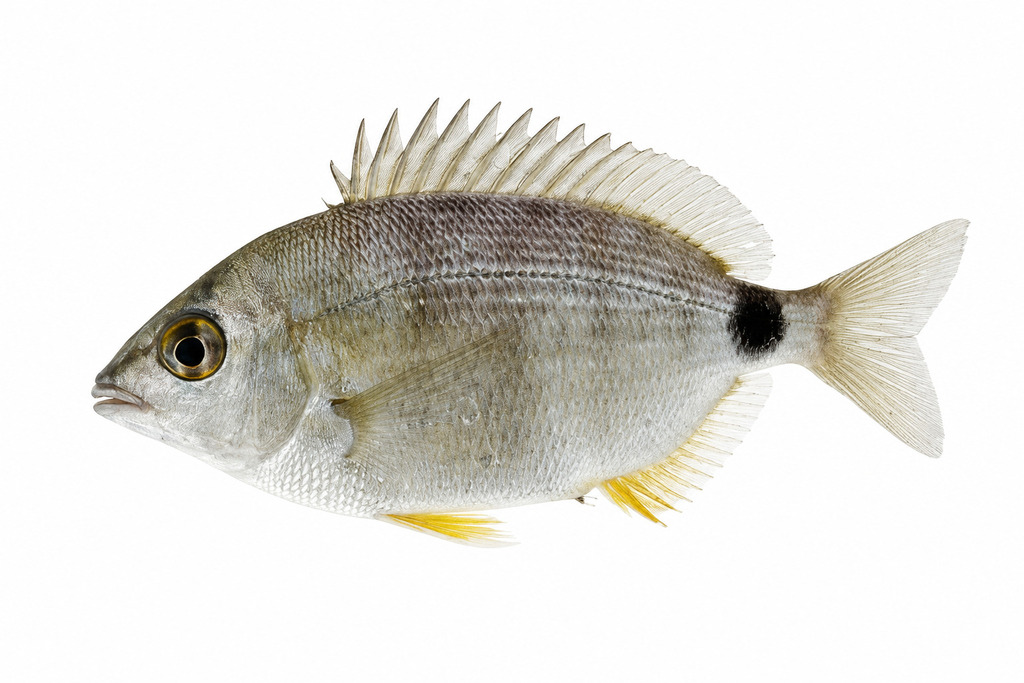
Annular seabream
Diplodus annularis · Sparidae
Annular seabream is a small sparid of the eastern Atlantic and Mediterranean, from the Canaries and Portugal to the Bay of Biscay, Black Sea and Sea of Azov. It lives from the surface to 90 m in subtropical water, reaches 28 cm TL and 0.33 kg, can live 17 years, and feeds on crustaceans, fish, worms and echinoderms. Its season runs January to September.
- Family
- Sparidae
- Max length
- 28 cm TL
- Max weight
- 0.33 kg
- Max age
- 17 years
- Depth
- 0–90 m
- IUCN
- LC
- Climate
- Subtropical
- Diet
- crustaceans, fishes, worms, echinoderms
Annular seabream (Diplodus annularis) is a fish of the family Sparidae. FishBase gives its range as: Eastern Atlantic: Canary islands, also found along the coast of Portugal northward to the Bay of Biscay, Mediterranean, Black Sea and Sea of Azov. It is recorded from 0 to 90 m, in subtropical water. The recorded maxima are 28 cm TL, 0.33 kg, 17 years. Diet includes crustaceans, fishes, worms and echinoderms. IUCN status: Least Concern (LC). Chinese name: .
Seasonality
Other FR regulations
Same jurisdictionBefore you keep a fish
- Read the recorded value. It is copied from the notice; if the number and the notice disagree, the notice wins.
- Check the area. Federal, state and local waters can set different limits for the same fish.
- Check the date. Seasons, quotas and closures change; confirm the current notice before you go.
Common questions
- What is the minimum size for Annular seabream in France?
- ≥12 cm
- Where does this regulation apply?
- France — Mediterranean
- When was it checked?
- 2026-11-18, against Arrêté du 26 octobre 2012 — tailles minimales de capture (pêche maritime de loisir).