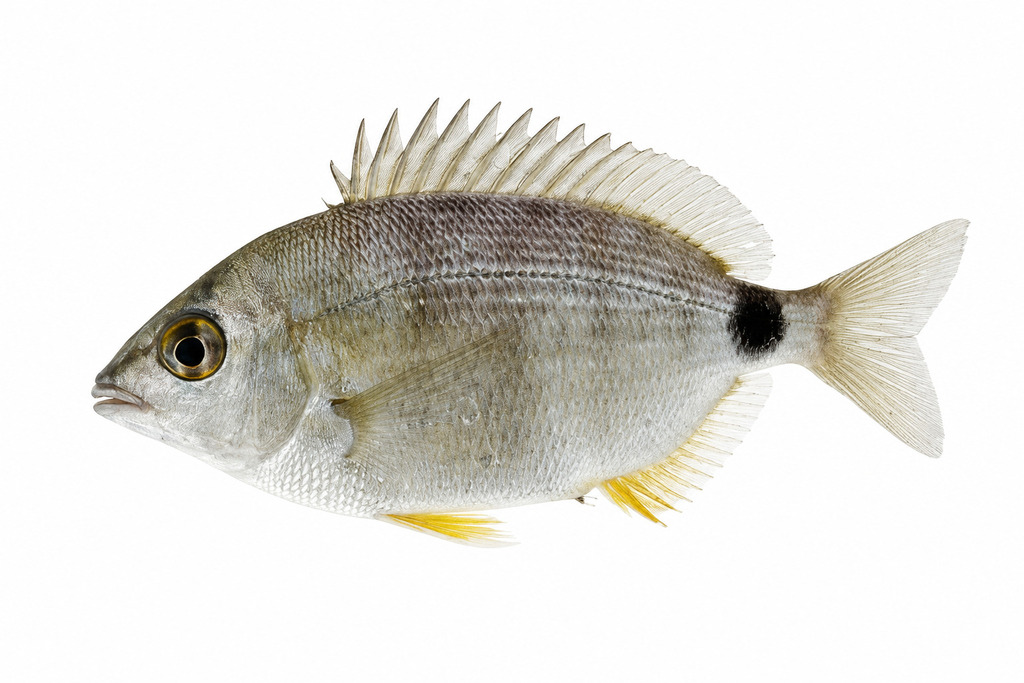
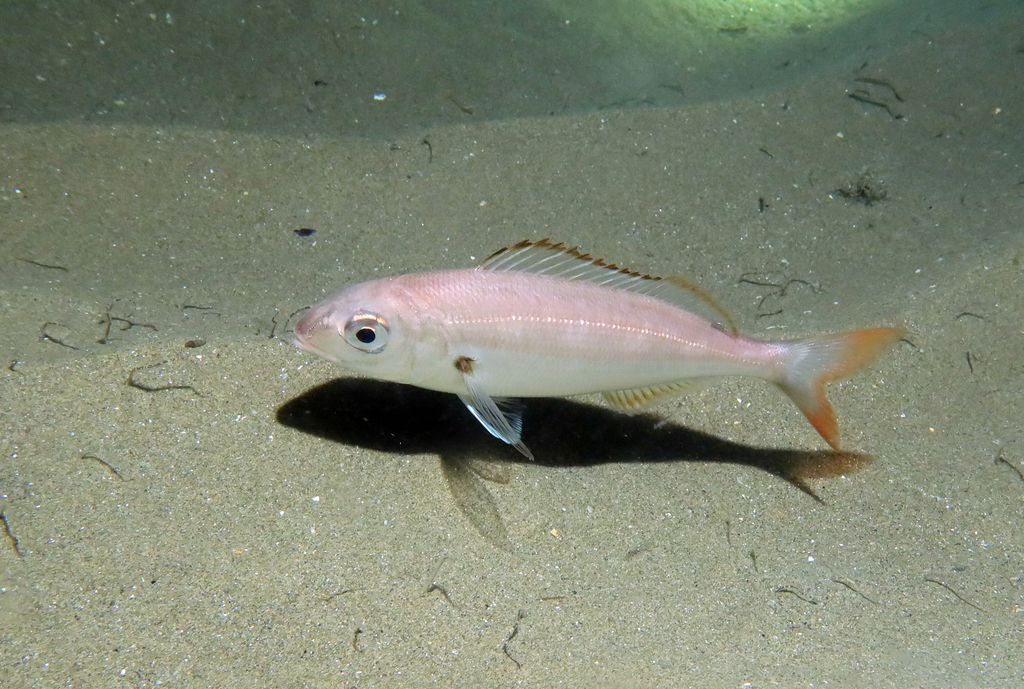
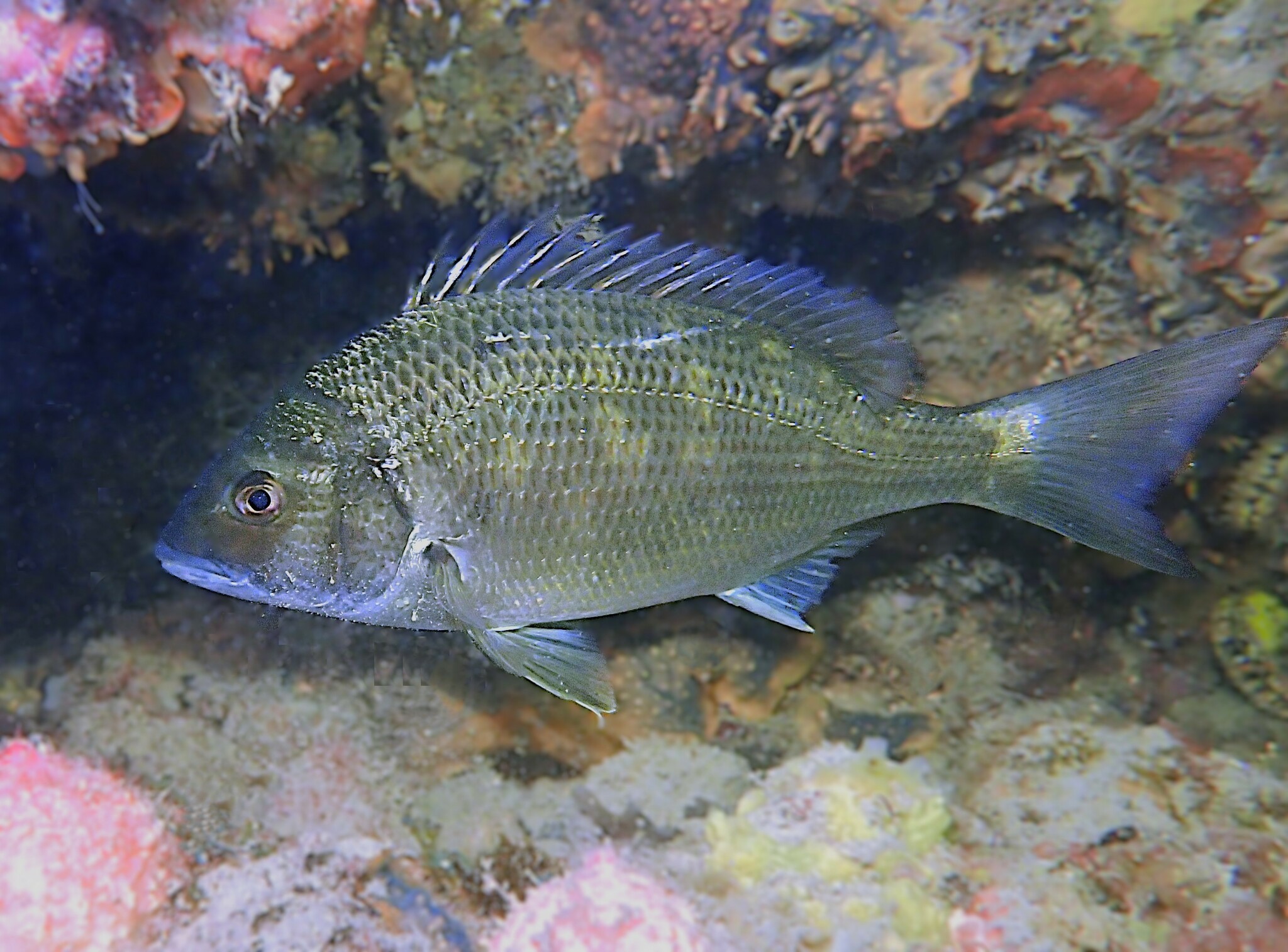
Annular seabream (Diplodus annularis) is a fish of the family Sparidae. FishBase gives its range as: Eastern Atlantic: Canary islands, also found along the coast of Portugal northward to the Bay of Biscay, Mediterranean, Black Sea and Sea of Azov. It is recorded from 0 to 90 m, in subtropical water. The recorded maxima are 28 cm TL, 0.33 kg, 17 years. Diet includes crustaceans, fishes, worms and echinoderms. IUCN status: Least Concern (LC). Chinese name: .
Two ends of one distribution line
FishBase's text names the Canary Islands, the Portuguese coast north to the Bay of Biscay, the Mediterranean, the Black Sea and the Sea of Azov. The territory table turns that sentence into 29 entries, running from Morocco, Spain and Portugal through Italy and Greece to Romania, Ukraine, Georgia and Russia. The extremes are not equivalent water: Azov is a shallow, nearly enclosed basin, while the Canary Islands sit in open ocean. The source supplies the geography but no salinity figure, so the gradient can be located from this page but not measured from it. The common-name table adds five English entries, split between "sea bream" and "seabream" spellings and attached to different countries; the fish does not change with the label.
What the word brackish covers
The environment field carries three words — marine, brackish, benthopelagic. That is a flag, not a range. The record is silent on how low the salt content can fall, and nothing labels the species as a regular migrant between the two ends. The honest reading is spatial rather than seasonal: the same fish appears in fully marine ground and in diluted coastal water, and the angler has to work out which part of that list the local population occupies. The occurrence data show how broad the option is: GBIF holds 7,155 records, led by Spain with 2,571, France with 1,891 and Greece with 1,008.
A depth band with no usual figure
The recorded range is 0 to 90 m, and unlike some sparid entries this one carries no "usually" qualifier. Both ends therefore stand exactly as written: the fish can be met at the surface edge and down to 90 m. What the record does not provide is the middle of the band, the depth where most of the population actually lives. For a shore angler or a diver that missing middle is the working question, and the habitat list answers it more usefully than the depth number alone.
Zostera first, rock last
The biology section ranks the ground rather than merely listing it: chiefly Zostera seagrass beds, also Posidonia beds and sandy bottoms, rarely rocky bottoms. That order is unusually specific for a catalogue entry and should be read as the primary locating instruction. The diet is broad — worms, crustaceans, molluscs, echinoderms and hydrozoans — which fits a fish grubbing through rooted vegetation rather than one hunting over clean rock. A seagrass edge with sand patches is the mark; a bare reef is the last choice, not the first.
Two versions of the sex life
The same page gives two accounts of reproduction. One says the sexes are separate although the fish are potential hermaphrodites, with certain individuals protandric. The other says protandry occurs in some individuals as a geographic variant, but histological work found neither degenerating functional tissue of one sex nor proliferation of the other, indicating no sex change; the condition is called nonfunctional hermaphroditism. Both statements are left standing here. They disagree about mechanism, not about the size at first maturity, which is given as 11.6 cm, bounded by 8 and 19.6 cm.
The thirteen-centimetre class
At 13.0 cm TL, the common size sits against a 28.0 cm TL maximum. The top published weight is 330 g, with a reported maximum age of 17 years. Set the common length beside the maturity figure and the overlap becomes clear: a 13 cm fish sits above the 11.6 cm midpoint, so the typical fish in the standing biomass is already mature. The 28 cm maximum is more than double the common size, and it describes an exceptional individual rather than the school fish most anglers will meet.
Where the records cluster
GBIF's 7,155 records are concentrated in Spain, France and Greece, while iNaturalist carries 2,597 observations. Neither platform covers the eastern Black Sea shore in proportion to the 29-territory list, and neither samples the 90 m end of the depth range evenly. The counts describe where people look — mostly wading, diving or fishing the shallow shelf — and they should not be read as evidence that the species is scarce in the Azov basin or in deeper water.
The GBIF distribution declarations put the Black Sea and European Marine Waters at PRESENT through WoRMS, and add no introduced flag anywhere in the list. The WoRMS entry, AphiaID 127049, carries Linnaeus, 1758, and ticks brackish alongside marine; the lagoon and estuary sentences above sit under that tick.
Rigs for the middle of the gradient
A common length of 13 cm sets hook size and rod power: small hooks, light braid, and bait a grubbing mouth can take. From shore, the useful mark is the shallow edge of a seagrass bed; from a boat, the same plant community on the shelf, not the deepest point of the 0–90 m range. The diet list points to worm and small crustacean baits rather than fish strips. A baited rig drawn slowly along the weed edge covers the transition without moving the boat; from shore the same rig can be cast past the weed line and retrieved back across it. Because the common fish is already mature, the release decision should follow the local rule and the condition of the individual, not the assumption that small means juvenile.
Regulations before you keep it
These are the published regulations for this fish. Read the number first. The notice below it is the actual regulation.
Minimum size1
The minimum size for Annular seabream in France is ≥12 cm.
| SPARAILLON | Diplodus annularis | 12 cm |
Every record above names its source and the date it was retrieved. See the regulation register for the full list, or how to read these regulations.
Where these facts come from
Check these pages before you rely on a size, range or protection status.
-
FishBase — Diplodus annularis
— FishBase · T2
-
GBIF — Diplodus annularis occurrence records
— GBIF · T2
-
IUCN Red List — Diplodus annularis
— IUCN · T1
-
Photo record — iNaturalist
— iNaturalist · T3