
Common two-banded seabream in Spain — Canary Islands: ≥22 cm — Spain — Canary Islands.
| Mojarra (Diplodus vulgaris) | Seifia, seifio | 22 |
Quoted from Real Decreto 560/1995 — tallas mínimas (texto consolidado, actualizado 1 November 2025)
Regulation guide
Official sourcesHow the two-banded seabream is managed
Common two-banded seabream (Diplodus vulgaris) is a sparid of the eastern Atlantic and the Mediterranean. In the Mediterranean, the European Commission's minimum conservation reference size database gives 18 cm total length for the species and lists that figure against the western, central and eastern Mediterranean fishing areas.
The EU figure sits inside the technical-measures framework of Regulation (EU) 2019/1241, with the Mediterranean regulation (EC) No 1967/2006 still supplying the basin-specific baseline. National law decides how recreational fishing is licensed and whether a stricter size applies.
The current database holds two rules for this species: France at 18 cm in the Mediterranean and Spain at 22 cm in the Canary Islands. The two figures are not competing versions of one rule; they belong to different fishing areas and different legal instruments.
Source: European Commission: Diplodus vulgaris, minimum conservation reference size · EUR-Lex: Regulation (EU) 2019/1241 on technical measures · EUR-Lex: Council Regulation (EC) No 1967/2006 (Mediterranean)
France: 18 cm in the Mediterranean
France's recreational minimum-size arrêté of 26 October 2012 lists the species in Annex I, part II, for the Mediterranean, as sar à tête noire (Diplodus vulgaris) at 18 cm. The annex has been in force since 14 January 2026 and keeps the 18 cm figure.
Article 1 sets the scope: it reaches recreational fishing from a boat, while swimming or diving, and on foot on the public maritime domain. The same article says the arrêté yields to more restrictive international, EU or national rules.
Article 3 requires fish to be measured under the EU rules recalled in Annex II, which for Mediterranean fish means from the tip of the snout to the end of the caudal fin. Article R921-83 of the rural and maritime fishing code limits the catch to the fisher and family and forbids sale.
Source: Légifrance: Arrêté du 26 octobre 2012 (tailles et poids minimaux, pêche maritime de loisir) · Légifrance: Code rural et de la pêche maritime, articles R921-83 to R921-93
Spain: 22 cm in the Canary Islands
Spain's national table is set by Real Decreto 560/1995. Annex III, for the Canary Islands caladero, lists mojarra (Diplodus vulgaris) at 22 cm. The consolidated text was last updated on 1 November 2025, and the current annex entered into force on 2 November 2025.
The same decree has a separate annex for the Mediterranean. Annex II lists sargo (Diplodus spp.) at 15 cm, a generic entry that is lower than the EU's 18 cm figure for D. vulgaris. Because the Commission publishes a species-specific 18 cm entry for the Mediterranean, that is the safer reference in those waters.
The Canary Islands are treated as their own Atlantic caladero, so the Mediterranean figure does not carry across. Article 3 of the decree bans keeping, transhipping, landing, transporting, storing, selling, displaying or marketing a fish below the required size.
Source: BOE: Real Decreto 560/1995 (tallas mínimas, consolidated text updated 1 November 2025) · European Commission: Diplodus vulgaris, minimum conservation reference size
Spain's recreational rules
Real Decreto 347/2011 sets the framework for recreational sea fishing in Spanish external waters. Its Article 4 requires anglers to respect the minimum sizes in Real Decreto 560/1995, which is the bridge between the national size table and a recreational catch.
Real Decreto 347/2011 also defines the activity as non-commercial and bars sale or any other transaction of the catch. The licence comes from a coastal autonomous community, or from Ceuta or Melilla, and is required for shore, boat and underwater fishing under Articles 8, 9 and 13.
Neither of the two national instruments sets a daily bag limit for two-banded seabream. Any bag limit, closed area or additional size rule would come from the autonomous community's own rules, so the regional rule should be checked before the trip.
Source: BOE: Real Decreto 347/2011 (pesca marítima de recreo en aguas exteriores) · BOE: Real Decreto 560/1995 (tallas mínimas)
France's Mediterranean registration duty
A new registration duty came with the arrêté of 7 November 2025. From 10 January 2026, recreational fishers aged 16 or over must register on the European Recreational Fisheries portal or the RECFishing app before targeting a species listed in its annex.
In the Mediterranean the duty is wider: all recreational fishers except those fishing on foot must register, whatever species they target. Two-banded seabream is not on the annex list, so registration is required but a catch declaration is not triggered by this species alone.
Registration lasts twelve months and must be made at least the day before the fishing action. The declaration duty in Article 3 applies to the listed species and must be completed on the day of capture, before 23:59.
Source: Légifrance: Arrêté du 7 novembre 2025 (conditions d'exercice de la pêche de loisir)
Before you keep a two-banded seabream
The water decides the number. A fish taken in the French Mediterranean must reach 18 cm; a fish taken in the Canary Islands must reach 22 cm. In mainland Spanish Mediterranean waters, measure against the EU's 18 cm species figure rather than the generic 15 cm sargo entry.
Measure from the snout tip to the end of the tail fin, lay the fish flat, and return anything short. In Spain the recreational licence and the no-sale rule apply; in France the catch must stay in the family and the Mediterranean registration must be in place.
If the fish is to be kept, check the regional rules for bag limits and closed areas as well, because the national instruments cited here do not set a bag limit for the species.
Source: Légifrance: Arrêté du 26 octobre 2012 · BOE: Real Decreto 560/1995 · BOE: Real Decreto 347/2011
Official pages: European Commission: Diplodus vulgaris · Légifrance: Arrêté du 26 octobre 2012 · BOE: Real Decreto 560/1995 · BOE: Real Decreto 347/2011 · Légifrance: Arrêté du 7 novembre 2025
Common two-banded seabream regulations at a glance
2 jurisdictions| Jurisdiction | Area | Size | Bag | Season / closure | Closed area | Other |
|---|---|---|---|---|---|---|
| France | France — Mediterranean | ≥18 cm | — | — | — | — |
| Spain — Canary Islands | Spain — Canary Islands | ≥22 cm | — | — | — | — |
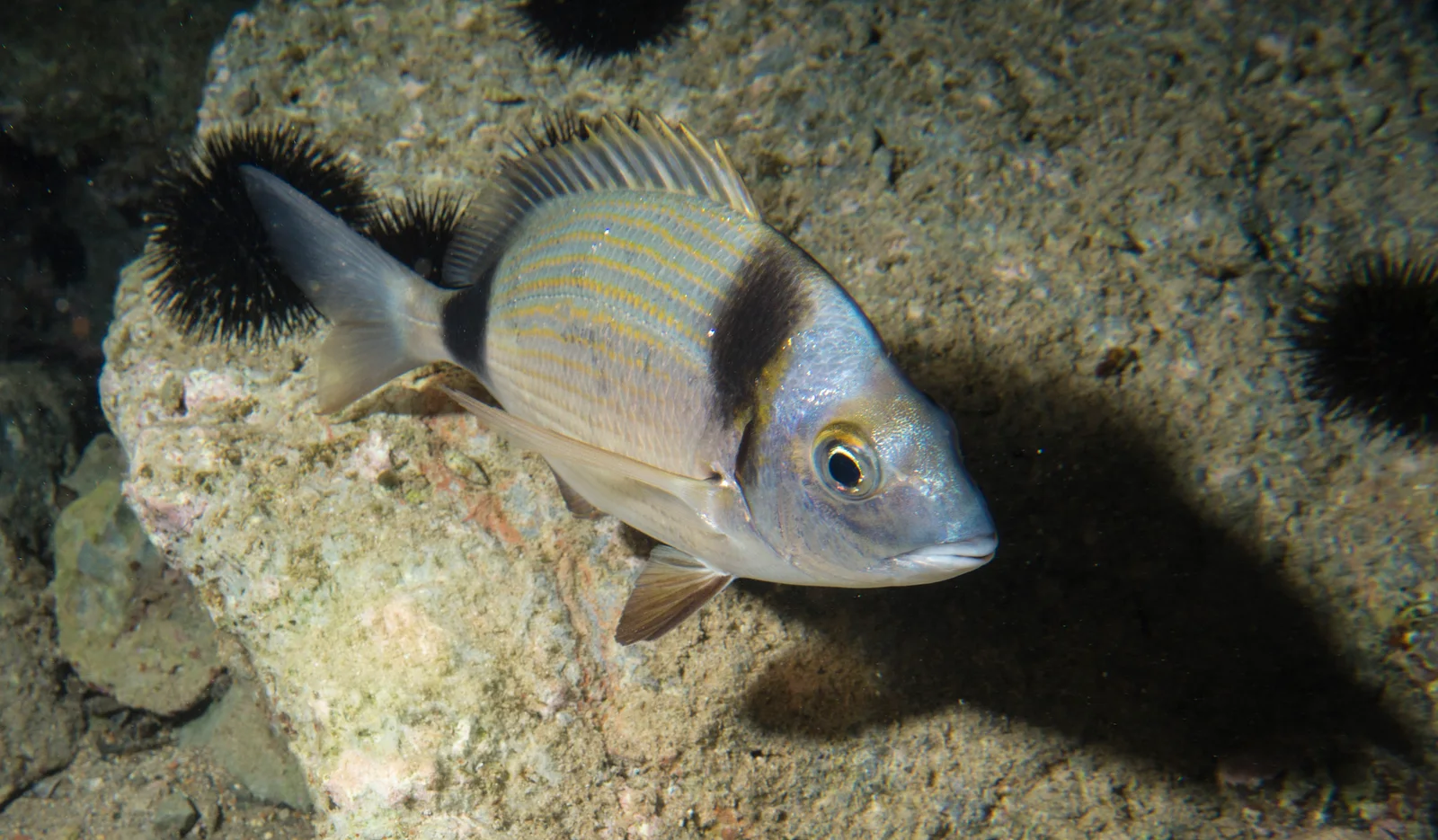
Common two-banded seabream
Diplodus vulgaris · Sparidae
Common two-banded seabream, a member of the family Sparidae, is found across the Eastern Atlantic, from Bay of Biscay to Cape Verde and the Canary Islands including the Mediterranean and Black Sea (off Bulgaria). Its depth range is from 0 to 160 m, in subtropical seas. It grows to 45 cm TL and 1.3 kg, with a diet of crustaceans, fishes and worms. The standard approach is shore casting or boat fishing. It is present year-round.
- Family
- Sparidae
- Max length
- 45 cm TL
- Max weight
- 1.3 kg
- Depth
- 0–160 m
- IUCN
- LC
- Climate
- Subtropical
- Diet
- crustaceans, fishes, worms
Common two-banded seabream (Diplodus vulgaris) is a fish of the family Sparidae. FishBase gives its range as: Eastern Atlantic: Bay of Biscay to Cape Verde and the Canary Islands including the Mediterranean and Black Sea (off Bulgaria); also from Angola to South Africa. It is recorded from 0 to 160 m, in subtropical water. The recorded maxima are 45 cm TL, 1.3 kg. Common length is recorded at 22 cm. Diet includes crustaceans, fishes and worms. IUCN status: Least Concern (LC). Chinese name: .
Techniques
- Shore casting —
- Boat fishing —
Seasonality
Other ES-CN regulations
Same jurisdictionBefore you keep a fish
- Read the recorded value. It is copied from the notice; if the number and the notice disagree, the notice wins.
- Check the area. Federal, state and local waters can set different limits for the same fish.
- Check the date. Seasons, quotas and closures change; confirm the current notice before you go.
Common questions
- What is the minimum size for Common two-banded seabream in Spain — Canary Islands?
- ≥22 cm
- Where does this regulation apply?
- Spain — Canary Islands
- When was it checked?
- 2026-11-18, against Real Decreto 560/1995 — tallas mínimas (texto consolidado, actualizado 1 November 2025).
- Do other jurisdictions set different limits?
- Yes. This register lists 2 jurisdictions for Common two-banded seabream; compare them in the table above.