
Large-eyed dentex in Spain — Canary Islands: ≥22 cm — Spain — Canary Islands.
| Cachucho (Dentex macrophtalmus) | Antoñito, dientón | 22 |
Quoted from Real Decreto 560/1995 — tallas mínimas (texto consolidado, actualizado 1 November 2025)
Regulation guide
Official sourcesWho sets the size for large-eyed dentex
The minimum size for large-eyed dentex comes from Spain's state schedule of fishing sizes, Real Decreto 560/1995, whose Annex III sets the sizes authorised for the Canary fishing ground. The Canary Government then regulates recreational fishing in the archipelago's internal waters through the Ley de Pesca de Canarias and its 2004 regulation.
That division matters. The state fixes the size for the Canary ground, while the regional rules govern the licence, the daily catch limit, the gear and the areas where a recreational angler may fish. A legal fish therefore has to satisfy both layers.
The BOE's consolidated text of Real Decreto 560/1995 records the 2015 amendment to Article 1 and is kept up to date, so it is the version to check rather than an older reprint.
Source: BOE: Real Decreto 560/1995, tallas minimas (consolidated, Annex III) · BOE: Ley 17/2003, de Pesca de Canarias (consolidated)
The 22 cm minimum
Annex III of Real Decreto 560/1995 lists the species as Cachucho (Dentex macropthalmus), with the local names antoñito and dientón, at a minimum of 22 cm. That is the entry an angler should look for, because the official schedule uses the local name rather than the English one.
The same annex sets sizes for other Canary species, including mero at 45 cm and gitano at 35 cm. The figures are species-specific, so a fish measured against the wrong row can be misjudged in either direction.
Source: BOE: Real Decreto 560/1995, tallas minimas (consolidated, Annex III)
How the size is measured
Article 2 of Real Decreto 560/1995 provides that the size of fish, crustaceans and molluscs is measured in accordance with Article 5(2) of Regulation (EEC) 3094/86. In practice that is total length, taken from the tip of the snout to the end of the tail fin.
A measurement to the fork of the tail will read short of the legal figure. For a 22 cm limit the difference is small in absolute terms but large in proportion, so a dentex close to the line should be laid flat and measured along the full body.
Source: BOE: Real Decreto 560/1995, tallas minimas (consolidated, Article 2)
The recreational licence
Article 32 of the Canary fishing regulation requires anyone practising recreational sea fishing in the community's internal waters to hold the corresponding licence, issued by the competent department of the Canary Government. The licence is personal and non-transferable and must be accompanied by an identity document.
Licences are issued in three classes: first class for boat fishing with surface trolling, second class for underwater fishing, and third class for surface fishing from shore or from a boat without trolling. A licence is valid for three years from issue or renewal.
Source: Decreto 182/2004, Reglamento de la Ley de Pesca de Canarias (BOC num. 4, 7 January 2005)
Five kilograms a day and no sale
Article 38 of the regulation limits recreational catches to five kilograms per person per day, whether taken as several pieces or as one heavier piece, although one piece may be left out of the total. Catches are for the angler's own consumption or for donation to charitable institutions, and any commercial or profit-making use is prohibited.
The same article requires fish below the minimum size, and fish of prohibited species, to be returned immediately to the sea. A dentex under 22 cm therefore cannot be counted, kept or used to fill the five-kilogram allowance.
A separate rule governs movement between the islands: recreational catches may be transported between islands up to a maximum of ten kilograms, whether as several pieces of legal size or as one heavier piece.
Source: Decreto 182/2004, Reglamento de la Ley de Pesca de Canarias (BOC num. 4, 7 January 2005) · BOE: Ley 17/2003, de Pesca de Canarias (Article 4)
Gear and areas
Surface recreational gear may carry no more than three hooks in total, and electric or electronic devices intended to attract or concentrate fish are prohibited. From shore, a licensee may use a maximum of two rods or handlines, with at least three metres between rods of the same holder and the same minimum distance from another angler's rods.
Fishing is prohibited within 150 metres of bathing areas from shore, within 250 metres of bathing areas from a boat, and within half a mile of commercial fishing vessels that are working. Port areas are also closed.
Source: Decreto 182/2004, Reglamento de la Ley de Pesca de Canarias (Articles 30, 39 and 40)
What to check before keeping a dentex
Confirm the local name on the official schedule, measure the fish from snout to the end of the tail against 22 cm, and weigh the day's catch against the five-kilogram limit. Check that the licence is on hand and that the boat or shore mark is outside the distances reserved for swimmers and working commercial boats.
If the fish is short, or the day's weight is already at five kilograms, it cannot be kept. The five-kilogram figure is a daily limit, so fish kept earlier in the same day count against it, and a legal dentex at the end of a good day may still be an excess fish.
Source: BOE: Real Decreto 560/1995, tallas minimas (consolidated, Annex III) · Decreto 182/2004, Reglamento de la Ley de Pesca de Canarias (Article 38)
Official pages: BOE: Real Decreto 560/1995, tallas minimas (Annex III, Canary Islands) · BOE: Ley 17/2003, de Pesca de Canarias · Decreto 182/2004, Reglamento de la Ley de Pesca de Canarias
Large-eyed dentex regulations at a glance
1 jurisdictions| Jurisdiction | Area | Size | Bag | Season / closure | Closed area | Other |
|---|---|---|---|---|---|---|
| Spain — Canary Islands | Spain — Canary Islands | ≥22 cm | — | — | — | — |
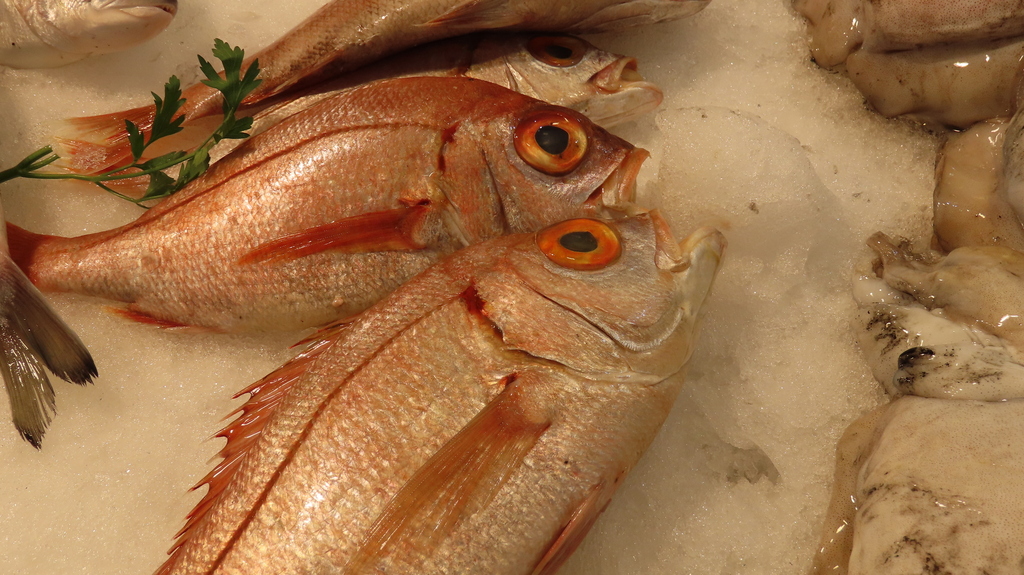
Large-eyed dentex
Dentex macrophthalmus · Sparidae
The large-eyed dentex is a deep-water red fish that sits on the bottom by day and lifts at night, so the fishing is about finding the right depth and putting a bait in that layer. It is also the fish most often misnamed at the boat: a red body invites the name Dentex dentex, and the Croatian 30 cm rule belongs to that other species.
- Family
- Sparidae
- Max length
- 65 cm TL
- Depth
- 30–500 m
- IUCN
- LC
- Climate
- Subtropical
The large-eyed dentex is a deep-water red fish that sits on the bottom by day and lifts at night, so the fishing is about finding the right depth and putting a bait in that layer. It is also the fish most often misnamed at the boat: a red body invites the name Dentex dentex, and the Croatian 30 cm rule belongs to that other species.
Techniques
- Boat bottom fishing —
- Jigging —
Seasonality
Other ES-CN regulations
Same jurisdictionBefore you keep a fish
- Read the recorded value. It is copied from the notice; if the number and the notice disagree, the notice wins.
- Check the area. Federal, state and local waters can set different limits for the same fish.
- Check the date. Seasons, quotas and closures change; confirm the current notice before you go.
Common questions
- What is the minimum size for Large-eyed dentex in Spain — Canary Islands?
- ≥22 cm
- Where does this regulation apply?
- Spain — Canary Islands
- When was it checked?
- 2026-11-18, against Real Decreto 560/1995 — tallas mínimas (texto consolidado, actualizado 1 November 2025).