
Comber in Spain — Canary Islands: ≥19 cm — Spain — Canary Islands.
| Cabrilla (Serranus cabrilla) | Cabrilla, cabrilla reina | 19 |
Quoted from Real Decreto 560/1995 — tallas mínimas (texto consolidado, actualizado 1 November 2025)
Regulation guide
Official sourcesHow comber is managed in the Canary Islands
Comber, Serranus cabrilla, is cabrilla in Spanish and is a small serranid caught around the Canary Islands. It appears in the Canary annex of Spain's national minimum-size schedule, Real Decreto 560/1995.
The state recreational framework, Real Decreto 347/2011, applies to Spanish external waters and treats the Canary Islands as a distinct management zone. The autonomous community regulates inshore waters and issues the licence that an angler uses in both inshore and external waters.
The 1995 decree and the 2011 decree do different jobs. The first supplies the size; the second supplies the species lists, the licence regime, the gear limits and the prohibition on selling catches.
Source: BOE: Real Decreto 560/1995, annex III (Canarias) · BOE: Real Decreto 347/2011, pesca marítima de recreo en aguas exteriores
19 cm in the Canary table
Annex III of the 1995 decree lists Cabrilla (Serranus cabrilla) at 19 cm. The annex uses three columns: the Spanish name, the local Canary name and the size in centimetres.
The local-name column gives cabrilla and cabrilla reina for this fish. That is useful, because the same local name is applied loosely to other small groupers and serranids, and the Spanish name in the first column is what ties the row to the species.
The annex was last amended by Real Decreto 936/2025, and the consolidated text in force since 2 November 2025 carries the 19 cm figure.
19 cm is a Canary figure only
Annex I of the same decree, which covers the Cantabrian and northwest grounds and the Gulf of Cadiz, has no comber row. Annex II, the Mediterranean table, has none either.
That means the 19 cm is written for the Canary ground and nowhere else in the Spanish size schedule. An angler on the mainland coast will not find a state size for Serranus cabrilla in this decree, although the recreational framework and any regional rule still apply.
The distinction matters because the Canary annex is not a national list with a Canary addendum; it is a separate table built around the species and local names of the islands.
Neighbouring serranids with different sizes
The Canary annex also lists Serrano imperial (Serranus atricauda) at 20 cm, under the local names cabrilla negra and cabrilla ruana. It lists Mero (Epinephelus marginatus) at 45 cm and Gitano (Mycteroperca fusca) at 35 cm.
Two fish that an angler might both call cabrilla therefore carry different limits: 19 cm for Serranus cabrilla and 20 cm for Serranus atricauda. A 19.5 cm imperial is undersized, while a 19.5 cm comber is legal.
The common names in the annex are given alongside the scientific names precisely because the local vocabulary overlaps. Identification comes before measurement.
How a comber is measured
Article 2 of the size decree measures fish in accordance with the EU technical rules, which use total length: the distance from the tip of the snout to the end of the caudal fin. The tail fin is included, and fork length is not the measure.
A comber is a small fish, so the measurement is easy to get wrong on a moving deck. Lay it flat on a wet board, close the jaws naturally and measure to the tip of the tail rather than to the fork.
Measure before gutting. A gutted or headed fish cannot be checked against a total-length figure, and the size is defined on the intact animal.
Source: BOE: Real Decreto 560/1995, article 2 · EUR-Lex: Regulation (EU) 2019/1241
Bag limit, licence and declarations
The general limit is 5 kg per licence per day, with one fish allowed not to count towards the weight. When more than five licences are on board, the boat total may not exceed 25 kg per day.
Comber has no separate piece limit or closed season in the instruments cited here, so the size and the general weight cap are the species-specific controls. The licence itself is issued by the autonomous community, and the boat needs its own licence where fishing is from a vessel.
Since 2026 recreational fishers must be registered and must record and notify catches and releases daily through the ministry's PescaREC application. The obligation applies to shore, boat and underwater fishing.
Source: BOE: Orden de 26 de febrero de 1999, article 4 · BOE: Real Decreto 347/2011, articles 8 and 9 · MAPA: PescaREC
Before you keep one
Identify the fish first. If it is a comber the figure is 19 cm; if it is a Serranus atricauda it is 20 cm, and the local names in the annex do not separate the two cleanly.
Measure from the snout to the end of the tail, then weigh the day's catch against the 5 kg limit. The heaviest fish may be left out of the weight, but only one fish per licence.
Recreational fishing is non-commercial, the sale of catches is prohibited, and undersized fish must be returned. Keep the licence and the electronic declaration in order before landing.
Source: BOE: Real Decreto 560/1995, annex III and article 3 · BOE: Real Decreto 347/2011, article 1 · MAPA: PescaREC
Official pages: BOE: Real Decreto 560/1995, tallas mínimas · BOE: Real Decreto 347/2011, pesca marítima de recreo · BOE: Orden de 26 de febrero de 1999, pesca marítima de recreo · MAPA: Pesca marítima de recreo · MAPA: PescaREC
Comber regulations at a glance
1 jurisdictions| Jurisdiction | Area | Size | Bag | Season / closure | Closed area | Other |
|---|---|---|---|---|---|---|
| Spain — Canary Islands | Spain — Canary Islands | ≥19 cm | — | — | — | — |
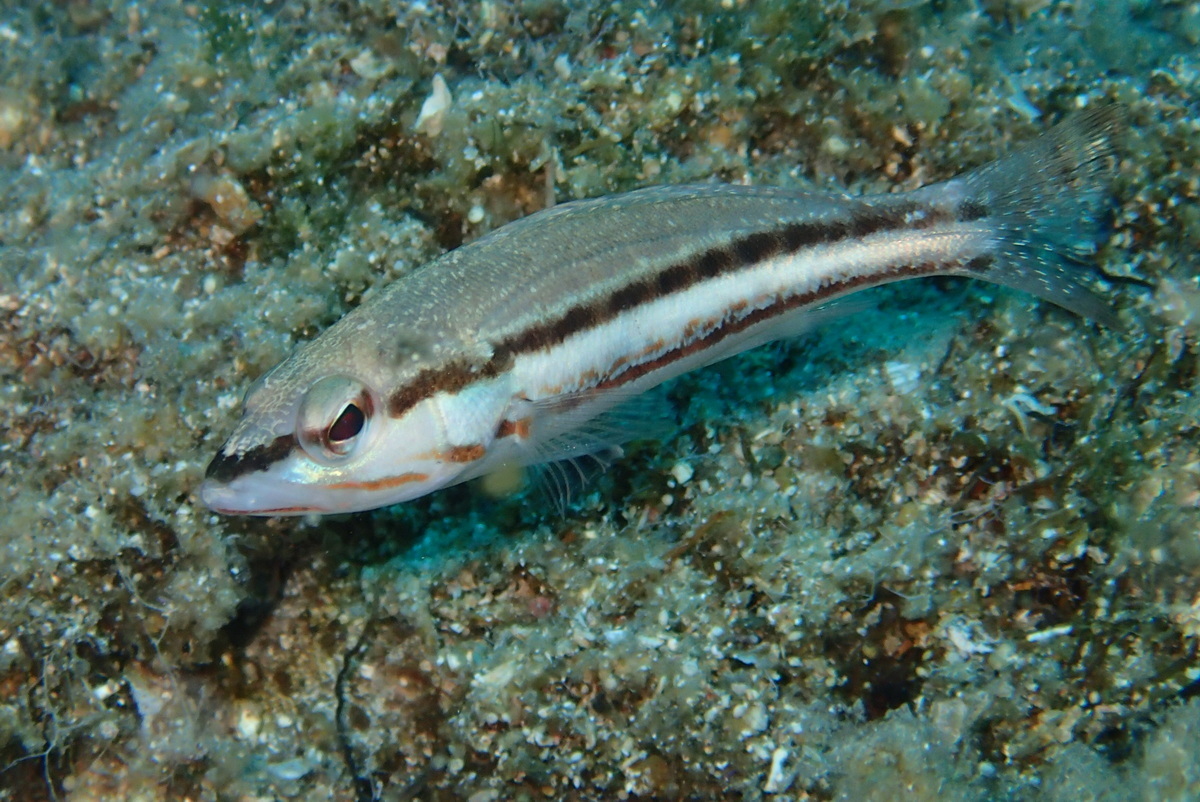
Comber
Serranus cabrilla · Serranidae
Comber is a bottom-dwelling serranid of the eastern Atlantic and Mediterranean, from the English Channel around the Cape of Good Hope to Natal, including the Azores, Madeira and the Canaries. It lives from 5 to 500 m in deep water, reaches 40 cm SL, and feeds on crustaceans, fish and molluscs. Boat bottom fishing is the usual approach, with the season running February to August.
- Family
- Serranidae
- Max length
- 40 cm SL
- Depth
- 5–500 m
- IUCN
- LC
- Climate
- Deep-water
- Diet
- crustaceans, fishes, molluscs
Comber (Serranus cabrilla) is a fish of the family Serranidae. FishBase gives its range as: Eastern Atlantic: English Channel southward round the Cape of Good Hope to Natal, South Africa, including Azores, Madeira and the Canary Islands. It is recorded from 5 to 500 m, in deep water. The recorded maximum is 40 cm SL. Common length is recorded at 25 cm. Diet includes crustaceans, fishes and molluscs. IUCN status: Least Concern (LC). Chinese name: .
Techniques
- Boat bottom fishing —
Seasonality
Other ES-CN regulations
Same jurisdictionBefore you keep a fish
- Read the recorded value. It is copied from the notice; if the number and the notice disagree, the notice wins.
- Check the area. Federal, state and local waters can set different limits for the same fish.
- Check the date. Seasons, quotas and closures change; confirm the current notice before you go.
Common questions
- What is the minimum size for Comber in Spain — Canary Islands?
- ≥19 cm
- Where does this regulation apply?
- Spain — Canary Islands
- When was it checked?
- 2026-11-18, against Real Decreto 560/1995 — tallas mínimas (texto consolidado, actualizado 1 November 2025).