
Skipjack tuna in Australia — Tasmania: 10 fish per day · 20 in possession — Tasmania state waters.
Tuna, Skipjack | 10 | 20 | - | -
Quoted from NRE Tasmania — Recreational Sea Fishing Guide 2025-26, Quick Reference Rules
Regulation guide
Official sourcesWho manages skipjack in Tasmania
Recreational sea fishing in Tasmania is managed under the state's recreational sea fishing rules, published by Fishing Tasmania as an annual guide and as individual species pages.
Skipjack has its own page, with the scientific name Katsuwonus pelamis and the bag, possession and boat limits displayed at the top. The size and bag limits page presents the same figures in a single table.
The table treats a fish group as a combined total across the species in that group. Skipjack has its own row, so it is not pooled with the other tunas for bag purposes.
The guide is republished each season, and the figures on the page are the current season's figures rather than a historical table.
Source: Fishing Tasmania: Size and bag limits · Fishing Tasmania: Skipjack tuna (Katsuwonus pelamis)
Ten a day
The daily bag limit for skipjack is 10 fish per fisher. The species page shows the figure as the first of the three limits, under the heading bag limit.
The table places skipjack in its own row. Bigeye, yellowfin and southern bluefin share a separate row with a bag of 2, and albacore has a bag of 5, so a mixed tuna bag is not counted against the skipjack figure.
The bag limit is a per-fisher figure, not a boat figure. Two anglers on the same boat each have their own daily bag of 10.
The definitions page describes the daily bag limit as the maximum number or weight of a particular type of fish a fisher can take in any one day.
Source: Fishing Tasmania: Size and bag limits · Fishing Tasmania: Skipjack tuna (Katsuwonus pelamis)
Twenty in possession
The possession limit is 20 skipjack. It is double the daily bag, but it is not an automatic two-day bag.
Tasmania defines a possession limit as the maximum a fisher can possess in a specified area, and if no area is specified it applies anywhere in Tasmania including in the home.
The boat limit column shows a dash for skipjack, so no separate boat limit applies. The bag and possession limits are the controls.
Highgrading is not allowed: fish are regarded as taken and in possession as soon as they are caught, so a catch cannot be sorted on shore to improve the bag.
Source: Fishing Tasmania: Size and bag limits · Fishing Tasmania: Skipjack tuna (Katsuwonus pelamis)
No minimum size
The minimum size for skipjack is listed as none. The species page repeats that and adds that most scalefish are measured from the nose to the end of the tail.
Because there is no minimum, the measurement rule does not decide whether a skipjack can be kept. It still matters for other species on the boat and for any fish that might be confused with them.
The species page gives identifying features as well: three to five dark horizontal stripes on the lower half and sides against a silvery white belly, and narrowly separated dorsal fins.
The table's minimum size column is blank for several tunas, so the absence of a size is not unique to skipjack.
Source: Fishing Tasmania: Size and bag limits · Fishing Tasmania: Skipjack tuna (Katsuwonus pelamis)
Open all year
The skipjack season is open all year. The species page shows the season above the limits, and the table carries no closed season for the species.
The same page describes skipjack arriving off eastern Tasmania from sub-tropical waters and being caught from late January to April, mostly offshore. It also notes that they travel with albacore and yellowfin at times.
An open season is not the same as an open area. Area restrictions are published separately from the size and bag table, so a fish that is legal in season can still be illegal in a closed area.
Source: Fishing Tasmania: Size and bag limits · Fishing Tasmania: Skipjack tuna (Katsuwonus pelamis)
No licence for rod and line
Tasmania does not require a licence for rod and line fishing in marine waters. A licence is required for rock lobster pot, ring or dive, abalone, scallop, graball net, mullet net, beach seine net and set line.
A skipjack taken on a trolled lure or a baited rod therefore needs no sea fishing licence, while a trip that also sets a line does.
The licence rules are separate from the bag rules, so the absence of a licence requirement does not relax the bag or possession limit.
Source: Fishing Tasmania: Recreational sea fishing licences · Fishing Tasmania: Size and bag limits
What to check before keeping a skipjack
Check 10 for the day and 20 in possession, and count fish held at home.
Check that the boat limit column is empty for skipjack, and do not apply a tuna-group boat limit to it.
Check the area restrictions and the current guide, because the figures are republished each season.
The species page and the limits table are the two places to confirm the bag, possession and size figures together.
Source: Fishing Tasmania: Size and bag limits · Fishing Tasmania: Skipjack tuna (Katsuwonus pelamis)
Official pages: Fishing Tasmania: Size and bag limits · Fishing Tasmania: Skipjack tuna (Katsuwonus pelamis) · Fishing Tasmania: Recreational sea fishing licences
Skipjack tuna regulations at a glance
1 jurisdictions| Jurisdiction | Area | Size | Bag | Season / closure | Closed area | Other |
|---|---|---|---|---|---|---|
| Australia — Tasmania | Tasmania state waters | — | 10 fish per day · 20 in possession | — | — | — |
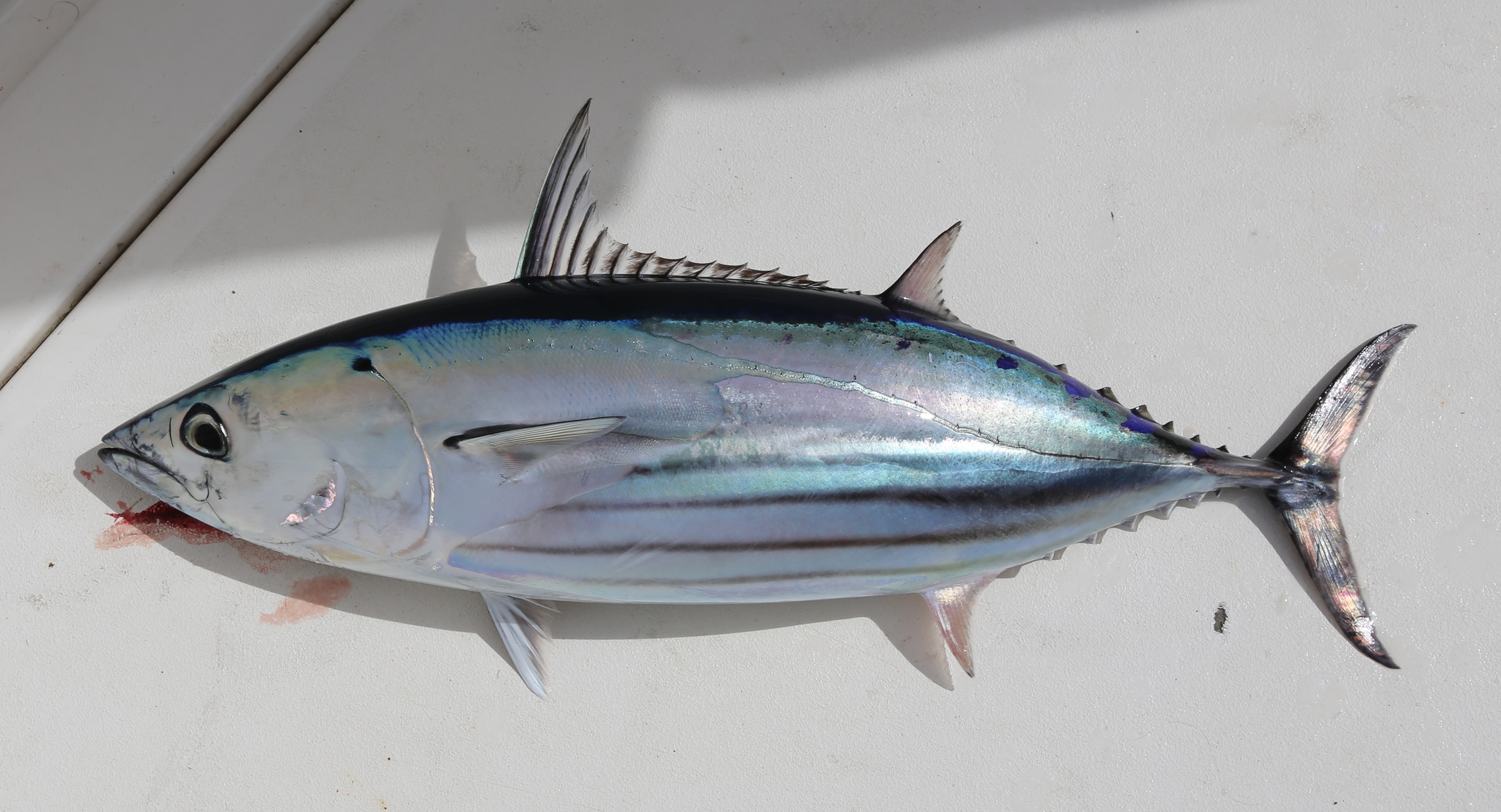
Skipjack tuna
Katsuwonus pelamis · Scombridae
Skipjack tuna is a cosmopolitan scombrid of tropical and warm-temperate waters. It lives from the surface to 260 m, reaches 110 cm and 34.5 kg, and feeds on crustaceans, fish and molluscs. Trolling or jigging is the usual approach, and fish are present year-round in water of 15 to 30 °C.
- Family
- Scombridae
- Max length
- 110 cm FL
- Max weight
- 34.5 kg
- Max age
- 12 years
- Depth
- 0–260 m
- IUCN
- LC
- Climate
- Tropical · 15–30 °C
- Diet
- crustaceans, fishes, molluscs
Skipjack tuna (Katsuwonus pelamis) is a fish of the family Scombridae. FishBase gives its range as: Cosmopolitan in tropical and warm-temperate waters. Not found in the Black Sea. It is recorded from 0 to 260 m, in tropical water at 15–30 °C. The recorded maxima are 110 cm FL, 34.5 kg, 12 years. Common length is recorded at 80 cm. Diet includes crustaceans, fishes and molluscs. IUCN status: Least Concern (LC). Chinese name: .
Techniques
- Trolling —
- Jigging —
Seasonality
Other AU-TAS regulations
Same jurisdictionBefore you keep a fish
- Read the recorded value. It is copied from the notice; if the number and the notice disagree, the notice wins.
- Check the area. Federal, state and local waters can set different limits for the same fish.
- Check the date. Seasons, quotas and closures change; confirm the current notice before you go.
Common questions
- What is the bag limit for Skipjack tuna in Australia — Tasmania?
- 10 fish per day · 20 in possession
- Where does this regulation apply?
- Tasmania state waters
- When was it checked?
- 2026-11-18, against NRE Tasmania — Recreational Sea Fishing Guide 2025-26, Quick Reference Rules.