
Sand flathead in Australia — Tasmania: 35–40 cm (35 cm minimum with no maximum at King/Flinders Islands; no take in the south-eastern zone) — Tasmania — zone-specific.
Flathead, Sand* | D'Entrecasteaux Channel, Derwent River, Frederick Henry and Norfolk Bays | 2 | 2 ^ | - | Legal size between 35-40 cm ... King and Flinders Islands | 10 | 10 | - | 35 cm
Quoted from NRE Tasmania — Recreational Sea Fishing Guide 2025-26, Quick Reference Rules
Regulation guide
Official sourcesHow sand flathead is managed in Tasmania
Sand flathead (Platycephalus bassensis) is a Tasmanian scalefish. The rules for taking it are published by Fishing Tasmania, the Tasmanian Government's recreational fishing service, in the state's size and bag limit tables.
The species is managed as a recreational-only fishery and the state lists its stock status as depleted. New sand flathead rules took effect across Tasmania on 1 March 2026, including a closure in a new south-eastern zone.
Rod-and-line fishing in Tasmanian marine waters does not require a licence. Anglers may use any number of lines with up to five hooks per line and must stay within 20 metres of the gear or have the lines attached to the boat.
Source: Fishing Tasmania: Southern Sand Flathead · Fishing Tasmania: New rules and research to rebuild Tasmania's sand flathead fishery · Fishing Tasmania: Scalefish and bait fishing gear
Four zones, four different bag limits
The bag limit depends on the zone. The south-eastern zone is zero, the Eastern Zone is 5, the Northern/Western Zone is 10 and King and Flinders Islands is 10. The on-water possession limit matches the bag limit in each zone.
The on-land possession limit is 10 sand flathead per person, whether the fish are at home, in a car or at a shack. An overall limit of 20 sand and tiger flathead combined applies to the bag, and 30 combined to possession.
You cannot hold more sand flathead than the on-water possession limit of the zone you are in, regardless of where the fish were caught. Fish held on land in the south-east must have been taken before the closure or outside the zone.
The south-eastern zone is closed
Since 1 March 2026 the south-eastern zone has a bag limit of zero and an on-water possession limit of zero. No sand flathead may be taken there.
The zone runs between a north-south line at Whale Head (146 degrees 52 minutes 15 seconds) and a north-south line at Cape Pillar (148 degrees 00 minutes 41 seconds). It includes the whole of the former D'Entrecasteaux Channel, Derwent River, Frederick Henry and Norfolk Bays Zone, and its northern boundary is the southern end of the Dunalley Canal.
Possession of any part of a sand flathead is also prohibited in the zone, including parts kept for bait or berley.
Source: Fishing Tasmania: New rules and research to rebuild Tasmania's sand flathead fishery · Fishing Tasmania: Southern Sand Flathead
Size limits and measuring
In all waters except King and Flinders Islands and the south-eastern zone, the legal size is between 35 cm and 40 cm. At King and Flinders Islands the minimum is 35 cm with no maximum.
Scalefish are measured from the nose to the end of the tail. Measuring stickers are available from Service Tasmania outlets.
When moving between zones, every sand flathead on board must meet the size limit of the zone being entered.
Landing and filleting rules
All species of flathead must be landed whole or as fillets with intact frames, meaning the head and tail stay attached. The rule is statewide and was introduced with the 2026 changes.
Fillets with no frame, or with a frame that has been cut, do not comply. The requirement covers sand flathead, tiger flathead, southern bluespotted flathead and rock flathead.
The landing rule is an enforcement measure: it lets fisheries officers check the size and bag limits after the fish has left the water.
Source: Fishing Tasmania: Southern Sand Flathead · Fishing Tasmania: Size and Bag Limits · Fishing Tasmania: New rules and research to rebuild Tasmania's sand flathead fishery
Why the limits are tight
The 2025 IMAS stock assessment found that sand flathead fishing is unsustainable in most of Tasmania. There are too few large females, and in many areas 79 to 100 per cent of fish were below the 35 cm legal size. In the south-east only 1 per cent were legal-sized.
More than half of the sand flathead catch is taken in the south-east, which is why the closure is concentrated there. The state has also funded a 1.2 million dollar sand flathead breeding and stock enhancement program with IMAS.
The department advises barbless or circle hooks, a de-hooker, a wet cloth for handling and minimal time out of the water. Gut-hooked fish should have the line cut and the hook left in place.
Source: Fishing Tasmania: New rules and research to rebuild Tasmania's sand flathead fishery · Fishing Tasmania: Southern Sand Flathead
What to check before keeping a sand flathead
First confirm the zone. In the south-eastern zone the answer is no take at all; elsewhere the bag is 5 or 10 depending on the zone.
Then check the size against the 35 to 40 cm slot, or the 35 cm minimum at King and Flinders Islands, and count against both the zone possession limit and the 10-fish on-land limit.
Keep the fish whole or as fillets with the frame attached. The species page also carries a public health advisory to limit meals of Derwent-caught scalefish, including flathead, because of heavy metal contamination.
Source: Fishing Tasmania: Southern Sand Flathead · Fishing Tasmania: New rules and research to rebuild Tasmania's sand flathead fishery
Official pages: Fishing Tasmania: Southern Sand Flathead · Fishing Tasmania: Size and Bag Limits · Fishing Tasmania: New rules and research to rebuild Tasmania's sand flathead fishery · Fishing Tasmania: Scalefish and bait fishing gear
Sand flathead regulations at a glance
1 jurisdictions| Jurisdiction | Area | Size | Bag | Season / closure | Closed area | Other |
|---|---|---|---|---|---|---|
| Australia — Tasmania | Tasmania — zone-specific | 35–40 cm (35 cm minimum with no maximum at King/Flinders Islands; no take in the south-eastern zone) | 0 (south-eastern zone) · 5 (eastern zone) · 10 (northern/western zone and King/Flinders Islands) | — | — | — |
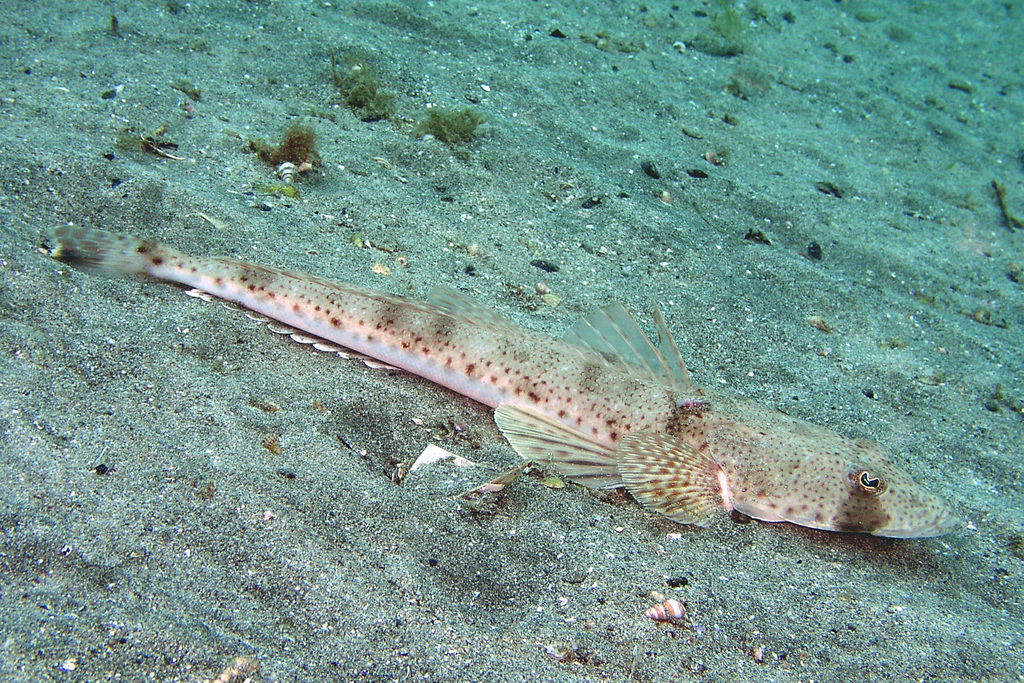
Sand flathead
Platycephalus bassensis · Platycephalidae
The sand flathead is southern Australia's jetty, estuary and small-boat flathead: a sand-coloured ambush predator with eyes on top and a shovel-shaped head. It is also a management problem, with the Tasmanian stock officially depleted and Victoria rebuilding slowly. Fish sand edges and drop-offs with soft plastics or bait hopped along the bottom.
- Family
- Platycephalidae
- Max length
- 46 cm TL
- Max weight
- 3.1 kg
- Depth
- 1–100 m
- IUCN
- NE
- Climate
- Temperate
- Diet
- crustaceans, fishes
The sand flathead is the flathead of southern Australia: a low, sand-coloured ambush predator with a head like a shovel and eyes on top, caught from jetties, estuaries and small boats across four states. It is also the fish that Australian fisheries managers have spent the last decade arguing about, because the Tasmanian stock is now officially depleted while the Victorian one is only slowly rebuilding.
Techniques
- Boat bottom fishing —
Seasonality
Other AU-TAS regulations
Same jurisdictionBefore you keep a fish
- Read the recorded value. It is copied from the notice; if the number and the notice disagree, the notice wins.
- Check the area. Federal, state and local waters can set different limits for the same fish.
- Check the date. Seasons, quotas and closures change; confirm the current notice before you go.
Common questions
- What is the minimum size for Sand flathead in Australia — Tasmania?
- 35–40 cm (35 cm minimum with no maximum at King/Flinders Islands; no take in the south-eastern zone)
- Where does this regulation apply?
- Tasmania — zone-specific
- When was it checked?
- 2026-11-18, against NRE Tasmania — Recreational Sea Fishing Guide 2025-26, Quick Reference Rules.