
Barracouta in Australia — Tasmania: 15 fish per day · 30 in possession — Tasmania state waters.
Barracouta | 15 | 30 | - | -
Quoted from NRE Tasmania — Recreational Sea Fishing Guide 2025-26, Quick Reference Rules
Regulation guide
Official sourcesOne fish, two state rulebooks
Barracouta (Thyrsites atun) is a schooling, migratory species taken in Tasmania and Victoria. Each state sets its own recreational limits, and the two sets differ.
Tasmania allows 15 a day and 30 in possession, with no minimum size. Victoria allows 20 a day, also with no minimum size.
The species is also called couta, snoek and barracuda in Tasmania, and it is fished around baitfish schools.
Tasmania describes barracouta as a fish of open coastal waters, found where baitfish gather around shallow reefs, headlands and deep bays. Young fish enter sheltered bays and large estuaries.
It is caught by trolling or casting with lures and baits, by jigging around baitfish schools, and sometimes on bottom rigs, which is why anglers lose shiny sinkers where barracouta are present.
A wire trace is used to stop the fish biting through lures, and the Tasmanian fishing advice lists barbless hooks with red tags among the gear used.
Source: Fishing Tasmania: Barracouta · VFA: Barracouta
Tasmania: 15 a day, 30 in possession
The Tasmanian species page lists a bag limit of 15, a possession limit of 30 and no boat limit. No minimum size applies.
The season is open all year. Most scalefish, including barracouta, are measured from the nose to the end of the tail.
The 15 and the 30 are separate figures: 15 is the daily bag, while 30 is the maximum that may be held. Tasmania gives the species as growing to about 1.4 m and 6 kg.
Source: Fishing Tasmania: Barracouta · Fishing Tasmania: Size and Bag Limits
Tasmania: gear and access
No licence is needed to fish with a hook and line in Tasmanian marine waters, including rod and line and squid jigs.
Anglers may use any number of lines with up to five hooks per line. You must be within 20 metres of the gear, or have the lines attached to the boat from which you are fishing.
Gear that is not listed cannot be used. Gillnets, set lines and beach seine nets require a licence, and area restrictions apply to some gear.
Source: Fishing Tasmania: Scalefish and bait fishing gear · Fishing Tasmania: Barracouta
Victoria: 20 a day, no minimum size
The Victorian guide lists barracouta with no minimum legal size and a bag limit of 20.
The default bag limit of 5 that applies to unlisted marine and estuarine scale fish does not apply, because barracouta has its own entry.
Victorian bag limits apply while you are in, on or next to the water: an angler cannot hold more than 20 barracouta at the boat, the ramp or the shore.
The separate Victorian possession limit, which applies away from the water, is limited to southern bluefin tuna, Murray cod, abalone, yabbies and Murray spiny freshwater crayfish. Barracouta is not on that list, so the bag limit is the controlling figure.
Source: VFA: Barracouta · VFA: Marine and Estuarine Scale Fish · VFA: Fishing definitions
Victoria: licence and measuring
A Victorian recreational fishing licence is required for anglers aged 18 to 70. Exemptions include people under 18, people 70 and over, and holders of specified concession cards.
Scale fish are measured from the tip of the snout with the mouth closed to the end of the tail. The legal size must be checked at the first available opportunity, and undersize fish must be released immediately.
For barracouta there is no size to check, so the licence and the count are the practical checks.
Source: VFA: Buy a fishing licence · VFA: Fishing definitions · VFA: Marine and Estuarine Scale Fish
The two numbers compared
Tasmania's daily figure is lower than Victoria's, but Tasmania also sets a possession figure of 30, while Victoria's entry gives only a daily bag of 20.
Neither state sets a minimum size, so there is no length to measure in either jurisdiction.
Neither state's barracouta entry sets a boat limit, which means the catch is counted per person rather than per vessel.
Source: Fishing Tasmania: Barracouta · VFA: Barracouta
What to check before keeping a barracouta
Identify the state first: 15 a day and 30 in possession in Tasmania, 20 a day in Victoria.
In Tasmania, check that you are within 20 metres of your lines and within the five-hooks-per-line rule. In Victoria, check the licence requirement before you fish.
Handle barracouta with care because of the teeth and the spines on the back, and release unwanted fish over the water with a de-hooker.
The species bleeds easily and sheds scales profusely once hooked, which is the reason for releasing it over the water rather than lifting it aboard.
The Tasmanian advice is that barracouta should not be eaten raw, because larger fish may carry a parasite in the gut or flesh that is killed by cooking.
Neither state sets a minimum size, so the count is the only numerical check to make.
Source: Fishing Tasmania: Barracouta · Fishing Tasmania: Scalefish and bait fishing gear · VFA: Buy a fishing licence
Official pages: Fishing Tasmania: Barracouta · Fishing Tasmania: Size and Bag Limits · VFA: Barracouta · VFA: Buy a fishing licence
Barracouta regulations at a glance
2 jurisdictions| Jurisdiction | Area | Size | Bag | Season / closure | Closed area | Other |
|---|---|---|---|---|---|---|
| Australia — Tasmania | Tasmania state waters | — | 15 fish per day · 30 in possession | — | — | — |
| Australia — Victoria | Victorian marine and estuarine waters | — | 20 fish per person per day · no minimum size | — | — | — |
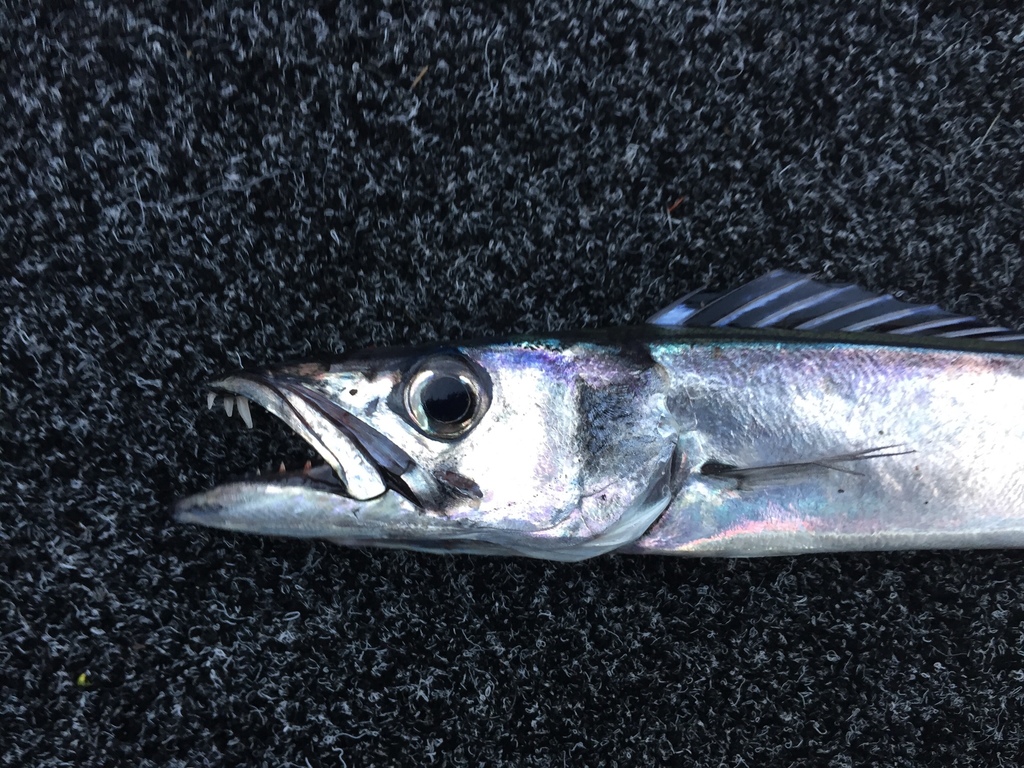
Barracouta
Thyrsites atun · Gempylidae
Barracouta is a gempylid of the southwest Atlantic and southern oceans, from Uruguay, Argentina and Tierra del Fuego to South Africa, Australia and New Zealand. It lives from the surface to 550 m in water of 13 to 18 °C, reaches 200 cm SL, can live 10 years, and feeds on crustaceans, fish and molluscs. Trolling or boat fishing is the usual approach, and it is present year-round.
- Family
- Gempylidae
- Max length
- 200 cm SL
- Max age
- 10 years
- Depth
- 0–550 m
- IUCN
- NE
- Climate
- Subtropical · 13–18 °C
- Diet
- crustaceans, fishes, molluscs
Barracouta (Thyrsites atun) is a fish of the family Gempylidae. FishBase gives its range as: Southwest Atlantic: Uruguay, Argentina and Tierra del Fuego. Eastern Atlantic: Tristan da Cunha and South Africa. It is recorded from 0 to 550 m, in subtropical water at 13–18 °C. The recorded maxima are 200 cm SL, 10 years. Diet includes crustaceans, fishes and molluscs. IUCN status: Not Evaluated (NE). Chinese name: .
Techniques
- Trolling —
- Boat fishing —
Seasonality
Other AU-TAS regulations
Same jurisdictionBefore you keep a fish
- Read the recorded value. It is copied from the notice; if the number and the notice disagree, the notice wins.
- Check the area. Federal, state and local waters can set different limits for the same fish.
- Check the date. Seasons, quotas and closures change; confirm the current notice before you go.
Common questions
- What is the bag limit for Barracouta in Australia — Tasmania?
- 15 fish per day · 30 in possession
- Where does this regulation apply?
- Tasmania state waters
- When was it checked?
- 2026-11-18, against NRE Tasmania — Recreational Sea Fishing Guide 2025-26, Quick Reference Rules.
- Do other jurisdictions set different limits?
- Yes. This register lists 2 jurisdictions for Barracouta; compare them in the table above.