
Common dab in Spain: ≥23 cm — Spain — Cantabrian/Northwest and Gulf of Cadiz.
| Limanda (Limanda limanda) | 23 |
Quoted from Real Decreto 560/1995 — tallas mínimas (texto consolidado, actualizado 1 November 2025)
Regulation guide
Official sourcesHow dab is regulated
Dab, Limanda limanda, is limande in France and limanda in Spain. The two figures here differ by 3 cm: 20 cm in France and 23 cm in Spain.
No EU minimum conservation reference size is set for dab in the Atlantic annexes of Regulation (EU) 2019/1241, and the UK table has no dab entry. The French and Spanish figures are national.
The Spanish figure sits in a table that also covers lemon sole, plaice and flounder, each with its own number, so the species has to be identified before the size is applied.
The French and Spanish tables list dab under different names, but both give a single figure for the species, with no area subdivision beyond the Atlantic list.
Source: Légifrance: Arrêté du 26 octobre 2012, annexe I · BOE: Real Decreto 560/1995, annex I · EUR-Lex: Regulation (EU) 2019/1241, Annexes VI and VII · GOV.UK / MMO: Minimum Conservation Reference Sizes (MCRS) in UK waters
There is no EU minimum size
Part A of Annexes VI and VII of Regulation (EU) 2019/1241 do not list dab. The tables cover cod, haddock, saithe, pollack, hake, megrim, sole, plaice, whiting, ling, blue ling and the shellfish, but not Limanda limanda.
The UK table follows the same pattern: it lists lemon sole at 25 cm in ICES divisions 7d and 7e, but no dab. A species absent from the table has no MCRS in UK waters.
Because the EU repealed Regulation (EC) No 850/98 and replaced its technical measures with the 2019 regulation, the absence from the current annexes is the relevant test, not an older table.
The French and Spanish figures therefore stand alone, and neither is a European baseline.
Source: EUR-Lex: Regulation (EU) 2019/1241, Annexes VI and VII · GOV.UK / MMO: Minimum Conservation Reference Sizes (MCRS) in UK waters
France: 20 cm in the Atlantic list
Annex I of the arrêté of 26 October 2012 lists LIMANDE, Limanda limanda, at 20 cm in part I, covering the North Sea, the Channel and the Atlantic. Part II, the Mediterranean list, has no limande entry.
The order applies to recreational fishing from vessels without a commercial permit, swimming and diving, and fishing on foot on the public maritime domain, and it binds French-flagged pleasure craft outside French waters.
It sets no bag limit or season for dab. The 20 cm is the whole of the French species rule.
The 20 cm is 3 cm below the Spanish figure, so a dab that is legal in France is undersized in Spain.
Source: Légifrance: Arrêté du 26 octobre 2012, annexe I · BOE: Real Decreto 560/1995, annex I
Spain: 23 cm for limanda
Annex I of Real Decreto 560/1995 lists Limanda (Limanda limanda) at 23 cm for the Cantabrian/Northwest and Gulf of Cadiz grounds. Annex II, the Mediterranean table, and Annex III, the Canary table, have no entry.
The same annex lists mendo limón (Microstomus kitt) at 25 cm and platija (Platichthys flesus) at 25 cm, so three flatfish in the table sit within 2 cm of each other.
Article 3 prohibits retaining, transporting, storing, selling, displaying or marketing fish below the required size.
Spain's recreational species list
The 23 cm is a minimum size in the commercial table. Recreational fishing in Spanish external waters is governed by Real Decreto 347/2011, which limits catches to the species listed in its Annex I and requires the 1995 sizes to be respected.
Dab, Limanda limanda, is not named in that Annex I. The list includes acedía, boga, maruca, octopus and the sea breams, but no dab, so the species should be checked before it is targeted under the recreational regime.
That does not change the 23 cm figure in the size decree; it changes whether an angler may keep the fish at all in the waters covered by the recreational decree.
Outside external waters, the coastal autonomous communities regulate recreational fishing in their own waters, so the regional rule is the one to check for a dab taken inside a bay or estuary.
The regional rule can differ from the national table, so the two questions are separate: whether the species may be taken at all, and what size applies in that water.
Source: BOE: Real Decreto 347/2011, Article 4 and Annex I · BOE: Real Decreto 560/1995
No bag limit, and how to measure
No instrument cited sets a bag limit for dab. France publishes a size only; Spain's decree publishes sizes and prohibits retention below them.
Measure from the tip of the snout to the end of the caudal fin. A flatfish should be laid flat and the tail spread, because the tail is included in the measurement.
A dab close to 20 or 23 cm is worth measuring on a board rather than by eye, since the two national figures differ by a margin smaller than a hand.
If the fish is under the figure, it cannot be retained; the French order and the Spanish decree both prohibit keeping it.
Source: Légifrance: Arrêté du 26 octobre 2012, annexes I and II · BOE: Real Decreto 560/1995 · EUR-Lex: Regulation (EU) 2019/1241, Annex IV
Official pages: Légifrance: Arrêté du 26 octobre 2012 (tailles minimales, pêche de loisir) · BOE: Real Decreto 560/1995 (tallas mínimas) · BOE: Real Decreto 347/2011 (pesca marítima de recreo) · EUR-Lex: Regulation (EU) 2019/1241 (technical measures)
Common dab regulations at a glance
2 jurisdictions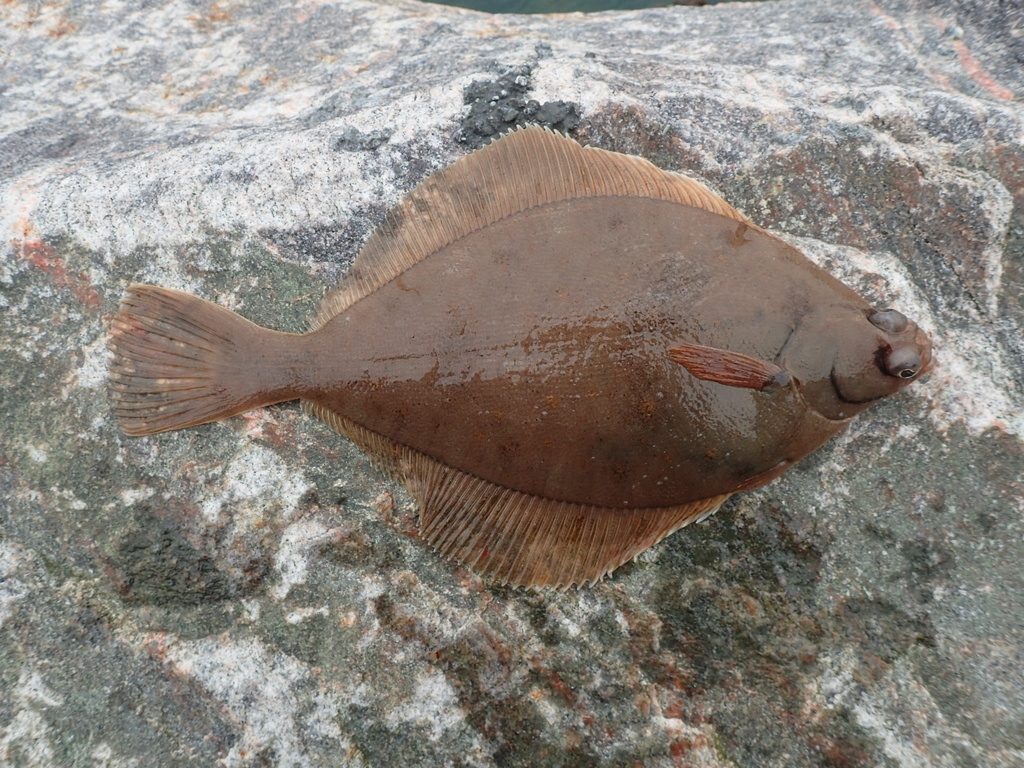
Common dab
Limanda limanda · Pleuronectidae
Common dab is a small flatfish of the northeast Atlantic, found on sandy ground in the North Sea and the Baltic. It is a shallow shelf fish, generally worked between 20 and 150 m. It is small: 40 cm SL and about a kilo is the top of the range, though most fish never get near 20 cm. The season runs January to August, and the Baltic records widen its range beyond the North Sea.
- Family
- Pleuronectidae
- Max length
- 40 cm SL
- Max weight
- 1 kg
- Max age
- 12 years
- Depth
- 20–150 m
- IUCN
- LC
- Climate
- Temperate
- Diet
- crustaceans, fishes
Three labels on this page do not line up. The environment row says marine; the spawning table includes the Baltic Sea. The habitat keyword says sandy; the Baltic is not the North Sea. The maximum length is 40 cm; the summary says most specimens never pass 20 cm. None of these contradictions needs to be resolved to fish for common dab, but each one changes what a bait, a depth, and a size limit mean.
Seasonality
Other ES regulations
Same jurisdictionBefore you keep a fish
- Read the recorded value. It is copied from the notice; if the number and the notice disagree, the notice wins.
- Check the area. Federal, state and local waters can set different limits for the same fish.
- Check the date. Seasons, quotas and closures change; confirm the current notice before you go.
Common questions
- What is the minimum size for Common dab in Spain?
- ≥23 cm
- Where does this regulation apply?
- Spain — Cantabrian/Northwest and Gulf of Cadiz
- When was it checked?
- 2026-11-18, against Real Decreto 560/1995 — tallas mínimas (texto consolidado, actualizado 1 November 2025).
- Do other jurisdictions set different limits?
- Yes. This register lists 2 jurisdictions for Common dab; compare them in the table above.