
Common ling in France: ≥63 cm — France — North Sea, Channel and Atlantic.
| LINGUE | Molva molva | 63 cm |
Quoted from Arrêté du 26 octobre 2012 — tailles minimales de capture (pêche maritime de loisir)
Regulation guide
Official sourcesHow ling is regulated
Common ling (Molva molva) is lingue in France and maruca in Spain. It is a large gadoid taken by boat anglers, and it is one of the few species in this group where the European and national figures agree exactly.
Regulation (EU) 2019/1241 sets a minimum conservation reference size of 63 cm for ling in each of the three Atlantic sea basins, and the UK, French and Spanish tables all publish 63 cm. There is no national variation among the jurisdictions in this dossier.
That agreement makes ling simpler than conger, which has three different national figures and no EU size, and simpler than flounder, which has three national figures and again no EU size.
Source: EUR-Lex: Regulation (EU) 2019/1241, annexes V–VII part A · Légifrance: Arrêté du 26 octobre 2012 (tailles minimales, pêche de loisir) · BOE: Real Decreto 560/1995 (tallas mínimas, texto consolidado)
The EU minimum is 63 cm
Part A of Annex V, for the North Sea, part A of Annex VI, for North Western Waters, and part A of Annex VII, for South Western Waters, each list Ling (Molva molva) at 63 cm. Blue ling is listed separately at 70 cm in the same tables.
Minimum conservation reference sizes are set to protect juveniles and to establish minimum marketing sizes. Article 2(2) of the regulation applies only Articles 7, 10, 11 and 12 to recreational fishing, and allows Part A of the annexes to be extended to anglers by a later act where recreational fishing has a significant impact in a region.
Because the national figures equal the EU figure, no jurisdiction in this dossier is stricter than the baseline. What still varies is which annex covers the water being fished, and the national instrument that an angler is actually dealt with under.
Source: EUR-Lex: Regulation (EU) 2019/1241, annexes V–VII part A and Article 2
France: 63 cm in the Atlantic
Annex I of the arrêté of 26 October 2012 lists LINGUE, Molva molva, at 63 cm in part I, which covers the North Sea, the Channel and the Atlantic. Part II, the Mediterranean list, has no ling entry, and the species is not part of the Mediterranean fishery described there.
The order applies to recreational sea fishing from vessels other than those holding a commercial fishing permit, while swimming or diving, and on foot on the public maritime domain, including the salt-water parts of rivers and canals. It also binds French-flagged pleasure craft outside French waters.
The annex carries no bag limit or season for ling. The 63 cm is the whole of the French species rule, and the version in force dates from 14 January 2026.
UK: 63 cm in Region 2
The Marine Management Organisation's statutory guidance on minimum conservation reference sizes, updated on 3 February 2026, lists Ling, Molva molva, at 63 cm. The table's footnote defines its area as Region 2 as set out in Article 2(1)(b) of Council Regulation (EC) No 850/98.
The guidance sets a size and nothing else for the species. No daily limit, possession limit or closed season for ling appears in the table, and no separate recreational catch limit for ling is published alongside it.
An angler fishing UK waters therefore has one number to check against, but still has to establish that the water being fished falls inside Region 2 as the table defines it.
Source: GOV.UK / MMO: Minimum Conservation Reference Sizes (MCRS) in UK waters
Spain: 63 cm on the Atlantic grounds
Real Decreto 560/1995 lists maruca (Molva molva) at 63 cm in Annex I, which covers the Cantabrian/Northwest grounds and the Gulf of Cadiz. The row above it gives maruca azul (Molva dypterygia) 70 cm, so the two ling species have to be told apart before the size is applied.
Annex II, the Mediterranean table, and Annex III, the Canary table, contain no ling entry, so the Spanish decree gives no size for the species on those coasts.
Article 3 prohibits retaining, landing, transporting, storing, selling, displaying or marketing fish below the required size. Recreational fishing in external waters is further governed by Real Decreto 347/2011, which limits catches to the species authorised in its Annex I, requires the 1995 sizes to be respected, and prohibits the sale of catches.
Source: BOE: Real Decreto 560/1995, annexes I–III · BOE: Real Decreto 347/2011 (pesca marítima de recreo en aguas exteriores)
There is no ling bag limit
None of the instruments in this dossier sets a bag limit, season or quota for ling. The French order is a minimum-size instrument, the Spanish decree sets sizes and prohibitions, and the UK guidance sets sizes for the stocks in its table.
That is worth stating plainly because the absence of a bag limit is often read as the absence of a rule. The size limit is the control: a ling under 63 cm cannot be kept, transported or sold in the waters covered here.
Local measures can still sit on top of the national rule. Marine protected areas, port byelaws and licence conditions are separate instruments and are not described by a size table.
Source: Légifrance: Arrêté du 26 octobre 2012 · BOE: Real Decreto 560/1995 · GOV.UK / MMO: Minimum Conservation Reference Sizes (MCRS) in UK waters
Measuring and keeping a ling
Article 3 of the French order and Annex IV of Regulation (EU) 2019/1241 use the same definition: a fish is measured from the tip of the snout to the end of the caudal fin. Fork length is not the measure.
Ling has a rounded tail rather than a forked one, so the end of the tail fin is the last point of the fish. Lay it straight, spread the fin and read to its tip, not to the narrowest part of the wrist.
Measure before gutting or filleting. A ling close to 63 cm is worth measuring properly, because the difference between a legal fish and an undersized one is smaller than the span of a hand.
Source: Légifrance: Arrêté du 26 octobre 2012, annexe II (mesure de la taille) · EUR-Lex: Regulation (EU) 2019/1241, annex IV (measurement of size)
Official pages: EUR-Lex: Regulation (EU) 2019/1241 (technical measures) · GOV.UK / MMO: Minimum Conservation Reference Sizes (MCRS) in UK waters · Légifrance: Arrêté du 26 octobre 2012 (tailles minimales, pêche de loisir) · BOE: Real Decreto 560/1995 (tallas mínimas)
Common ling regulations at a glance
3 jurisdictions| Jurisdiction | Area | Size | Bag | Season / closure | Closed area | Other |
|---|---|---|---|---|---|---|
| France | France — North Sea, Channel and Atlantic | ≥63 cm | — | — | — | — |
| Spain | Spain — Cantabrian/Northwest and Gulf of Cadiz | ≥63 cm | — | — | — | — |
| United Kingdom | UK waters (Region 2 as defined by Council Regulation (EC) No 850/98) | ≥63 cm | — | — | — | — |
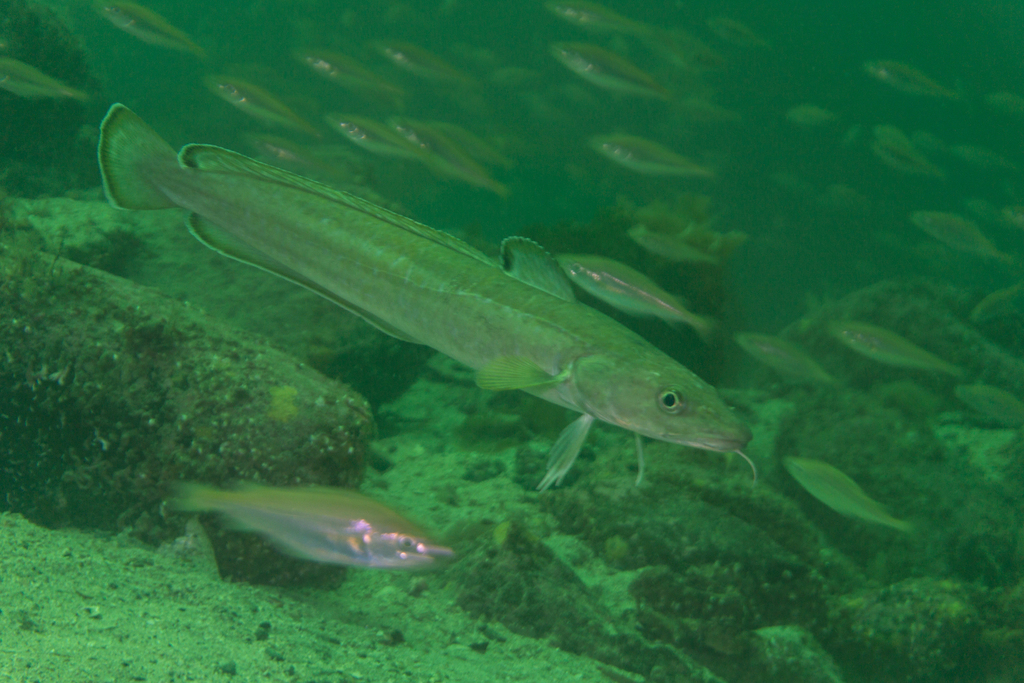
Common ling
Molva molva · Lotidae
For most coastal species, "shallow" means the edge of the beach. For the ling it means a hundred metres. That single offset reorganises everything else on this page: the fish is not deep in the sense of extreme, it is deep in the sense that the shallow end of its range is already past the limit of a rod cast, and the band it actually occupies sits further down the slope.
- Family
- Lotidae
- Max length
- 200 cm TL
- Max weight
- 45 kg
- Max age
- 25 years
- Depth
- 100–1000 m
- IUCN
- NE
- Climate
- Temperate
- Diet
- fishes, molluscs, echinoderms
For most coastal species, "shallow" means the edge of the beach. For the ling it means a hundred metres. That single offset reorganises everything else on this page: the fish is not deep in the sense of extreme, it is deep in the sense that the shallow end of its range is already past the limit of a rod cast, and the band it actually occupies sits further down the slope.
Seasonality
Other FR regulations
Same jurisdictionBefore you keep a fish
- Read the recorded value. It is copied from the notice; if the number and the notice disagree, the notice wins.
- Check the area. Federal, state and local waters can set different limits for the same fish.
- Check the date. Seasons, quotas and closures change; confirm the current notice before you go.
Common questions
- What is the minimum size for Common ling in France?
- ≥63 cm
- Where does this regulation apply?
- France — North Sea, Channel and Atlantic
- When was it checked?
- 2026-11-18, against Arrêté du 26 octobre 2012 — tailles minimales de capture (pêche maritime de loisir).
- Do other jurisdictions set different limits?
- Yes. This register lists 3 jurisdictions for Common ling; compare them in the table above.