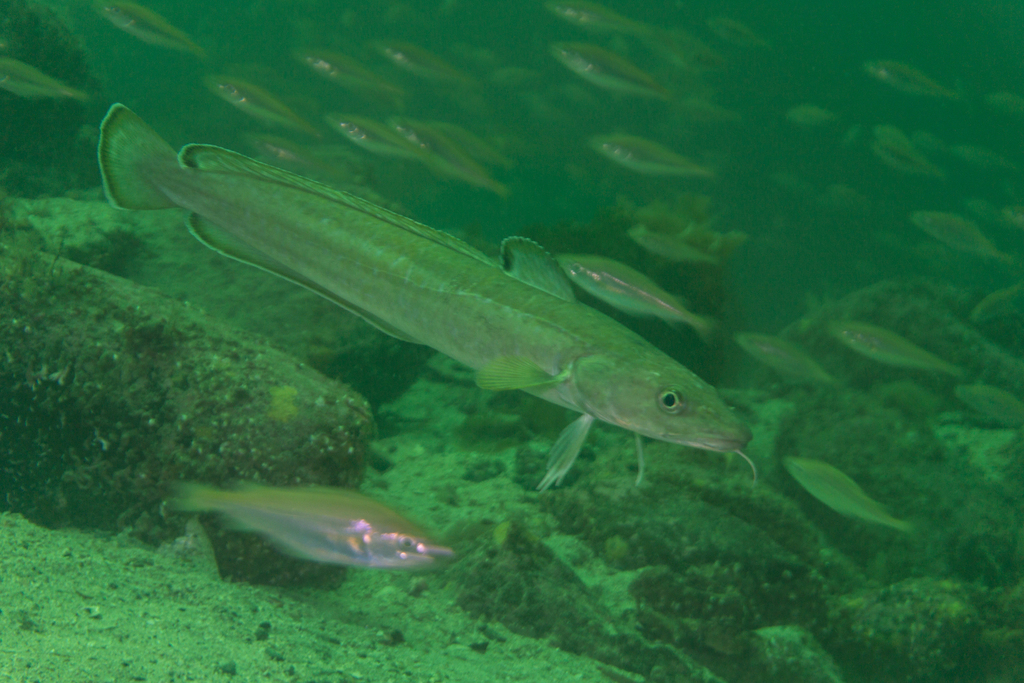
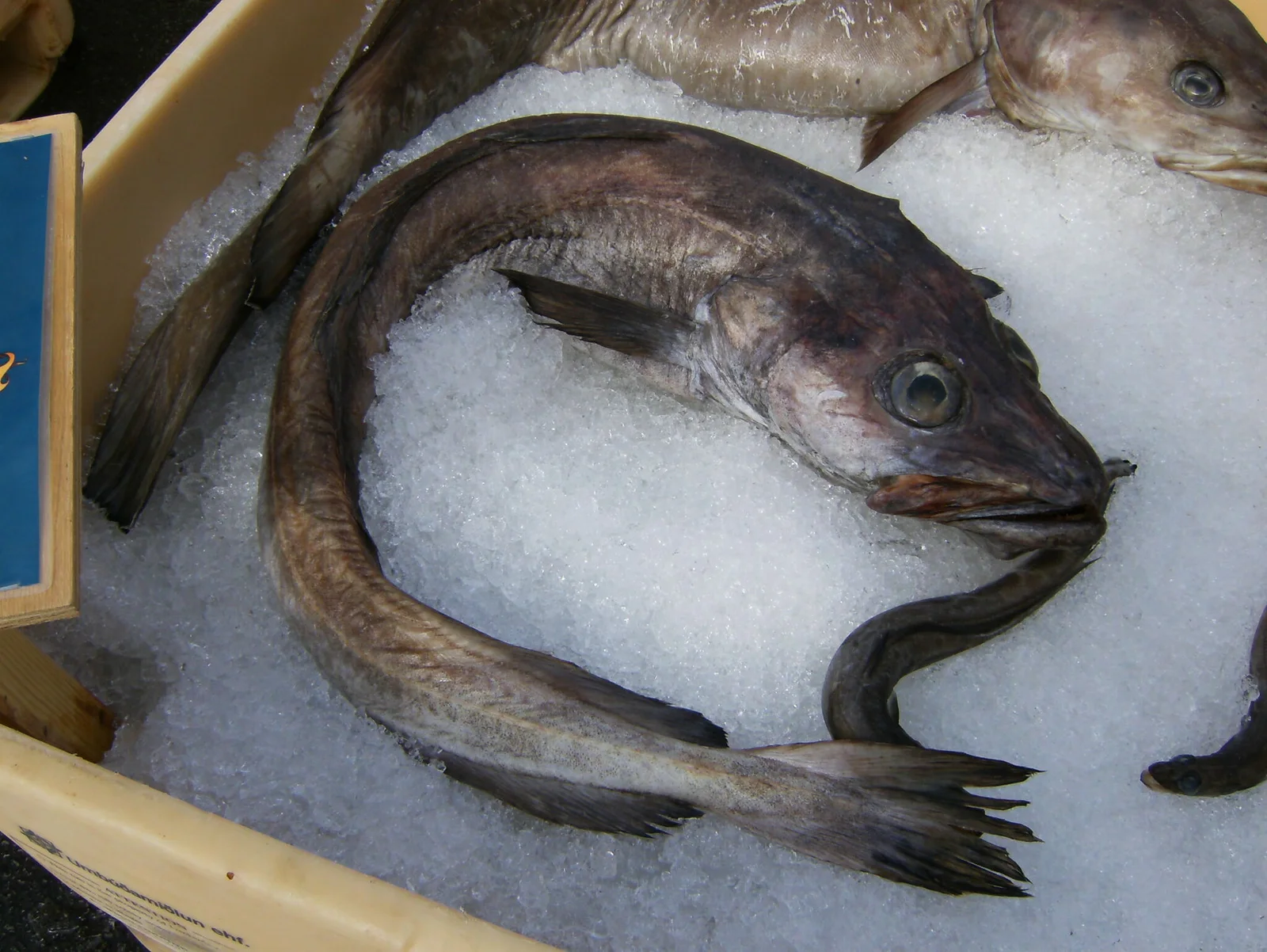
For most coastal species, "shallow" means the edge of the beach. For the ling it means a hundred metres. That single offset reorganises everything else on this page: the fish is not deep in the sense of extreme, it is deep in the sense that the shallow end of its range is already past the limit of a rod cast, and the band it actually occupies sits further down the slope.
A hundred metres is the shallow edge
FishBase gives the vertical range as 100 to 1000 metres, with the usual fishing between 100 and 400. Read the first number as a gate rather than as a preference. A hundred metres is boat water in most places, and in exposed water it is already beyond what an angler can reach with a shore rod and a heavy lead. The ling's shallow is somebody else's deep.
The consequence is simple. Everything written about this species assumes a boat, a sounder and a slope. Advice about casting distance, wash and surf zone belongs to other fish; here the first decision is whether the boat is over the right contour at all.
The band follows the slope
The habitat field pairs rocky with deep. The pairing describes a specific place: the rough, boulder-strewn slope where the shelf drops away, not the flat sand beyond it and not the kelp shallows above it. Ling hold on hard relief inside the depth band, which is why the band and the bottom have to be read together.
That also explains why a soft, even mark inside the correct depth produces nothing. The contour is right and the ground is wrong. Find the depth first, then look for the hardness — a boulder field, a wall, a wreck sitting on the slope — and only then start thinking about bait.
Tide moves water, not depth
Inshore species are often described by how the tide shifts them: up the beach on a flood, down the gully on the ebb. Ling do not do this. Their band is set by the shape of the slope, and the tide changes the drift, the speed of the current over the reef and the way a bait sits, but it does not move the fish two hundred metres up or down.
This is the most useful correction in the whole page. Time the session around the tide for presentation and for the angle of the boat, not in the belief that the fish will come shallower. A ling mark that produces at slack water will produce again at slack water, because the mark is geography rather than a tide stage.
A metre is normal
The common length is 106 centimetres, the maximum 200 centimetres at 45 kilograms, and the oldest recorded fish 25 years. A metre is therefore not a good fish — it is an ordinary one. The record is roughly double the normal size and belongs to an animal that has been on the slope for decades.
That matters when tackle is chosen. A rod that can lift a metre-long fish on the drift is adequate for the species; gear built around the two-hundred-centimetre record is gear built for a fish most boats never see.
Sixty-three centimetres will not protect it
The minimum conservation reference size for ling in UK waters is 63 centimetres, while the blue ling that shares the same ground carries 70. FishBase puts the onset of maturity at 92.5 centimetres, with a reported range starting around 90. The legal line and the biological line are almost thirty centimetres apart.
That gap is the actionable part. A ling landed at 63 centimetres is legal and, in all likelihood, has never spawned. If the aim is to take fish without touching the breeding stock, the number to use is nearer 92 than 63. The regulation answers whether the fish may be kept; the maturity figure answers whether keeping it costs next year's recruits, and on this species the two answers are far apart.
The second number matters just as much. Ling and blue ling are different animals with different limits, and the seven-centimetre difference between them is enough to turn a legal fish into an offence if the identification is wrong. Learn the dorsal fin before the ruler comes out.
March to July
Spawning runs from March through July, recorded in both the Mediterranean and the North Atlantic. For a fish whose range reaches from the Barents Sea to Morocco, a single long season across that span is what the sources support, and it means there is no month in which the whole stock is resting.
For a boat angler, the practical reading is that a spring or early-summer ling is the one most likely to be carrying roe, and the one most worth releasing even when it measures well past the legal line.
Nine thousand three hundred and twenty-two tonnes
The international advice for ling in subareas 3, 4, 6 to 9, 12 and 14 sets catches at no more than 9 322 tonnes in each of 2026 and 2027. It is a two-year ceiling covering a stock that is fished by several nations across a very large area, which is why the number is written for a fleet rather than for a mark.
The angler's takeaway is structural rather than numerical. The fish you release is inside a system that already counts the ones the fleet takes, and the ceiling applies to the whole combined area. A local mark looking healthy says nothing about the stock, because the stock is assessed across subareas that no single boat will ever see.
Where the band is
The distribution records for this species name European marine waters and the North West Atlantic, with country entries for Belgium, Denmark, France, Great Britain, Ireland, Norway and Sweden, and localities as specific as Wimereux and Scotland. FishBase describes the range as the Barents Sea and Iceland south to Morocco, plus the north-western Mediterranean, and separately off southern Greenland and Canada.
Put together, those two descriptions place the band along the eastern slope of the North Atlantic, with a second population on the western side. The practical version for a boat is that the band is wherever a rocky slope crosses 100 to 400 metres, and that is a chart question, not a latitude question.
Regulations before you keep it
These are the published regulations for this fish. Read the number first. The notice below it is the actual regulation.
Minimum size3
The minimum size for Common ling in Spain is ≥63 cm.
| Maruca (Molva molva) | 63 |
The minimum size for Common ling in France is ≥63 cm.
| LINGUE | Molva molva | 63 cm |
≥63 cm
United Kingdom · UK
The minimum size for Common ling in UK waters is ≥63 cm.
| Ling | Molva molva | 63 cm |
Every record above names its source and the date it was retrieved. See the regulation register for the full list, or how to read these regulations.
Where these facts come from
Check these pages before you rely on a size, range or protection status.
-
FishBase — Molva molva
— FishBase · T2
-
GBIF — Molva molva occurrence records
— GBIF · T2
-
IUCN Red List — Molva molva
— IUCN · T1
-
Photo record — iNaturalist
— iNaturalist · T3