
Common octopus in Spain: ≥1 kg — Spain — Cantabrian/Northwest, Gulf of Cadiz and Mediterranean.
| Pulpo *(Octopus vulgaris)* | 1 kg |
Quoted from Real Decreto 560/1995 — tallas mínimas (texto consolidado, actualizado 1 November 2025)
Regulation guide
Official sourcesHow common octopus is regulated
Common octopus, Octopus vulgaris, is poulpe in France, pulpo in Spain and polvo in Portugal. It is a cephalopod rather than a fish, and every limit in this dossier is expressed as a weight: 750 g in the UK and Portugal, 1 kg in Spain.
That difference in units is the first thing to notice. An angler cannot check an octopus against a ruler; the animal is weighed, and the legal question is whether it reaches the figure in grams or kilograms for the water being fished.
The European baseline is 750 g, set in the Atlantic annexes of Regulation (EU) 2019/1241. Spain's 1 kg is stricter, while the UK and Portuguese figures repeat the European one.
Source: EUR-Lex: Regulation (EU) 2019/1241, Annexes VI and VII · GOV.UK / MMO: Minimum Conservation Reference Sizes (MCRS) in UK waters · BOE: Real Decreto 560/1995 (tallas mínimas) · DGRM: Tabela de Tamanhos Mínimos de Captura (26 February 2026)
The European baseline is 750 g
Part A of Annex VI, for North Western Waters, and Part A of Annex VII, for South Western Waters, list octopus (Octopus vulgaris) at 750 g. The figure appears in the tables of minimum conservation reference sizes, not in a length table.
Article 13 of the regulation describes those sizes as protection for juveniles and as minimum marketing sizes. Article 2(2) applies only Articles 7, 10, 11 and 12 directly to recreational fishing, so the annex figure is extended to anglers by national measures of the kind described below.
The annex gives no conversion from weight to length, and Annex IV, which deals with measurement, sets out how to measure fish and shellfish rather than how to convert a weight.
Source: EUR-Lex: Regulation (EU) 2019/1241, Annexes VI and VII, Articles 2 and 13, Annex IV
Spain: 1 kg, with a Balearic exception
Annex I of Real Decreto 560/1995 lists pulpo (Octopus vulgaris) at 1 kg for the Cantabrian/Northwest and Gulf of Cadiz grounds. Annex II, for the Mediterranean, gives the same 1 kg, and Annex III, for the Canary Islands, also gives 1 kg.
The Mediterranean table carries a footnote: the octopus size does not apply in the internal waters and on the continental shelf of the Balearic Islands. That is the only exception in the Spanish tables.
Because 1 kg is above the European 750 g, the Spanish figure is the stricter one and governs Spanish vessels fishing the grounds in the tables. Article 3 prohibits retaining, transporting, storing, selling, displaying or marketing octopus below the required weight.
Source: BOE: Real Decreto 560/1995, annexes I-III, Article 3 and Annex II footnote · EUR-Lex: Regulation (EU) 2019/1241, Annexes VI and VII
Portugal: 750 g and a 10 kg daily cap
DGRM's minimum-size table dated 26 February 2026 lists Polvo-vulgar (Octopus vulgaris) at 750 g. The table is issued under Portaria n.º 255/2022 and refers to Regulation (EU) 2019/1241 and Regulation (EU) 2026/249.
The same minimum applies to recreational fishing: DGRM's species page states that fish, crustaceans, molluscs and echinoderms below the commercial minimum sizes may not be taken. There is no separate species bag limit for octopus.
Recreational fishing requires a licence apart from limited exceptions such as hand gathering, and the daily catch is capped at 10 kg per angler, with the heaviest fish not counted; spearfishing has a 15 kg limit. The DGRM rules also require retained catch to be marked before the angler leaves the site or lands it.
Source: DGRM: Tabela de Tamanhos Mínimos de Captura (26 February 2026) · DGRM: Pesca Lúdica - Espécies · DGRM: Licenças
The UK: 750 grams
The Marine Management Organisation's statutory guidance lists Octopus, Octopus vulgaris, at 750 grams in its molluscs table. The same Region 2 footnote applies as to the fish table.
The UK table places octopus in the molluscs section rather than with the fish, so an angler looking only at the fish rows will not find the 750 grams.
The guidance publishes no bag limit, season or possession limit for octopus. Its general rule is that undersized catches must be returned to the sea immediately unless the species is subject to the landing obligation.
Inshore byelaws inside six nautical miles can add stricter measures, so the national table is the floor rather than the whole picture.
Source: GOV.UK / MMO: Minimum Conservation Reference Sizes (MCRS) in UK waters
Weighing an octopus before keeping it
The check is a weighing, not a measurement. Put the animal on a scale that reads in grams, and compare the result with 750 g in the UK and Portugal or 1 kg in Spain.
The Spanish 1 kg is 250 g above the European and Portuguese figures, so an octopus that is legal in Portugal or the UK is undersized in Spain. The Balearic exception is the one place in the Spanish tables where the 1 kg is disapplied.
No species bag limit appears in the instruments cited, but Portugal's 10 kg daily cap and its marking rule still apply. Check the water, the weight and the marking before landing the animal.
Source: EUR-Lex: Regulation (EU) 2019/1241, Annexes VI and VII · BOE: Real Decreto 560/1995 · DGRM: Pesca Lúdica - Espécies · GOV.UK / MMO: Minimum Conservation Reference Sizes (MCRS) in UK waters
Official pages: EUR-Lex: Regulation (EU) 2019/1241 (technical measures) · GOV.UK / MMO: Minimum Conservation Reference Sizes (MCRS) in UK waters · BOE: Real Decreto 560/1995 (tallas mínimas) · DGRM: Tabela de Tamanhos Mínimos de Captura · DGRM: Pesca Lúdica - Espécies
Common octopus regulations at a glance
3 jurisdictions| Jurisdiction | Area | Size | Bag | Season / closure | Closed area | Other |
|---|---|---|---|---|---|---|
| Portugal | Portugal (mainland) | ≥0.750 kg | — | — | — | — |
| Spain | Spain — Cantabrian/Northwest, Gulf of Cadiz and Mediterranean | ≥1 kg | — | — | — | — |
| United Kingdom | UK waters (Region 2 as defined by Council Regulation (EC) No 850/98) | ≥750 g | — | — | — | — |
Common octopus
Octopus vulgaris · Octopodidae
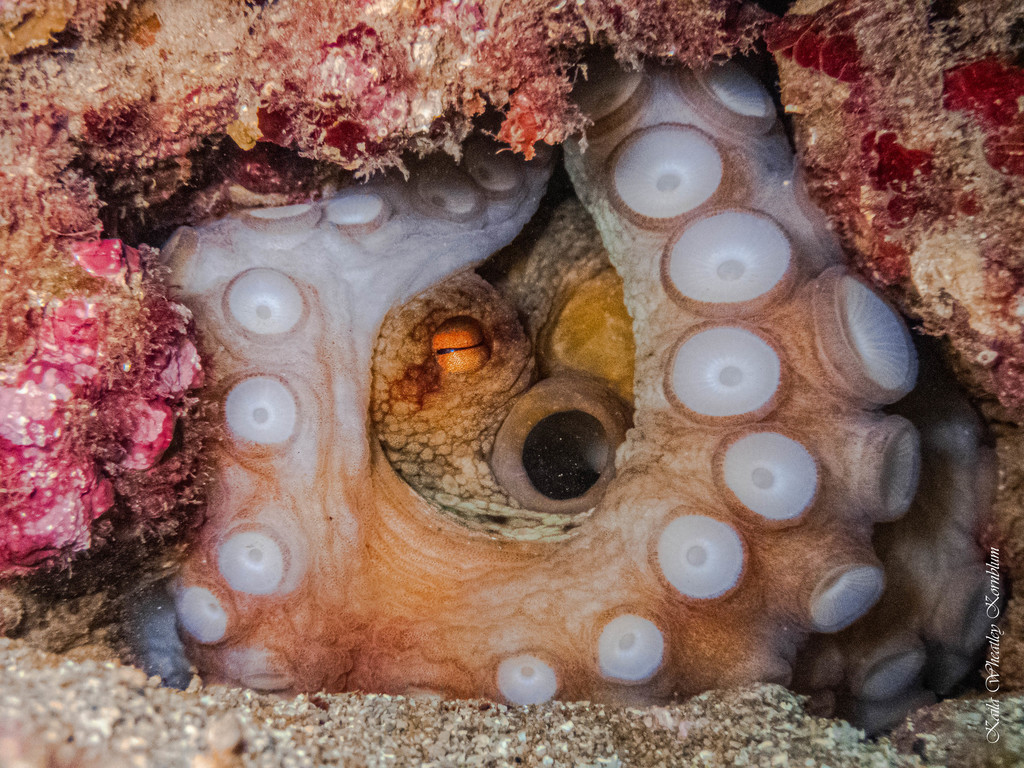
The common octopus is the cephalopod most coastal anglers meet by accident: on a jig that stopped falling, in a trap, or wrapped around a crab-pot rope. It is not a fish, and the record says so plainly — class Cephalopoda, family Octopodidae — which means the measurements that matter are not the ones a bass angler would reach for first.
- Family
- Octopodidae
- Max length
- 180 cm TL
- Max weight
- 10 kg
- Depth
- 0–347 m
- IUCN
- LC
- Climate
- Tropical
The common octopus is the cephalopod most coastal anglers meet by accident: on a jig that stopped falling, in a trap, or wrapped around a crab-pot rope. It is not a fish, and the record says so plainly — class Cephalopoda, family Octopodidae — which means the measurements that matter are not the ones a bass angler would reach for first.
Techniques
- Boat bottom fishing —
- Handline —
- Trap fishing —
Seasonality
Other ES regulations
Same jurisdictionBefore you keep a fish
- Read the recorded value. It is copied from the notice; if the number and the notice disagree, the notice wins.
- Check the area. Federal, state and local waters can set different limits for the same fish.
- Check the date. Seasons, quotas and closures change; confirm the current notice before you go.
Common questions
- What is the minimum size for Common octopus in Spain?
- ≥1 kg
- Where does this regulation apply?
- Spain — Cantabrian/Northwest, Gulf of Cadiz and Mediterranean
- When was it checked?
- 2026-11-18, against Real Decreto 560/1995 — tallas mínimas (texto consolidado, actualizado 1 November 2025).
- Do other jurisdictions set different limits?
- Yes. This register lists 3 jurisdictions for Common octopus; compare them in the table above.