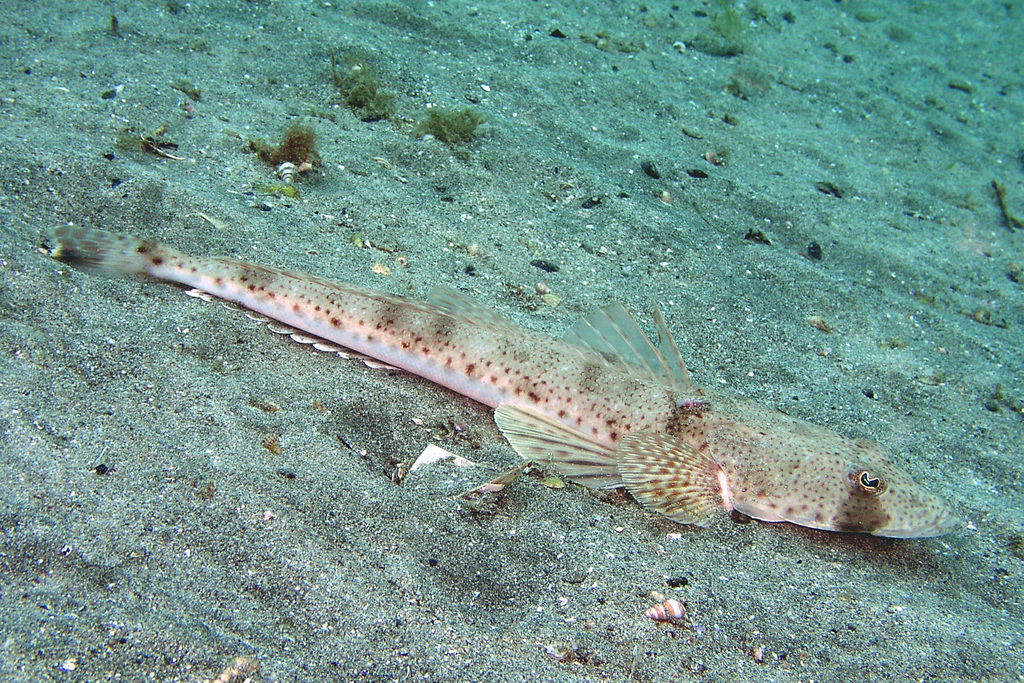
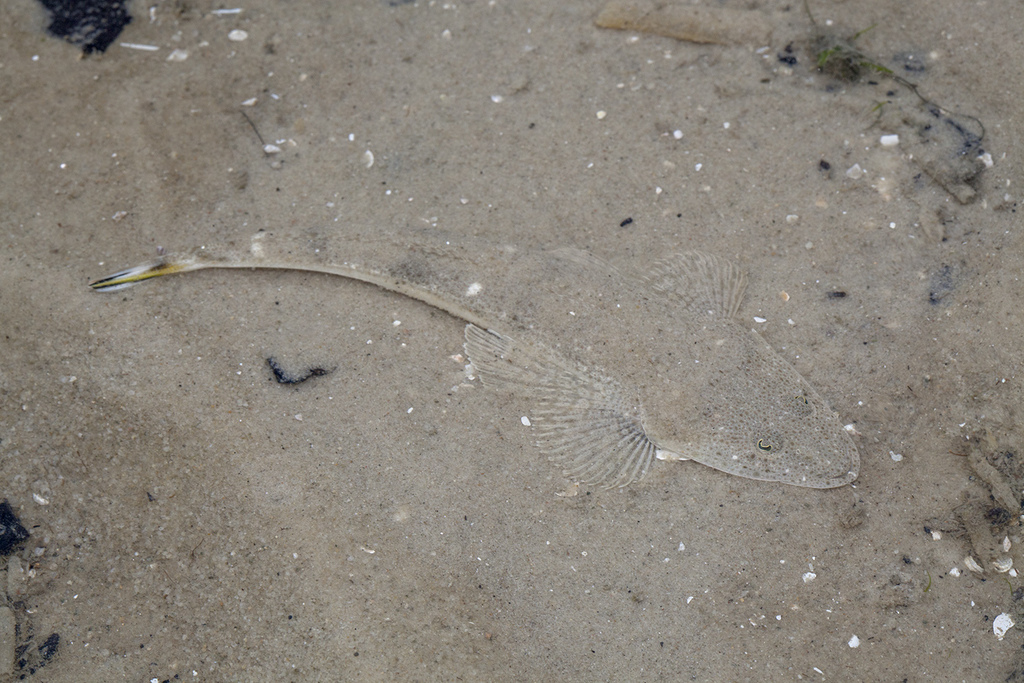
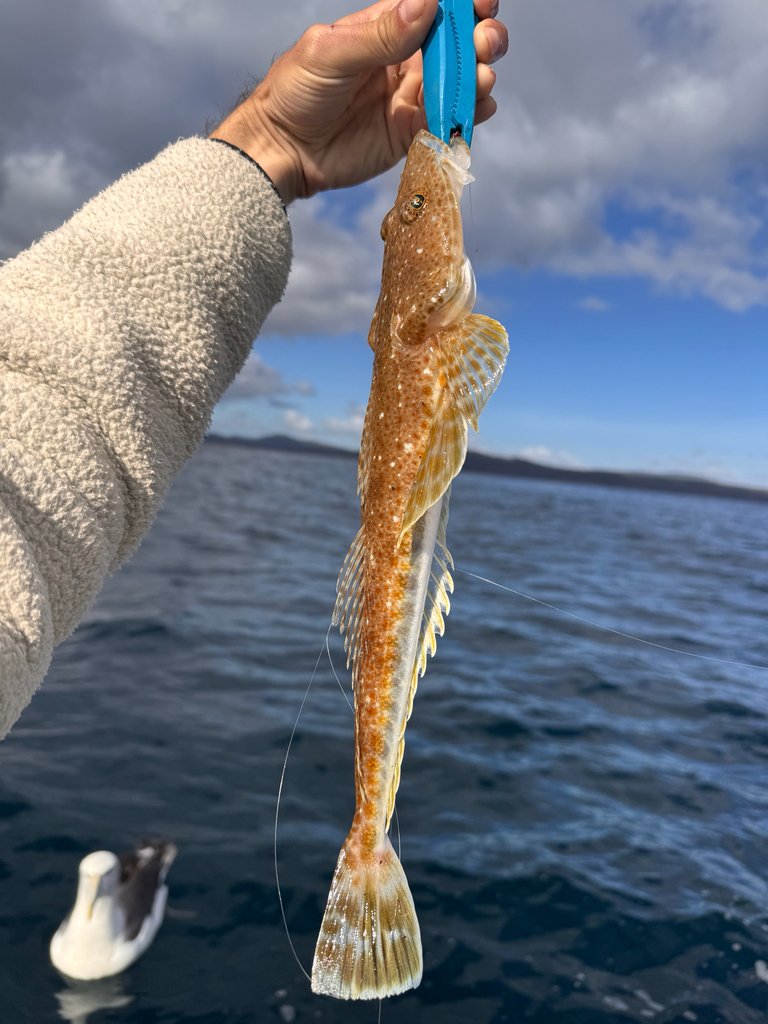
The sand flathead is the flathead of southern Australia: a low, sand-coloured ambush predator with a head like a shovel and eyes on top, caught from jetties, estuaries and small boats across four states. It is also the fish that Australian fisheries managers have spent the last decade arguing about, because the Tasmanian stock is now officially depleted while the Victorian one is only slowly rebuilding.
A flathead that belongs to one coastline
Platycephalus bassensis was described by Cuvier in 1829 and sits in the Platycephalidae, the flatheads, within the scorpaenoid line of the Perciformes. GBIF carries it as an accepted species with 19,288 records, of which 19,241 are Australian.
The range is unusually tidy for a fish page: southern Australia only, from the central New South Wales coast around Tasmania to South Australia and southern Western Australia, in bays, inlets, estuaries and shallow coastal water to about 100 m. FishBase compresses the same fact into one line — "known only from southern Australia" — and lists 1–100 m, sand and mud, and a tolerance of brackish water.
The names are where it gets untidy. FishBase lists sand flathead, southern sand flathead, bass flathead, bay flathead, common flathead, sandy flathead, slimy flathead and "yanks" as English vernaculars, and the Wikipedia entry repeats the same list. Several of those names belong to other flatheads in ordinary speech, which is why the scientific name is the only reliable handle when you are comparing regulations across state borders.
Told apart by the head, not the colour
Every flathead is built on the same plan: a depressed head, eyes set on the upper surface, a mouth that opens upward, and a body that lies flat on the bottom. That plan is also why they are hard to tell apart in a photograph — the diagnostic characters are ridges, spines and counts on the head, not the pattern on the back.
For this species the public record is thin on counts: FishBase exposes no fin-ray formula and no body-shape description for it, and the only meristic figure in the retrieval is 18–20 vertebrae. What the record does give is a set of working separations. Victorian fisheries guidance warns anglers specifically about confusing southern sand flathead with the southern bluespotted flathead, which carries the local name "yank" in some districts. The dusky flathead is the other common mix-up, and it is a bigger, estuary-dwelling fish of the east coast with its own separate rules.
In practice the field marks that matter are size, habitat and where you are. A flathead of around 25–40 cm taken on sand in 10–30 m of water in Bass Strait or Gulf St Vincent is very likely this species; a metre-long fish taken in a New South Wales estuary is not.
From one metre to a hundred
The recorded depth range is 1 m to 100 m, which is the single most useful line on the page. One metre puts the fish within reach of a shore angler in a bay; 100 m puts it on ground that only a boat will cover. Everything in between — the harbour margins, the inlet channels, the shallow shelf — is fair territory, and the species is recorded over sand and mud rather than reef.
FishBase gives a spawning season of August to October. That matters for regulation more than for fishing: several jurisdictions time their closed seasons and their size limits around that window.
The stock structure is not uniform. Tagging, larval sampling and growth studies indicate that Port Phillip Bay holds a distinct biological stock whose fish grow more slowly, with an asymptotic length about 30% smaller than fish from Bass Strait and 20% smaller than fish from south-east Tasmania. A flathead from the Bay is not interchangeable with one from offshore, and the assessments treat them separately.
The biology numbers the assessments carry
The 2023 national stock status report gives the fullest biological picture available: a maximum longevity of 23 years for both sexes, males reaching about 370 mm total length and females about 480 mm, with males maturing at 2.5–3.5 years and roughly 210 mm, and females at 2.6–5.2 years and roughly 235 mm.
FishBase's headline figures are different in scale: 46 cm total length, 3.1 kg maximum published weight, and a length at first maturity of 21.9 cm. The maturity figure sits close to the assessment's 210–235 mm, which is reassuring; the maximum length sits below the 480 mm female figure in the assessment, which is not a contradiction so much as a reminder that "maximum size" means the largest specimen anyone has measured and published, not a ceiling the species respects.
There is no age in the FishBase record, no growth curve, no natural mortality. For a fish that lives more than two decades, that gap matters: a 35 cm fish may be six years old or sixteen, and the difference decides whether removing it costs the stock one spawning season or ten.
A fishery managed four times over
There is no Commonwealth quota for southern sand flathead; it is managed by the states, and the rules diverge sharply.
In Victoria, flathead other than dusky flathead share a 27 cm minimum and a combined bag limit of 20 fish. In Tasmania the rules have tightened twice in a decade: in November 2015 the recreational daily bag limit fell from 30 to 20 and the minimum legal size rose from 300 to 320 mm, and after the 2021–22 survey work the bag limit was cut again from 20 to 10 and the minimum size raised from 320 to 350 mm, with the southern zone sand flathead fishery closed. South Australia reports about 2 t a year of commercial flathead across eight species, with no species-level assessment, and classifies the stock as undefined. Western Australia records no catch at all and calls the stock negligible.
The pattern is worth reading as a management lesson: the same species, the same biology, four different answers, because the four jurisdictions have different data and different recreational pressure.
Port Phillip Bay: a slow rebuild
Port Phillip Bay is the best-documented stock and the most instructive. Commercial landings of 200–300 t a year were normal before the 1980s and are now below 1 t, after licence buy-backs removed the effort. Recreational catch, estimated at about 450 t a year in the late 1980s, had fallen to roughly 110 t by the mid-2000s.
Catch rates from creel surveys stayed low from the mid-2000s, stabilised, and then fell to a historic low in 2021–22. Independent beam-trawl surveys of mature fish show the same mid-2000s drop and an increase from 2012 onward. Recruitment events in 2004, 2009, 2013, 2018 and 2021 are what has kept the stock from sliding further; the current population is dominated by fish below the legal minimum, many of them already mature. The classification is "recovering", not "sustainable".
For an angler, that has a concrete consequence: most of what you catch in the Bay will be under the size limit, and the fish you are releasing are the ones doing the spawning.
The ambush, and the gear that suits it
A flathead does not chase. It lies on or partly in sand and mud, waits, and takes what passes within reach of an upward-opening mouth. FishBase's biology keywords for the species are crustaceans and fishes; the practical translation is that soft plastics hopped along the bottom, and bait fished statically on a running sinker, both put the offering where the fish already is.
The take usually comes on the drop or on the first lift, not on a fast retrieve. Working a lure away from the bottom for more than a second or two is working where the fish is not.
One handling note belongs in any flathead page: FishBase records the species as venomous, and the spines on the head and operculum are sharp enough to matter. A wet towel and a firm grip behind the head are worth more than speed.
What the record still leaves out
No IUCN assessment exists for the species. There is no published diet composition, no age-length key in the public database, and no larval description in the sources used here.
The taxonomy is not fully settled either. The Platycephalidae have been revised repeatedly, GBIF files the species under Scorpaeniformes while FishBase uses Perciformes/Scorpaenoidei, and WoRMS accepts the name without resolving the ordinal question. None of that changes which fish you are holding, but it explains why two pages can disagree about the family.
The honest summary is that this is a well-studied fishery species with a thinly studied biology. The stock assessments know how many are caught; nobody knows what they eat, how fast they grow in most of the range, or how the South Australian population is doing at all.
How to catch it
Boat bottom fishing
Anchored or drifting boat, bait or lure worked near the recorded bottom.
Regulations before you keep it
These are the published regulations for this fish. Read the number first. The notice below it is the actual regulation.
Minimum size1
35–40 cm (35 cm minimum with no maximum at King/Flinders Islands; no take in the south-eastern zone)
Australia — Tasmania · AU-TAS
Tasmania sets a 35–40 cm size range for sand flathead, except King and Flinders Islands where the minimum is 35 cm with no maximum. The south-eastern zone is closed to the species.
Flathead, Sand* | D'Entrecasteaux Channel, Derwent River, Frederick Henry and Norfolk Bays | 2 | 2 ^ | - | Legal size between 35-40 cm ... King and Flinders Islands | 10 | 10 | - | 35 cm
Bag limit1
0 (south-eastern zone) · 5 (eastern zone) · 10 (northern/western zone and King/Flinders Islands)
Australia — Tasmania · AU-TAS
From 1 March 2026 Tasmania's south-eastern zone is closed to sand flathead, with bag and on-water possession of 0 including fish kept for bait. The eastern zone allows 5 per day; the northern/western zone and King and Flinders Islands allow 10.
The former Derwent/Channel 2-fish rule no longer exists.
Flathead, Sand* | D'Entrecasteaux Channel, Derwent River, Frederick Henry and Norfolk Bays | 2 | 2 ^ | - ... Eastern Zone | 5 ... Northern/Western Zone | 10 ... King and Flinders Islands | 10
Every record above names its source and the date it was retrieved. See the regulation register for the full list, or how to read these regulations.
Where these facts come from
Check these pages before you rely on a size, range or protection status.
-
FishBase — Platycephalus bassensis
— FishBase · T2
-
GBIF — Platycephalus bassensis occurrence records
— GBIF · T2
-
IUCN Red List — Platycephalus bassensis
— IUCN · T1
-
Photo record — iNaturalist
— iNaturalist · T3