Sand whiting in Australia — New South Wales: ≥27 cm — New South Wales saltwater waters.
Whiting (sand only) 27 cm 20 in total*
Quoted from NSW DPIRD — Saltwater bag and size limits
Regulation guide
Official sourcesTwo states, two sets of limits
Sand whiting (Sillago ciliata), also called summer whiting, is an inshore species taken from beaches, sand flats and estuary channels in New South Wales and Queensland. Each state sets its own size and bag rules and they do not match.
New South Wales applies a 27 cm minimum to sand whiting and a bag limit of 20 whiting. Queensland applies 23 cm and a combined possession limit of 30 across sand, goldenline and northern whiting.
Neither state accepts the other's figure, so an angler fishing close to the border needs to know which jurisdiction the water is in before the first fish is measured.
Source: NSW DPIRD: Saltwater bag and size limits · Queensland Government: Size and possession limits in tidal waters
New South Wales: 27 cm for sand whiting
The NSW saltwater table gives whiting a 27 cm minimum that applies to sand whiting only, and a daily bag limit of 20 whiting. Other whiting species in the table do not carry the same size floor.
For whiting the possession limit equals the bag limit, so 20 fish is also the maximum that may be held at any one time, including fish stored at home or in a freezer. A higher possession limit applies only to the species listed for it, such as bream, flathead and tailor.
The NSW recreational fishing fee is payable unless the fisher is exempt, and the receipt for current payment must be carried whenever fishing or in possession of fishing gear next to the water.
Source: NSW DPIRD: Saltwater bag and size limits · NSW DPI: Saltwater recreational fishing rules and regulations summary, October 2025
Queensland: 23 cm and a combined limit of 30
Queensland's tidal water table lists sand (summer) whiting at a 23 cm minimum, with a combined possession limit of 30 in total across sand, goldenline and northern whiting. The three species share one allowance.
A Queensland possession limit is the total number a fisher may legally take and keep at any single time. It is not a daily limit and it includes fish at home, including those in the freezer, so a second day's fishing does not reset a full box.
Because the 30 is shared, 20 sand whiting and 10 goldenline whiting uses the whole allowance. Trumpeter whiting is listed separately at no minimum size and a limit of 50 and does not count against the 30.
Source: Queensland Government: Size and possession limits in tidal waters
Measuring and handling
New South Wales measures fish from the point of the nose to the tip of the tail, and warns that fish can shrink after capture, so a whiting right on 27 cm should be measured carefully before it is kept.
Queensland measures fish from the tip of the snout to the end of the tail and prohibits manipulating a fish to increase or decrease its length.
In NSW it is illegal to alter a fish by filleting or removing the head or tail until well away from the water; gilling and gutting are permitted. The exception covers areas normally used for cleaning fish, such as boat ramp cleaning tables, and fish for immediate consumption.
Source: NSW DPIRD: Saltwater bag and size limits · Queensland Government: Measure your catch · NSW DPI: Saltwater recreational fishing rules and regulations summary, October 2025
What changes at the border
The 4 cm gap between the states is the largest single difference in the rules for this species. A 24 cm whiting is legal in Queensland and undersized in New South Wales by 3 cm.
Queensland also counts three species against one limit, while New South Wales sets a single 20-fish whiting bag with the size floor attached to sand whiting alone.
The bag arithmetic changes too. Twelve sand whiting and ten goldenline whiting would be legal in Queensland's 30 and would exceed New South Wales' 20, so a box filled in Queensland can become over the limit once the boat crosses south.
For a fisher who crosses the border by road, the safest practice is to treat the 27 cm figure as the working minimum and the lower number as valid only once the boat is in Queensland waters.
Source: NSW DPIRD: Saltwater bag and size limits · Queensland Government: Size and possession limits in tidal waters
Before you keep one
Measure the fish nose to tail, choose the state's figure, and release anything under it immediately. A whiting that is close to the line is worth measuring twice, because shrinkage after capture can take it below the limit.
Count every whiting you are holding, not just the sand whiting in the bucket: New South Wales counts 20 whiting and Queensland counts 30 across three species, and both figures include fish already at home.
Keep the NSW fishing fee receipt or a Queensland check of the current table handy. Both states revise their limit tables, and the state page is the version that applies on the day.
Source: NSW DPIRD: Saltwater bag and size limits · Queensland Government: Size and possession limits in tidal waters
Official pages: NSW DPIRD: Saltwater bag and size limits · Queensland Government: Size and possession limits in tidal waters · Queensland Government: Measure your catch
Sand whiting regulations at a glance
2 jurisdictions| Jurisdiction | Area | Size | Bag | Season / closure | Closed area | Other |
|---|---|---|---|---|---|---|
| Australia — New South Wales | New South Wales saltwater waters | ≥27 cm | 20 fish per person per day | — | — | — |
| Australia — Queensland | Queensland tidal waters | ≥23 cm | — | — | — | — |
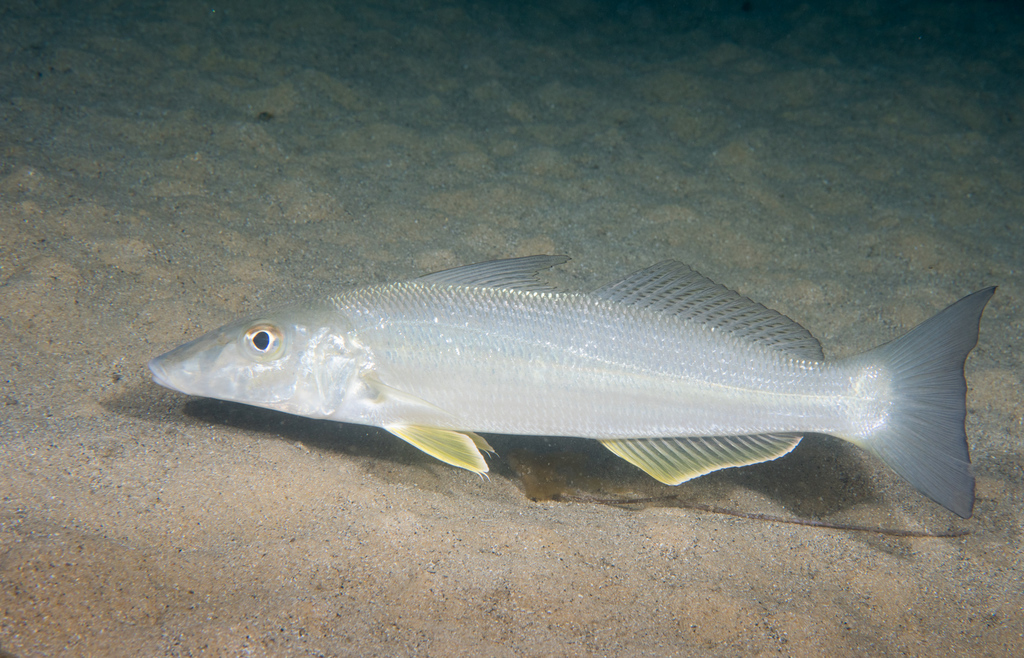
Sand whiting
Sillago ciliata · Sillaginidae
Sand whiting, a member of the family Sillaginidae, is found across the Western Pacific, from east coast of Australia from Cape York (rare) and the Great Barrier Reef, Queensland to eastern Victoria, Ulverstone on northeast coast of Tasmania. Its depth range is from 0 to 46 m, in tropical seas. It grows to 51 cm TL and 1.4 kg, with a diet of crustaceans and worms. Anglers target it by shore casting or boat fishing.
- Family
- Sillaginidae
- Max length
- 51 cm TL
- Max weight
- 1.4 kg
- Max age
- 22 years
- Depth
- 0–46 m
- IUCN
- LC
- Climate
- Tropical
- Diet
- crustaceans, worms
Sand whiting (Sillago ciliata) is a fish of the family Sillaginidae. FishBase gives its range as: Western Pacific: east coast of Australia from Cape York (rare) and the Great Barrier Reef, Queensland to eastern Victoria, Ulverstone on northeast coast of Tasmania; Lord Howe Island, New Caledonia, Woodlark Islands, and Papua New Guinea. Bleeker's records from Batavia and Java were in error. It is recorded from 0 to 46 m, in tropical water. The recorded maxima are 51 cm TL, 1.4 kg, 22 years. Diet includes crustaceans and worms. IUCN status: Least Concern (LC). Chinese name: .
Techniques
- Shore casting —
- Boat fishing —
Seasonality
Other AU-NSW regulations
Same jurisdictionBefore you keep a fish
- Read the recorded value. It is copied from the notice; if the number and the notice disagree, the notice wins.
- Check the area. Federal, state and local waters can set different limits for the same fish.
- Check the date. Seasons, quotas and closures change; confirm the current notice before you go.
Common questions
- What is the minimum size for Sand whiting in Australia — New South Wales?
- ≥27 cm
- Where does this regulation apply?
- New South Wales saltwater waters
- When was it checked?
- 2026-11-18, against NSW DPIRD — Saltwater bag and size limits.
- Do other jurisdictions set different limits?
- Yes. This register lists 2 jurisdictions for Sand whiting; compare them in the table above.