
Sergeant-major
The sergeant major is a fifteen-centimetre Caribbean damselfish named for five dark bars that supposedly resemble a military rank. The bars are shared with close relatives, the rank exists in many armies, and the name explains almost nothing about the fish. It hovers over coral by day, nests on rock, and is far more often seen by snorkellers than targeted by anglers.
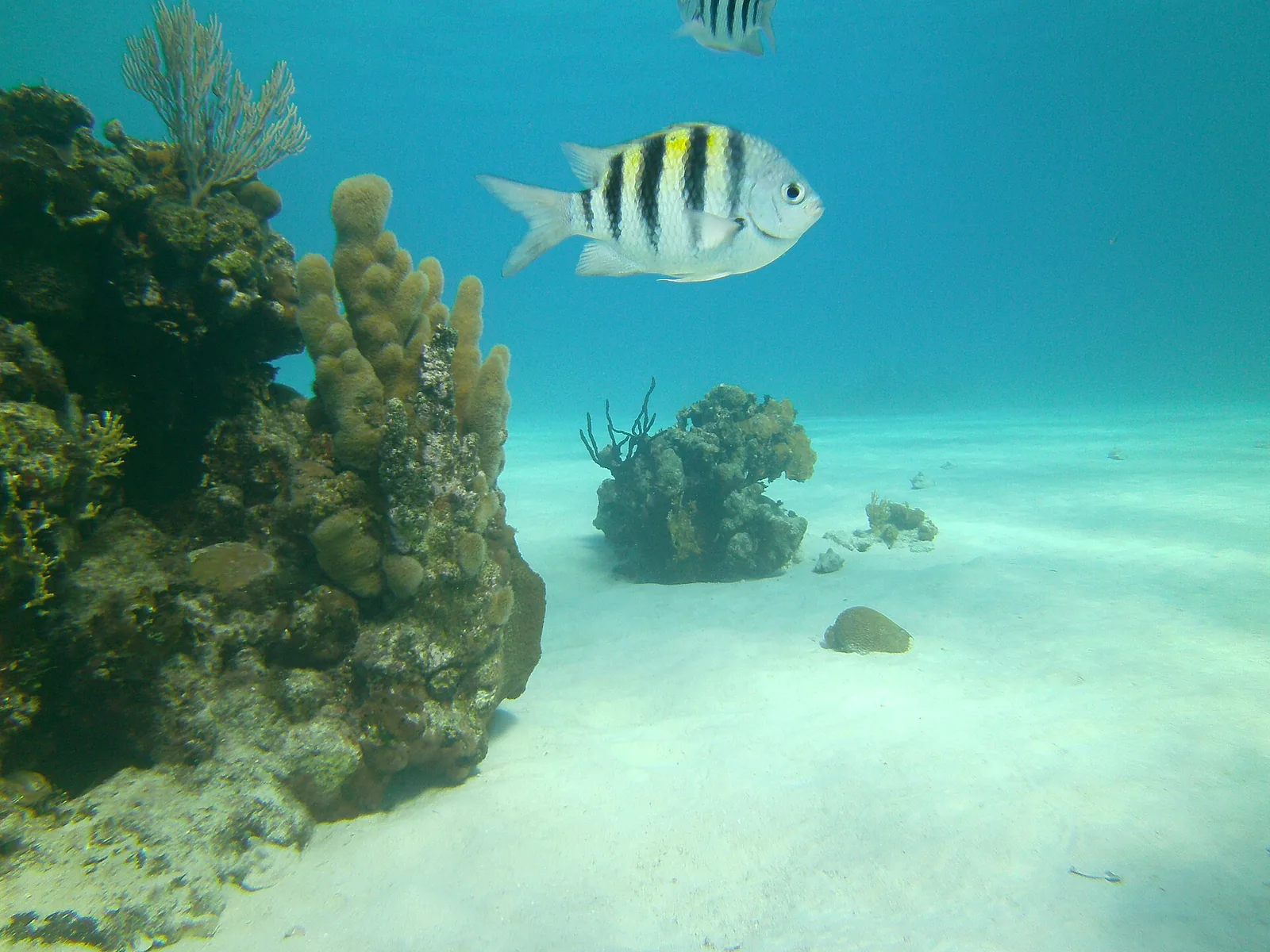
The sergeant major is named for the five dark bars across its side, which supposedly resemble the stripes of a military rank. That is a good description of a pattern and a poor description of a fish: the bars are shared with close relatives, the rank exists in many armies, and the animal itself is a fifteen-centimetre damselfish that spends its day hovering over Caribbean coral. Almost every confusion about this species starts with a name that was borrowed rather than earned.
A military name for a schooling reef fish
Adults gather over shallow reef tops, often in feeding aggregations of several hundred fish, a behaviour recorded in the catalogue and repeated in virtually every diver's account of the species. Juveniles live somewhere else entirely, in tide pools, and Wikipedia adds mangrove areas to the nursery list. So the same name covers a puddle-dwelling juvenile and a shoal of adults hanging in the current above coral, and neither of them looks much like a soldier.
The name also imports a family resemblance that is not there. Sergeant majors are pomacentrids, the damselfishes, a group built for manoeuvring around structure at short range. They are not groupers, not snappers, and not the thing most anglers mean when they say "reef fish".
What the five bars actually identify
The morphology is precise: 13 dorsal spines, 12 to 13 dorsal soft rays, two anal spines, 10 to 12 anal soft rays. Greenish yellow above, white below, five prominent vertical black bars that narrow toward the belly, a faint sixth bar sometimes present on the caudal peduncle, and a black spot at the upper base of the pectoral fin. Adult males turn dark bluish, which makes the bars less conspicuous rather than more.
Those bars are the reason the species is identified confidently in the western Atlantic and identified badly everywhere else. The Indo-Pacific has Abudefduf vaigiensis, which is close enough that FishBase states plainly that the Atlantic species is replaced there by its relative. Any "sergeant major" seen in Indonesia, the Red Sea or the Philippines is not this fish, and the record does not pretend otherwise.
Twenty-two centimetres, and a depth range that depends who you ask
The maximum is 22.9 cm total length, with 15 cm a more typical adult size and 200 g the largest published weight. There is no maximum age in the record, which is itself a signal: this is a small, fast-turnover fish that nobody ages for management, not a long-lived stock animal.
Depth is where the sources separate. FishBase gives 0–20 m, usually down to 10 m; Wikipedia says sergeant majors are found down to 40 m. Both can be true of a fish that is common shallow and occasional deeper, but the disagreement is worth keeping in view, because it decides whether a deep reef drop-off is worth a cast. Treat 20 m as the density limit and 40 m as the outer record.
Where the Atlantic version begins and ends
On the western side the species runs from Canada and Rhode Island south through the Gulf of Mexico, the Bahamas, the Caribbean and the coast of Central and South America to Uruguay. The eastern Atlantic population runs from Portugal, the Azores and the Canaries through Cape Verde to Angola. It is, in FishBase's words, strictly an Atlantic species — a rare thing in a hobby where most reef fish have Indo-Pacific twins.
The Mediterranean is the loose end. Wikipedia notes that its status there is unclear because of possible confusion with A. vaigiensis and A. troschelii, which is a polite way of saying that a sighting in the Med may be a misidentification. GBIF's 49,032 records lean heavily on the United States with 21,105 and Brazil with 16,319, then Mexico, Puerto Rico and the Virgin Islands. That is not a statement about abundance; it is a statement about where people dive with cameras.
Nests on rock, and a male that changes colour
Reproduction is the part of this fish's life that is easiest to watch and hardest to film. Males prepare nest sites on rock, reef outcrops, shipwrecks and pilings. Females lay egg masses there, and Wikipedia's account puts the clutch at roughly 200,000 ovoid eggs, attached to the substrate by a filament, turning greenish after a few days. The male guards them for about a week and turns bluish while he does it — the same colour shift that makes the bars fade.
FishBase gives the shorter version: oviparous, distinct pairing during breeding, demersal eggs that adhere to the substrate, males guard and aerate them. Either way, the nest is a fixed address. That matters for anyone snorkelling a reef: a blue male hovering over a patch of rock is not posing, and backing off is the difference between a photograph and a failed brood.
Algae, larvae, and whatever the dolphins leave behind
The diet is broad: algae, small crustaceans, fish, and invertebrate larvae, with zooplankton such as copepods and shrimp larvae and pelagic tunicates added by Wikipedia. At Fernando de Noronha the species has been recorded feeding on spinner dolphin faeces and vomit, a shift from plankton feeding to picking up drifting offal. Juveniles sometimes hold cleaning stations alongside the doctorfish and the blue tang and pick moulted skin and parasites from green turtles.
That is not trivia. A fish that eats algae, plankton, offal and turtle ectoparasites will take an astonishing range of small baits, which is exactly why it is a nuisance at a bait intended for something else. It is also prey: Wikipedia lists coral trout, bluehead wrasse, coney, Nassau grouper, yellowfin grouper and cobia among its predators, which is an unusual thing to read about a fish that is itself a predator of small invertebrates.
The hook that catches it is the hook you did not mean to use
Sergeant majors are caught mostly by accident. A scrap of shrimp dropped next to rock on a size 8 hook will find them before it finds a snapper; a tiny soft plastic twitched over reef will draw a dozen follows before anything else commits. A mouth that small will not hold a big hook, and the fish never sits still long enough for a long cast to pay off: short shank, light leader, close range.
As a target species they are honest but modest: the fight is a series of short runs and a lot of circling, and the fish is not good eating. The catalogue lists the fishery as minor commercial and the aquarium trade as commercial, which is the more accurate summary of its economic role — it is a pet-shop fish, and Wikipedia notes that it is regarded as difficult to breed in captivity.
The Chinese name points somewhere else
In Chinese this fish is , the rock damselfish. The name that sounds like a translation of "sergeant major" is , and that belongs to a different animal entirely: the cobia, a large open-water carangiform fish that happens to appear in the sergeant major's predator list. English keeps the military metaphor; Chinese keeps the habitat. Neither name survives contact with the other language.
That is the useful lesson from this species. The stripes are real, the bars are countable, and the fish is easy to identify once it is in your hand. The name is the part that travels badly — across oceans, across languages, and across the gap between a tide pool and a coral reef.
How to catch it
Shore fishing
Small baits or lures cast from rocks, piers and reef edges.
Small hook rig
Tiny hook and a scrap of bait, aimed at fish holding close to structure.
Where these facts come from
Check these pages before you rely on a size, range or protection status.
- FishBase — Abudefduf saxatilis — FishBase · T2
- GBIF — Abudefduf saxatilis occurrence records — GBIF · T2
- IUCN Red List — Abudefduf saxatilis — IUCN · T1
- Photo record — iNaturalist — iNaturalist · T3
Fish in the same water
These fish live in the same place.

Guides for this water
Technique, gear and safety guides that fit Sergeant-major.