
Pearl-spot chromis
A small reef damselfish of the genus Chromis, and the only damselfish that overwinters in the Sea of Japan. It feeds on plankton above shallow rock in daylight, the male cleans a nest in summer, and Kyushu treats it as food while most of Japan treats it as an ornamental fish or a bycatch.
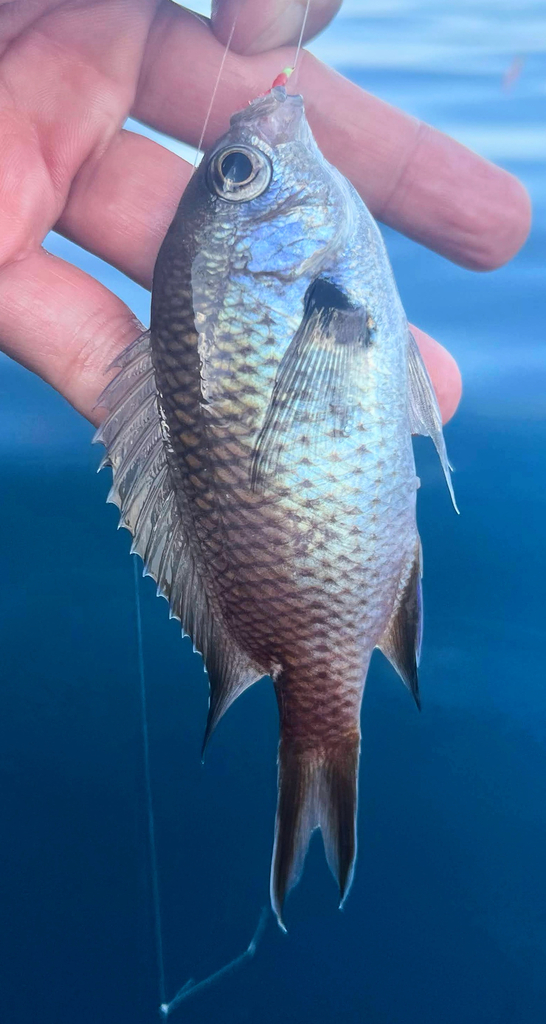
A small reef damselfish of the genus Chromis, and the only damselfish that overwinters in the Sea of Japan. It feeds on plankton above shallow rock in daylight, the male cleans a nest in summer, and Kyushu treats it as food while most of Japan treats it as an ornamental fish or a bycatch.
A damselfish named for one white spot
The body is oval and compressed, the snout short and the mouth small. Colour runs from blue-grey to grey-brown, and the feature that names the fish is a clear white spot on the caudal peduncle. Breeding males darken. FishBase gives a maximum total length of 17 cm, but fish of that size are not the rule; a rig built for 10 to 15 cm matches what an angler actually meets.
The species is regularly confused in Chinese-language material with Chromis punctipinnis, an eastern Pacific damselfish that has no white spot at the tail base. Chinese material has also carried a spotted-fin name that belongs to that eastern Pacific fish. The Japanese and western Pacific fish called suzume-dai is this species, not that one, and the tail spot is the safer character to check.
Southern Japan, with a northern outpost in Aomori
FishBase places the species in the northwest Pacific: southern Japan, the Ryukyu Islands, Taiwan and China. The Japanese market guide pushes the northern limit to Aomori Prefecture and traces the range through the Sea of Japan, the Pacific coast and the Seto Inland Sea to southern Kyushu, adding that the Ryukyus are in fact sparse.
The two statements are not in conflict. The centre of the range is warm-temperate, and the north is a marginal edge, which is exactly why a northern record is worth naming.
Habitat is rock and coral from 2 to 15 m, with fish hovering a metre or two above the substrate. A reef point where a gentle current delivers plankton, or the outer face of breakwater blocks, is a better bet than the dead bottom of a bay.
Summer nests, and the only damselfish that winters in the Sea of Japan
Spawning is in summer. The male first cleans a small patch of crevice or reef face, the female lays on the cleaned substrate, and the male guards the eggs to hatching. The same source calls this the most cold-tolerant damselfish and the only species able to overwinter in the Sea of Japan, which explains how it reaches Aomori.
In Kyushu the fishing period runs from spring into the spawning season, and Fukuoka's dried-fish processing is concentrated in the same weeks. In Kanto it is more often a summer and autumn bycatch.
No source gives a spawning temperature. None is inferred here.
Tiny hooks for a plankton feeder
The fish is a plankton feeder, schools in the middle and upper water column, and has a very small mouth. Rock fishing works with a very small hook baited with Antarctic krill or chopped shrimp, using light berley to hold the school up in the water. A small sabiki rig also takes fish from a school.
The bite is light and the lips are thin, so the strike has to be gentle or the hook tears out. Fish that will not be eaten should go back quickly; the same applies if the fish is kept as an ornamental or as bait, since it does not tolerate long exposure to air.
Light line, short casts, no need to reach deep
A 3 to 4.5 m iso rod or a soft raft rod is enough. Main line of 1 to 1.5 nylon, leader 0.6 to 0.8, hooks in sizes 1 to 3. A small float works, or no float at all with the rod tip watched; the sinker only has to give a slow descent.
There is no need to cast far and no need for heavy line. Keeping the fishing depth 1 to 3 m above the rock does more for the catch than switching to a heavier rig.
A food fish in Kyushu, a dried fish in Fukuoka
The flesh is white and the scales thin. The Japanese guide rates it among the best-eating fish it covers. Fukuoka salts it or dries it as abutte-kamo, and salt-grilling and deep-frying are also used. The fish are small, so cleaning has to be quick to keep gut bitterness from spreading into the flesh.
Japan has no nationwide recreational size limit or closed season. Sea fishing is governed by prefectural fishery adjustment regulations, with fishery cooperative rules on top for specific waters. No species-level restriction for this fish was found in public material, but the rules of the main producing prefectures, Fukuoka and Nagasaki, were not checked line by line. That item is deferred.
Two distribution statements, one marginal edge
Taxonomy, length, depth and range come from FishBase. The northern limit in Japan, the spawning behaviour, the cold tolerance and the Fukuoka food use come from the market guide. Fishing method and processing background come from the Japanese angling encyclopedia.
FishBase writes southern Japan; the guide writes Aomori to Kyushu. Both are kept. The article describes the northern records as a marginal edge rather than merging the two into a single boundary line, because the sources describe different things: a range statement and a national checklist. The naming history is a second warning: a name carried in a list can outlive the species it was attached to.
How to catch it
Shore fishing
Fished with the listed approach, matched to the recorded depth and size.
Float fishing
Fished with the listed approach, matched to the recorded depth and size.
Small hook rig
Fished with the listed approach, matched to the recorded depth and size.
Boat bottom fishing
Fished with the listed approach, matched to the recorded depth and size.
Where these facts come from
Check these pages before you rely on a size, range or protection status.
- FishBase — Chromis notata — FishBase · T2
- GBIF — Chromis notata occurrence records — GBIF · T2
- IUCN Red List — Chromis notata — IUCN · T1
- Photo record — iNaturalist — iNaturalist · T3
Fish in the same water
These fish live in the same place.

Guides for this water
Technique, gear and safety guides that fit Pearl-spot chromis.