≥25 cm
Australia — New South Wales · AU-NSW
New South Wales sets a 25 cm minimum legal length for yellowfin bream.
Bream (Yellowfin) 25 cm

Yellowfin bream reaches the angler through three doors. Sydney shops call it sea bream; Queensland breakwaters call it surf bream; FishBase calls it a fish of the southwest Pacific. Its distribution line calls the species endemic to eastern Australia, from Townsville to the Gippsland Lakes, then adds that records from Japan, the Ryukyu Islands and Taiwan region "need verification." Both statements sit on the same page, and either one changes where you would plan a trip.

Yellowfin bream reaches the angler through three doors. Sydney shops call it sea bream; Queensland breakwaters call it surf bream; FishBase calls it a fish of the southwest Pacific. Its distribution line calls the species endemic to eastern Australia, from Townsville to the Gippsland Lakes, then adds that records from Japan, the Ryukyu Islands and Taiwan region "need verification." Both statements sit on the same page, and either one changes where you would plan a trip.
The verified range is a single coast: eastern Australia, roughly from north Queensland to eastern Victoria. The doubts attach to the northward records, and the occurrence data shows the same tension at a smaller scale. GBIF holds 38,725 preserved records for the matched taxon; 38,666 are from Australia, with 11 from Taiwan region, nine from Japan, four from Guam and two from China. A handful of records is neither a second range nor proof of a vagrant. The Australian coast is the only place with a dense, repeatable signal; the Asian points are too few to separate a mislabelled specimen from a real stray.
For the shore angler this resolves into a simple rule: fish the east-coast estuaries and rock ledges, and treat any Asian report as a taxonomic question rather than a destination. The species is oceanodromous, so a mark that held fish last week is not a guarantee for this week.
The environment line gives marine and brackish water, a demersal habit and a temperate band from 19°S to 38°S, but no depth range. That silence is more useful than a made-up number. A rock ledge snags rigs, an estuary mouth moves with the tide, and the brackish shallows are reached from shore; that is one edge, not a flat.
In practice the edge is the salinity boundary: the rock wall at an estuary mouth, the breakwater where fresh water mixes out, the drop-off beside a sand flat. A bream that moves between marine and brackish water is not a fish to anchor over one patch and wait. Work the line where the bottom changes and the current carries food, and let the tide move you along it. On a shallow rock ledge, reading wash and colour is faster than watching a sounder. No depth figure is published because none was recorded.
The record tops out at 66 cm standard length and 4.5 kg, with a 14-year maximum age. No common-length figure is offered, leaving the typical shore-caught size unspecified. Maturity is given as "Lm ?, range 24 - ? cm": a lower bound of 24 cm with the upper end missing. Read together, those numbers say the record fish is old and heavy, while a 24 cm fish is already mature.
For tackle, a 4.5 kg bream can pull, but most fish you meet will be a fraction of it; a drag set for the maximum is a drag set for a fish that may never appear. Use a leader that survives rock and oyster, and set the drag by the fish you can see. The 14-year lifespan also means a big bream is not replaceable next season.
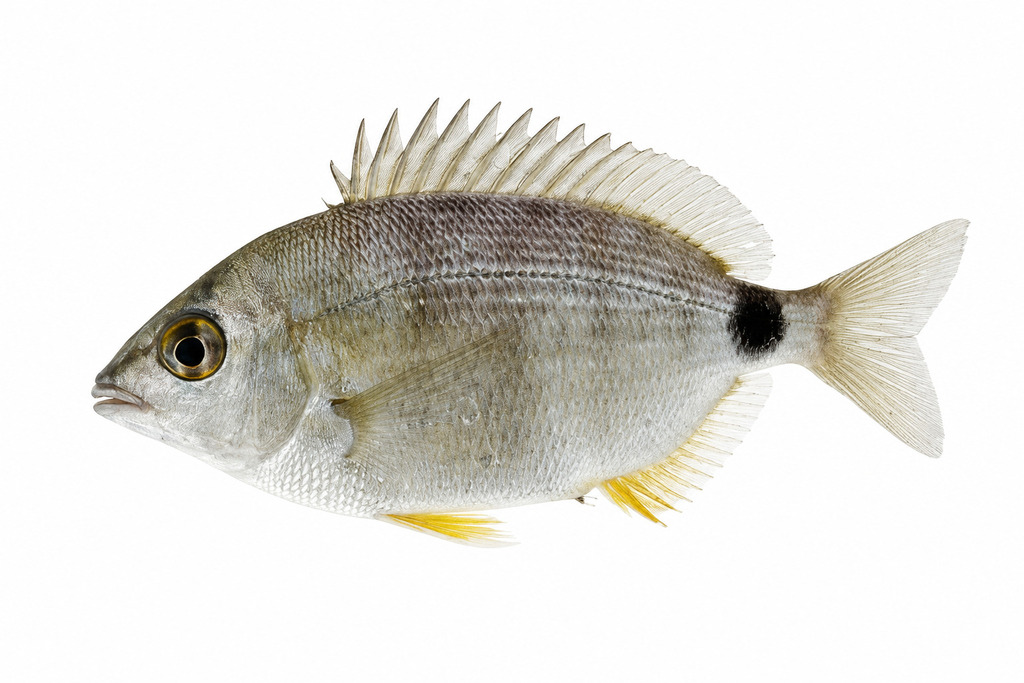
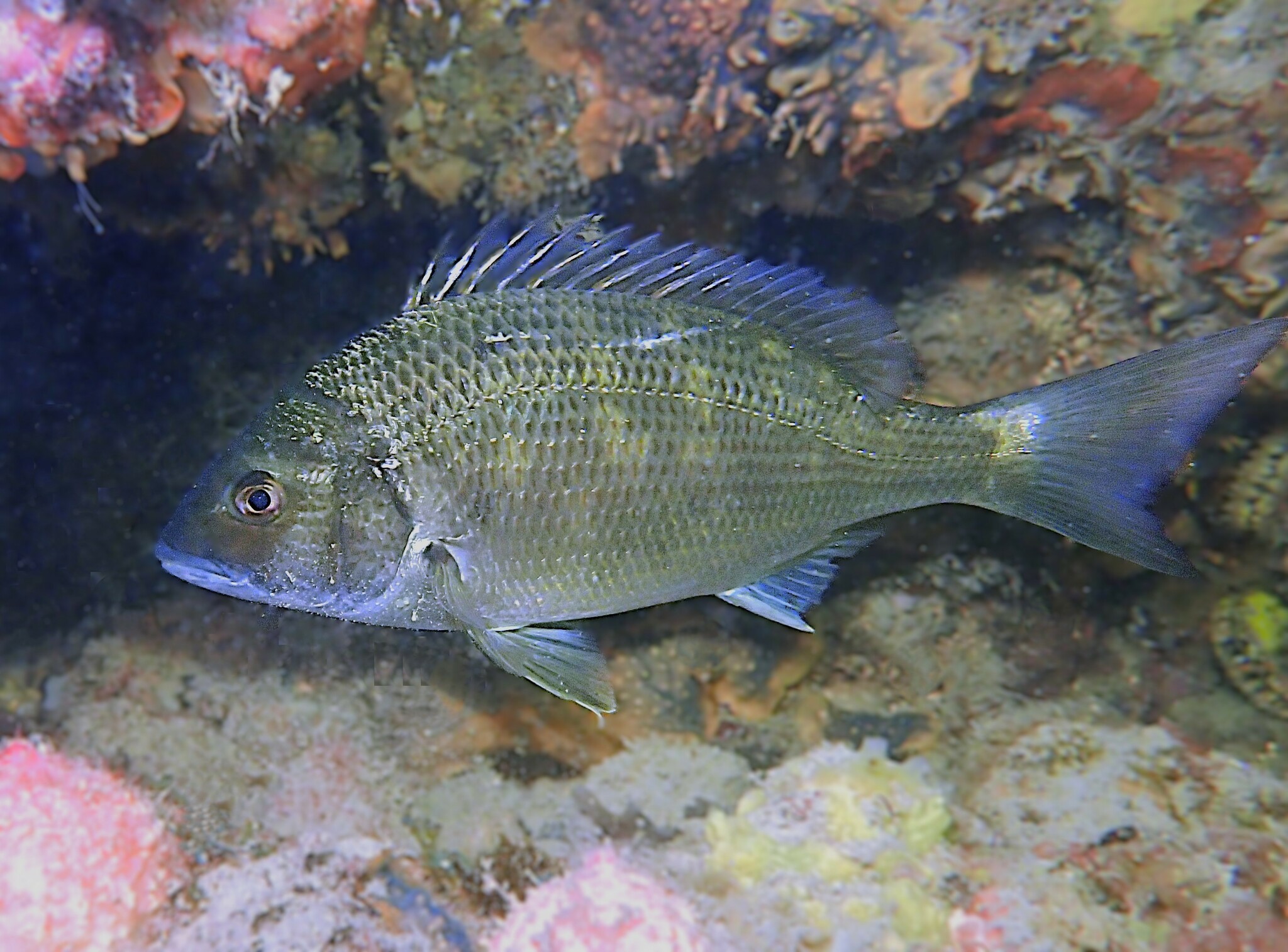
The checked FishBase page does not expose a fin formula or a body-shape record, so identification has to lean on the photograph and the common names. The English alias list is crowded: sea bream, surf bream, silver bream, black bream, eastern black bream. The yellowfin name comes from the yellowish tint on the ventral and anal fins, the usual field mark separating it from the black bream, Acanthopagrus butcheri. In poor light the tint disappears, and the two species share far more than colour.
So do not identify a bream by the name on the market slab. If the anal and ventral fins stay pale or yellow rather than sooty, and the body is deep rather than elongated, the fish is more likely this species; where the two overlap, release anything uncertain. The source gives no count-based key, so a daylight photograph is worth more than a confident guess at night.
The spawning table gives May, June, July and August for Australia, with a separate entry for Moreton Bay in July and August, recorded in 1979–80. In the southern hemisphere those months are late autumn and winter, not the warm season a northern reader might assume. The table records spawning, not easy fishing; spawning fish gather, and gatherings are what local closures are written around.
For a trip, the useful question is not "which month is best" but "is this estuary a spawning one, and is it open?" The Moreton Bay entry stands alone as one historical record; it does not amount to a coastal survey. Expect other anglers and expect rules; the record says when fish may be concentrated, not that they will be catchable.
Its recorded prey list runs from crustaceans and fishes to zooplankton and worms. That is broad enough for a fish that picks along rock, sand and estuary mud rather than chasing a fast lure. A fresh prawn, a strip of fish or a worm on a running sinker is the straightforward presentation; a small hardbody or soft plastic worked slowly along a rock wall is the other. The approved methods are shore casting and boat fishing, both mainstream.
Because the species is oceanodromous, present the bait where the fish is moving, not where it was last week. In an estuary, that means the turn of the tide and the channel edge; from a breakwater, the wash line rather than the flat sand beyond it. A light sinker that can be moved and a leader that can be re-tied after a snag beat a long cast.
Commercial fishing, commercial farming and gamefishing all appear in the use record; the Red List entry is Least Concern, dated 4 December 2009. That verdict is more than fifteen years old; a category is a snapshot at that date, not a permanent licence. The same page shows a farmed supply, so the fish in a shop and the fish on a ledge are not the same story.
Least Concern is not a bag limit and not a closed season. Bream size limits are set by state in Australia and vary by jurisdiction; the record checked here contains no regulation text. The biology supports keeping one fish for the table and releasing the rest: a 14-year lifespan makes big, old fish scarce.
The occurrence data is the most detailed part of the record: 38,725 GBIF specimens, overwhelmingly Australian, and 3,959 iNaturalist observations. Those numbers describe where people have looked, not where the fish must be. For a first trip, pick a coastline from them, then let a chart and the tide choose an estuary mouth or a rock ledge; the Asian records are a warning about names, not a travel plan.
Cast from shore or a breakwater, within reach of the recorded inshore range.
Fished from a boat, with the approach adjusted to the recorded depth.
These are the published regulations for this fish. Read the number first. The notice below it is the actual regulation.
New South Wales sets a 25 cm minimum legal length for yellowfin bream.
Bream (Yellowfin) 25 cm
Queensland sets a 25 cm minimum size for yellowfin bream.
Yellowfin bream | Min: 25cm | Combined limit: 30 in total of pikey bream, tarwhine and yellowfin bream
Every record above names its source and the date it was retrieved. See the regulation register for the full list, or how to read these regulations.
Check these pages before you rely on a size, range or protection status.
These fish live in the same place.
Technique, gear and safety guides that fit Yellowfin bream.